![]()
Introduction – 1: Architectural Theory in an Expanded Field
C. Greig Crysler, Stephen Cairns and Hilde Heynen
REVISITING PARC DE LA VILLETTE
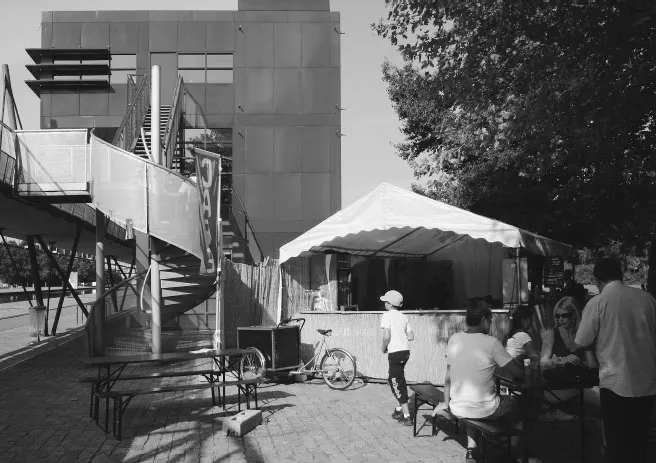
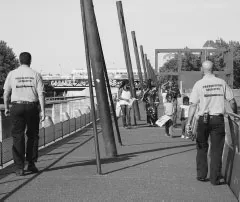
On a midsummer’s afternoon in Paris’ Parc de la Villette locals and tourists mingle amongst the famous red follies that dot the park. Children paddle in a shallow pool that surrounds one of the follies. Family groups and friends gather at tented cafés and bars that have sprouted up alongside one another. Strolling couples take in the sun, cyclists weave along the banks of the canal, while the distant din of an impromptu football match thickens the atmosphere. It is an evidently multicultural scene. Many women are dressed in strongly coloured and patterned fabrics of distant places, others wear hijabs. Some men wear kaftans, while many teens and children wear football strips bearing the names of global stars of the game such as Zidane, Ronaldo and Drogba. Security men walk their beats in pairs on the elevated decks that cut across the park. They wear black combat trousers and orange T-shirts branded with ‘Prevention Securité’ on the back. Walkie-talkies and bundles of keys hang from their belts. One of the routine jobs on their beat is to rattle the door handles of each of the 35 follies. They are checking that the follies are locked. Most are empty. Some have begun to appear a little dilapidated and worn. Once solidly red, some follies are now a patchwork of stained and faded panels and brighter replacements. At some, one can even stare through rusted panels to the structure within. But they are now also ‘worn in’. Once stark markers set out on a grid across the park, the follies are nowadays embedded, albeit ambiguously, in a mature landscape of trees, shrubs and human activity.
Figure 0.1 Temporary café next to a Folly at Parc de la Villette, Paris. (Stephen Cairns)
Figure 0.2 Security guards on elevated walkway at Parc de la Villette, Paris. (Stephen Cairns)
These follies began their lives as trademark elements of the original Parc de la Villette landscape, as designed by architect Bernard Tschumi. Tschumi won the commission to design Parc de la Villette in an international competition launched in 1982 by the then French Minister of Culture, Jack Lang. The forward-looking competition brief had little in the way of functional requirements, emphasizing instead the values of urbanism, pleasure and experimentation, calling for nothing less than an urban park for the twenty-first century. The seemingly open brief was underpinned by ambitious cultural and urban planning policy aspirations. To be sited on 55 hectares of semi-derelict land in the northeast corner of Paris, and framed by a new Science Museum and Music Centre, the Parc de la Villette was to reanimate what had been a relatively marginalized area of the city, open up the city to the suburbs beyond, and sustain Paris’ place as a global centre of cultural innovation.
Tschumi’s winning design proposal was significant not simply because of its intrinsic architectural qualities. It gained notoriety for the way it was self-consciously animated by ‘theory’. Parc de la Villette was widely regarded as a built manifestation of Tschumi’s ongoing critique of the foundational principles of architectural modernism, specifically the assumptions about the determinate role of function, structure and economy-of-means on built form. Parc de la Villette was not simply theorized after the event of its design and making, it was conceived in and through a specific articulation of design thinking that linked architecture to debates in literary theory and philosophy. This mobilization of theory in the design – enhanced by Tschumi’s invitation to Jacques Derrida and Peter Eisenman to collaborate on an aspect of it1 – triggered a scramble amongst critics, commentators and academics in the discipline to acquire the novel vocabularies required to appropriately engage. Suddenly, it seemed, architecture was pursuing theory in various postmodernist, post-structuralist and deconstructivist guises.
The Parc de la Villette project was by no means a unique nor even inaugural activation of theory in architecture, as we will see. Nor should it be seen as some emblematic monument of architectural theory. But it did demonstrate a self-conscious engagement with a particular kind of theory that, as Jonathan Culler usefully notes, is essentially a ‘nickname’ for eclectic styles of scholarship that challenge and reorient thinking across diverse disciplinary lines. The coherence that is attributed to writings in this mode resides, Culler suggests, in ‘their analyses of language, mind, history, or culture [that] offer novel and persuasive accounts of signification, make strange the familiar and perhaps persuade readers to conceive of their own thinking and the institutions to which it relates in new ways’ (Culler 1994, 13). In the 1980s this set of developments gave rise to new textbooks and special issue journals, as well as prestigious exhibitions. Titles such as What is Deconstruction? (Norris and Benjamin 1988), Deconstruction in Architecture (Papadakis 1988) and Deconstructivist Architecture (Johnson and Wigley 1988), mark architecture’s engagement with this extra-and interdisciplinary body of work. Theory was in the air and the Parc de la Villette project seemed to encapsulate it. This particular kind of theory mobilized not only a critique of architectures already made, but also saw this critique as grounds for an enrichment of the architectural design process itself. This involved the (re)invention of a host of metaphorical and literal design operations – montage, collage, automatic drawing, excavation, layering, fragmenting, juxtaposing, tracing – that coalesced in an ‘auto-generative’ design process in which the conventional agencies of client, user and architect came to be scrambled.2
Just as Parc de la Villette has found a place in the fabric and everyday life of Paris, so too has it found a place in the discipline’s history of itself. Parc de la Villette is today part of the architectural canon. With its architectural fabric now worn in, there is also an unavoidable sense that Parc de la Villette’s theory has worn thin. Tschumi explicitly sought to unhinge the conventional expectation that form should, as Sullivan’s cliché has it, ‘follow’ function. He did so by activating the ambiguities of chance and play, and the follies (which were loosely functional, sculptural, pavilion-like structures) played a key part in articulating this commitment. As such, the image of security guards rattling the locks of an empty pavilion, while an animated crowd is served beer and wine from a tent pitched in its shadow, is striking in its irony. Is it that the Parc, as critics at the time chimed, replaced functionalism with an intensified formalism? Is it that the Parc’s design, informed as it was by theory, was too clever for its own good? Or is it that the informal, performative and lived will always outflank a leaden-footed practice such as architecture, however radically it might be conceived?3 Despite this, the Parc has evidently been creatively and successfully programmed by the management teams of the Parc and the adjacent Science Museum and Music Centre. A myriad of local volunteer organizations have acquired spaces for daily and weekly events such as exhibitions, dance and theatrical performances, and gardening classes. These user groups have exploited the indeterminacy of the design. They have stitched themselves into the fabric of the Parc in multiple ways, sometimes as sustained and sanctioned user groups, and other times through fleeting and unpredictable appropriations.
With its vibrant activity co-existing with often-fallow follies, Parc de la Villette encapsulates the hope and ambiguity of architecture’s earlier engagement with poststructuralist theory. For example, it still captures something of the adventurous and open potential of critical attitudes to entrenched disciplinary truths such as functionalism, formulas of composition and essentialisms of place. As a marker of a disciplinary turning point, Parc de la Villette also reminds us of the ways in which connections with theoretical debates in other disciplines enabled architecture to see itself anew through emerging critiques of logocentrism, phallogocentrism and eurocentrism. The debates that followed provided openings for restructuring not only the Enlightenment intellectual legacy embedded in architecture, but also genuine practical alternatives for how architecture might comport itself in the world. These included new ways of conceptualizing and producing architecture, new modes of pedagogy, new logics of office organization, new commitments to a more inclusive, universally accessible architectural profession.
For all these gains, architecture’s engagement with post-structuralist theory also meant that more established conceptions of architectural theory were increasingly seen as unsatisfactory. The problematizing of such more conventional approaches saw many of them marginalized or merely rendered unfashionable. This certainly happened to established traditions of theory building in architecture that could be defined in terms of a Popperian ‘scientific method’ (Popper 2002 [1963], 333). Within architecture, a wide range of architectural theory followed this template, including building sciences, the ‘first generation’ of design methodologists (Alexander 1964; Broadbent and Ward 1969), instrumentally inflected approaches to design based on post-occupancy evaluation (Proshansky et al. 1970), amongst others. Theoretical approaches defined in terms of a Husserlian ‘phenomenological method’ (Husserl 1931) that garnered significant followings in architecture were suspiciously cast as essentialist (Norberg-Schulz 1965; Perez-Gomez 1985; see also Chapter 7 in this volume). Studies of vernacular built forms and environments, supported by Levi-Straussian structuralism (van Eyck 1961 and 1967; Bourdieu 1970; Blier 1995 ; Hertzberger 2005), were seen as tainted by their latent humanism. The discipline’s ancient investment in theories of aesthetic formalism, wherein various systems of proportion and composition authorized the proper arrangement of architectural forms and spaces (Boudon 1971; Ching 1979; Le Corbusier 2000 [1955]; Papadakis and Aslet 1988), were also questioned. As was the renewed interest in European urban history, urban morphology and architectural type that had, since the 1960s, begun to coalesce under the heading of ‘neo-rationalism’ (Krier 1988; Muratori 1967; Rossi 1982 [1966]; Panerai et al. 2004 [1977]). And finally, in the wake of post-structuralist theory, architecture’s intermittent engagement with critical theoretical traditions, such as Marxism (Tafuri 1980 [1968]; Tzonis 1972), was in some quarters thought too cheerless and too normative.
ENDS OF THEORY?
Many of the tensions between scientific, phenomenological and post-structuralist definitions of theory have been rehearsed, elaborated and reconsidered in one way or another, within a wider debate on the ‘ends of theory’ (Callus and Herbrechter 2004; Rabate 2002; Cunningham 2002; Butler et al. 2000; Payne and Schad 2004; Jameson 2004 in a special issue of Critical Inquiry on the theme). The seeds of this debate were, of course, already present in the unstable constellation of approaches, tendencies and tactics that were gathered under the heading of post-structuralism. In this respect, poststructuralist ‘theory’ was itself a thoroughgoing attack on the idea of theory – a tension that is nicely captured in a pair of essays by American literary critics J. Hillis Miller on ‘the triumph of theory’ (1987), and Paul de Man on the ‘resistance to theory’ (1982). Some strands of this debate might be characterized as a blatant reassertion of the ‘grand narratives’ of progress, universal justice or equality, in the name of an effective politics of globalization (Eagleton 2003). Other strands have taken the form of discipline- or medium-specific resistances (especially in those fields that are focused on creative practice, such as film studies, fine art and performance studies) subsumed within the language of critique or the language metaphor per se (Culler 2000). Often motivated by materialist or pragmatist attitudes, still further strands in this debate sought to ‘reconstruct’ disciplinary paradigms that were regarded as suffering the destructive effects of theory (see, for example, Bordwell and Carroll 1996).
Manfredo Tafuri’s neo-Marxist critique of architecture and capitalism was an important site for the development of a discipline-specific ‘resistance to theory’. In his Architecture and Utopia (1976 [1973]), Tafuri characterized semiology and structuralism as a ‘delicate ideological veil’ (Tafuri 1976, 150), and its application to architecture as disguising the deeper penetration of capital and economic logics into the processes of architectural production. Tropes that came to be so important in architectural theory – such as indeterminacy, open-endedness and ambiguity – were diagnosed in nascent form in the semiological project and critiqued by Tafuri as serving to dissolve the medium or materiality of architecture. While this served, in turn, to buttress architects’ sense of their own agency and creative freedom, it did so at the cost of disguising architecture’s growing sense of impotence in the world. That is, while ‘architecture seeks its own meaning’ through semiology, the discipline is, argues Tafuri, ‘tormented by the sense of having lost its meaning altogther’ (Tafuri 1976, 161). This line of argument was pointedly elaborated in his essay ‘L’Architecture dans le Boudoir’ (1974) where the theme of an illusory and destructive interiorization through theory was articulated through analysis of the work of specific avant-garde architects (the New York Five, Aldo Rossi, James Stirling). Tafuri’s critique of the avant-garde’s subsequent embrace of post-structuralist theory is articulated more fully in a set of essays and interviews in a special issue of Casabella (Gregotti 1995). Other authors have revisited this critical approach by attempting to reconcile its emphasis on architectural history with some of the themes that theory has activated, such as the everyday, gender and postcolonialism (see, for example, Borden and Rendell 2000; Heynen and Loeckx 1998).
The more recent end-of-theory atmosphere has found concrete expression in architecture under the name of the ‘post-critical’ (Baird 2004; Chapter 2 of this volume). Robert Somol and Sarah Whiting published in 2002 an article on ‘Projective architecture’ that came to be understood as an appeal for a ‘post-critical’ architecture (although the authors themselves were careful not to use that characterization). In the aftermath of this publication, many more voices were raised that pleaded for a more modest understanding of architecture’s capacities to critically reflect on the world, given that architecture is, out of necessity, mostly complicit with the flows of capital that increasingly structure that world.. This formulation was, in a way, a foregrounding of the disciplinary medium – bricks, mortar, glass, concrete and capital – and practice at the expense of the philosophical reflection that animated earlier theoretical paradigms. Other commentators (Allen 2004; Speaks 2001, 2002 (a), (b), (c); Martin 2005) rhetorically elaborated this view, suggesting that (as it coincided with an upturn in the economy and an increase in availability of work for architects) the pragmatic embrace of the market economy served as motivation, intellectual licence and ethical horizon for architectural practice.
The displacements, deconstructions and disruptions of long-held and relatively stable disciplinary norms served to proliferate what Jean-François Lyotard famously called ‘little narratives’. Architectural theory, as we have seen, inventively took up the possibilities of this new, fragmented discursive terrain. But it also seemed, in retrospect, especially susceptible to the consumptive mode that it inspired, in which novel theoretical vocabularies were adopted, briefly entertained, or (worse) ‘applied’ to built f...