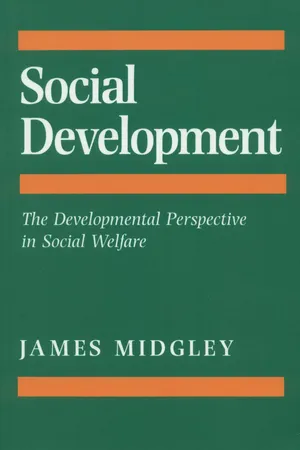
James Midgley describes the social development approach, traces its origins in developing countries, reviews theoretical issues in the field and analyzes different strategies in social development. By adding the developmental dimension, social development is shown to transcend the dichotomy between the residualist approach, which concentrates on targeting resources to the most needy, and the institutional approach which urges extensive state involvement in welfare.
- 208 pages
- English
- ePUB (mobile friendly)
- Available on iOS & Android
eBook - ePub
About this book
The social development approach seeks to integrate economic and social policies within a dynamic development process in order to achieve social welfare objectives. This first comprehensive textbook on the subject demonstrates that social development offers critically significant insights for the developed as well as the developing world.
Trusted by 375,005 students
Access to over 1.5 million titles for a fair monthly price.
Study more efficiently using our study tools.
Information
Publisher
SAGE Publications LtdYear
1995Print ISBN
9780803977730
9780803977723
Edition
1eBook ISBN
9781446232873
1
A Definition of Social Development
There is an urgent need to respond to the problem of distorted development described in the introduction to this book. By seeking to harmonize social policies with measures designed to promote economic development, social development offers a unique response to this problem. It also offers a broad macro-perspective on social welfare, and applies a variety of strategies which seek to enhance the levels of living of the whole population. As such, social development offers a comprehensive and dynamic approach to promoting social well-being today.
This chapter provides an overview of the concept of social development. It also offers a formal definition of social development and a description of its key characteristics. The account provided in this chapter will be augmented subsequently, and many of the features of social development discussed here in a preliminary form will be developed later.
The chapter begins by linking social development with the concept of social welfare. It defines the concept of social welfare and examines different approaches for promoting social welfare. These include social philanthropy, social work and social administration. Social development is defined as an approach to social welfare which offers an effective response to current social problems. By describing the differences between social development and these other approaches, it is hoped that the unique features of the social development approach will be clarified.
The chapter then formulates a formal definition of social development which frames the discussion in the rest of the book. This definition is inspired by the insights of modern-day political economy which offers an interdisciplinary perspective on current social and economic problems, and deals explicitly with ideological issues.
Finally, the chapter examines other definitions of social development which have been formulated in different academic fields in the past. These are discussed so that the definition provided in this book can be put into perspective. As will be shown, the term ‘social development’ has been defined in different ways in fields as diverse as psychology, sociology, social work and development studies. Although each field views social development differently, these various disciplines have all contributed to the formulation of the social development perspective.
THE CONCEPT OF SOCIAL WELFARE
Social development may be viewed as an approach for promoting people’s welfare (or social well-being). Social development may be contrasted with other approaches such as social philanthropy, social work and social administration. All have been institutionalized as approaches for promoting social welfare. Before reviewing these different approaches, the meaning of the term ‘social welfare’ needs to be discussed. The notion of social welfare is central to the concept of social development, and the way the term is used in this book.
The term ‘social welfare’ is today widely misused. Although its original meaning was a noble one, referring broadly to a state of social well-being, contentment and prosperity, most people today equate the term with charity or, in the United States, with public assistance for poor families and their children. In the United States, social welfare has almost become a term of abuse. Women who obtain welfare are known as ‘welfare mothers’ and they are often accused of being lazy, of not wanting to work and of exploiting government services. This is paradoxical because the founders of the United States used the term ‘welfare’ in a broad sense to connote the economic, social and political well-being of the nation.
The meaning adopted in this book reflects the wider connotation of the concept of social welfare. As used here the term ‘social welfare’ refers to a social condition, and not to the charity given by philanthropic individuals, charities or public assistance provided by governments. The book will argue that a condition of social welfare exists when families, communities and societies experience a high degree of social well-being.
It is difficult to define social welfare or social well-being precisely. The concept has both subjective and objective aspects and it can be defined either in descriptive, qualitative terms or by using empirical measures. Although there is no consensus about the characteristics of the condition of social welfare, perhaps the most significant contribution has been made by social scientists who have attempted to quantify its components.
Social scientists who have sought to develop quantifiable measures of social welfare have used various techniques to come to grips with the concept. One technique compares key statistics or indicators which measure social conditions. These statistics are known as indicators because they give some ‘indication’ of social conditions in different communities and societies. Examples of commonly used indicators are the unemployment rate, the infant mortality rate, the crime rate, the literacy rate and statistics relating to life expectancy, school enrolment, poverty and other social conditions. High rates of crime, unemployment, poverty and similar problems are indicative of a low level of social welfare. Conversely, communities that have low unemployment, poverty and crime rates, and high rates of life expectancy and literacy, are said to have a higher degree of social welfare.
Another technique is to combine these indicators into a single index of social welfare. As Nancy Baster (1972) reported, this idea was first developed at the United Nations Research Institute for Social Development in Geneva in the 1960s where social scientists defined social welfare in terms of the ‘level of living’ of societies. Subsequent composite indicators of social welfare such as the PQLI (Physical Quality of Life Index) of D. M. Morris (1979), the Index of Social Progress invented by Richard Estes (1985), and the more recent Human Development Indicator developed by the United Nations Development Programme (1990) are based on a few key components.
In addition, some social scientists have conducted surveys to ask citizens about their social concerns and anxieties, and their perception of social well-being. The findings of these surveys have then been compared with similar surveys undertaken in different communities, regions and countries to provide some insights into people’s subjective feelings of well-being. In this way, it is possible to discover what social situations are associated with a positive perception of social welfare and those that are not.
A Definition of Social Welfare
It is also possible to define social welfare in conceptual terms and many definitions of this kind have been formulated in the past. In this book, a condition of social welfare (or social well-being) is conceived of as comprising three elements. They are, first, the degree to which social problems are managed, second, the extent to which needs are met and, finally, the degree to which opportunities for advancement are provided. These three elements apply to individuals, families, groups, communities and even whole societies. The three elements thus operate at different social levels and need to apply at each level if a society as a whole is to enjoy a reasonable state of social well-being.
All families, communities and societies have social problems but they differ in the extent to which they manage them. For example, conflicts are managed quite well by some families but in others they seriously damage relationships, and sometimes result in the disintegration of the family. Crime and violence are more effectively prevented and controlled in some communities than others. Similarly, while some societies have implemented policies for keeping the rate of unemployment down, others have not been able to deal with this problem effectively. Generally, societies which are able to manage these and other problems have a higher degree of social welfare than others. An inability to manage social problems results in a condition that Richard Titmuss (1974) called ‘social illfare’.
All human beings, families, communities and societies have social needs which must be met if people are to experience social contentment. Needs refer to basic biological survival requirements such as nutrition, safe drinking water, shelter and personal safety but needs also exist at the level of communities and societies. Today, it is widely agreed that there is a necessity for communities and societies to have adequate levels of education and health care, harmonious social interaction, safe drinking water and social security. Communities and societies which meet these social needs experience a collective sense of well-being.
Finally, social welfare exists in communities which create social opportunities for people to advance and realize their potential. Societies with rigid social barriers that impede advancement are often characterized by a high degree of discontentment. Similarly, societies which fail to provide education, job opportunities and other means by which people can realize their potential often have high rates of crime and violence as people seek alternative, illegitimate means for improving their social position. The absence of opportunities is a major cause of social illfare in society.
These three dimensions – the management of social problems, the meeting of needs and the enhancement of opportunities – combine in a complex way to comprise the basic requirements for attaining a condition of social well-being. When all three requirements are met in any particular community or society, it may be argued that the community or society enjoys a satisfactory level of welfare. When these requirements are not met, it may be claimed that the community or society has failed to attain a satisfactory level of welfare.
Of course, this approach to defining social welfare is not intended to offer a precise set of standards for judging whether communities or societies enjoy an adequate level of social welfare. The use of quantitative measures such as official social statistics or indicators provides a more effective basis for making judgments of this kind. However, the definition which has been offered here provides some insights into the meaning of the concept.
APPROACHES FOR PROMOTING SOCIAL WELFARE
Today, most people associate the term ‘social welfare’ with the provision of government social services. However, it is only in relatively recent times that governments in Europe and North America expanded the public social services and assumed a major responsibility for promoting social welfare. For most of human history, individuals, with the support of their families, have been responsible for their own welfare. They attempted to solve their problems through their own efforts, and through hard work sought to earn the income they needed to meet their social needs.
While individual and family responsibility has traditionally been the primary means of promoting social welfare, other forms of support have also evolved. In most societies, culturally prescribed obligations require relatives, kin and even neighbours to assist those in need. Similarly, the world’s great religions have long prescribed that alms be given as a religious duty, and, in some cases, this duty evolved into complex systems of charitable provision. Religious charity fostered the emergence of a highly organized approach for promoting people’s welfare which, by the nineteenth century, catered for the needs of many needy people. Organized charity also promoted the emergence of professional social work. Similarly, it stimulated government involvement in social welfare.
Today, it is possible to identify three institutionalized approaches for promoting social welfare. The first is social philanthropy which relies on private donations, voluntary effort and non-profit organizations to meet needs, solve problems and create opportunities. The second is social work which relies on professional personnel to foster welfare goals by working with individuals, groups and communities. The final approach relies on government intervention through a variety of statutory social services. This latter approach may be called the social administration approach. This approach is also known as the social service or social policy approach.
All three approaches for promoting people’s welfare have been widely adopted throughout the world. They may be contrasted with the social development approach which has not been widely adopted. As will be shown, the key difference between the social development approach and the other approaches is the attempt to link social policies and programmes directly to a comprehensive process of economic development.
Social Philanthropy and Charitable Giving
Social philanthropy seeks to promote social welfare through encouraging the provision of private goods and services to needy people. While the systematic promotion of social philanthropy is a relatively recent development, philanthropy has ancient roots. For most of human history, social welfare has been provided by private citizens in the form of charity and, as was noted earlier, acts of charity were often prescribed and motivated by religious beliefs. In ancient Judaism, for example, farmers were expected to leave a portion of the harvest for the needy. In early Christianity, churchgoers were required to give tithes to help the poor. In Islam, the principles of zakat governed the giving of charity. Of course, these practices are still required today, and religious charity remains a major means of helping those in need.
Social philanthropy was implemented not only through individual acts of charity, but through organizations which provided specialized services to those in need. In Christianity, the first organizations to provide services of this kind were the monasteries which catered for the sick, the homeless and abandoned children. In time, specialized institutions that provided residential care for different groups of needy people such as the elderly, the mentally ill and orphans evolved. The provision of residential services to care for the needy became a major means of implementing the social philanthropy approach.
Although residential institutions were the most common form of social philanthropy, non-residential services were also provided. These services expanded very rapidly in the nineteenth century. By the middle of the century, a great variety of philanthropic organizations had been established in the cities of Europe and North America. Most provided poor relief in the form of food, clothing and other forms of material support. Others offered counselling and advice with social problems. Some were concerned with moral reform, seeking to rescue children and young women from alcohol abuse, vagrancy and prostitution. In time, the need to coordinate the activities of the different charities became a major concern of philanthropic leaders. As a result of their efforts, several coordinating agencies emerged. One of the first was the Charity Organization Society which not only sought to improve the coordination of philanthropic effort but formulated new techniques that resulted in the creation of professional social work.
At about this time, social philanthropy became increasingly secular. Although religious organizations had traditionally dominated charitable activity, many new charities without specific religious affiliations began to emerge. Much social philanthropy is now secular in character although, of course, religiously affiliated charities still operate on a large scale.
Today, a plethora of charitable organizations provide income, goods or services to needy people. Social philanthropy focuses primarily on those who cannot care for themselves, and it does not provide goods or services to the population as a whole. Historically, the providers of charity have drawn a sharp distinction between those who are ‘deserving’ and ‘undeserving’. The deserving include the elderly, the disabled, children and others who cannot take care of themselves. The undeserving are the able-bodied unemployed, and those who have fallen into need because of some behavioural problem such as drug abuse or crime. Generally, those who receive social philanthropy are passive recipients of goods and services. Philanthropy is dependent on the good will of donors and on the willingness of governments to use taxpayers’ money to supplement charitable activities.
Not all philanthropy is concerned with the provision of charitable relief to the needy. During the nineteenth century, when charitable activities were expanding rapidly in Europe and North America, some philanthropic leaders sought to bring about social reforms and improve social conditions. These leaders, who were often well-connected members of the upper middle class, sought to use their influence to solicit the support of political and business leaders. They used their connections to persuade governments to introduce new social services, to enact laws that prevented exploitation and discrimination, or to introduce measures that protected the vulnerable.
Many commentators have been sceptical of the achievements of philanthropic reformers, claiming that those with power and influence always protect their own interests, and only offer minor concessions that fail to bring about significant social changes. However, the successes of the reformers cannot be denied. Indeed, there are many historical examples of successful social reforms even though these reforms were not always introduced for altruistic reasons. Sometimes, reforms have come about because of a fear of social unrest and sometimes because political groups embracing reform proposals have done so in order to win elections. In other cases, the status and connections of social reformers have been critical factors resulting in the adoption of proposals primarily because of their ability to exercise influence.
Whatever the reason, philanthropic reform has produced significant results at different times. In the United States, the end of the nineteenth century is known as the Progressive Era because a large number of major reforms were introduced. An important social reformer at the time was Jane Addams who was well connected and able to exert influence on those in political office. She had a good relationship with President Teddy Roosevelt and was able to influence his policies. In Britain, leading members of the Fabian Society such as Beatrice and Sidney Webb actively promoted social reform. They adopted a strategy of ‘permeation’ by which they sought to gain the support of political leaders and to influence their policies.
The social philanthropy approach has been most successful in the industrial nations but similar developments have taken place in many developing countries as well. In addition, there has been a rapid growth in the number of international philanthropic agencies that specialize in finding resources for economic, social and community projects. Some of these agencies such as Oxfam have become large, multinational organizations with large budgets and extensive...
Table of contents
- Cover Page
- Title
- Copyright
- Dedication
- Contents
- Acknowledgements
- Introduction
- 1 A Definition Of Social Development
- 2 The Historical Context
- 3 Theoretical Debates
- 4 Strategies For Social Development
- 5 Achieving Social Development: The Institutional Perspective
- References
- Index
Frequently asked questions
Yes, you can cancel anytime from the Subscription tab in your account settings on the Perlego website. Your subscription will stay active until the end of your current billing period. Learn how to cancel your subscription
No, books cannot be downloaded as external files, such as PDFs, for use outside of Perlego. However, you can download books within the Perlego app for offline reading on mobile or tablet. Learn how to download books offline
Perlego offers two plans: Essential and Complete
- Essential is ideal for learners and professionals who enjoy exploring a wide range of subjects. Access the Essential Library with 800,000+ trusted titles and best-sellers across business, personal growth, and the humanities. Includes unlimited reading time and Standard Read Aloud voice.
- Complete: Perfect for advanced learners and researchers needing full, unrestricted access. Unlock 1.5M+ books across hundreds of subjects, including academic and specialized titles. The Complete Plan also includes advanced features like Premium Read Aloud and Research Assistant.
We are an online textbook subscription service, where you can get access to an entire online library for less than the price of a single book per month. With over 1.5 million books across 990+ topics, we’ve got you covered! Learn about our mission
Look out for the read-aloud symbol on your next book to see if you can listen to it. The read-aloud tool reads text aloud for you, highlighting the text as it is being read. You can pause it, speed it up and slow it down. Learn more about Read Aloud
Yes! You can use the Perlego app on both iOS and Android devices to read anytime, anywhere — even offline. Perfect for commutes or when you’re on the go.
Please note we cannot support devices running on iOS 13 and Android 7 or earlier. Learn more about using the app
Please note we cannot support devices running on iOS 13 and Android 7 or earlier. Learn more about using the app
Yes, you can access Social Development by James Midgley in PDF and/or ePUB format, as well as other popular books in Social Sciences & Social Work. We have over 1.5 million books available in our catalogue for you to explore.