![]()
Part I
Introduction
![]()
Chapter 1
Introduction
This chapter begins, like the others that follow, with a clear statement of the teaching and learning objectives (or purpose). They are shown below:
Teaching and learning objectives:
- To answer the question: What is research?
- To identify key features of research specific to Politics.
- To set out the structure and contents of the textbook.
What is research?
Research is essentially a process of systematic inquiry. Its core activities are:
- goal orientated and purposeful
- inquisitive – searching for answers to specific questions – especially ‘why?’ and ‘how?’
- careful, systematic and methodical
- original.
Additionally, we can claim that academic research can be distinguished from other research by
- its central concern for theory involving either testing or extending existing theory (deductive research), or developing new theory (inductive research).
Academic research essentially involves a systematic process. It begins with a research question. This is followed by a literature review, the collection or discovery of information, analysis, interpretation and conclusions. It can be both inventive and creative in terms of designing the research process and framing new theory. However, research may also involve serendipity – the happy knack of making discoveries by accident. For example, penicillin was ‘discovered’ in 1928 when Fleming noted that a petri dish had been contaminated by mould. However, rather than throwing out the dish, he first examined the contents and discovered that the mould had prevented the formation of Staphylococcus bacilli. The discovery thereby evidenced Pasteur’s earlier remark that ‘chance only favours the prepared mind’ (Greenfield et al, 2001: 302).1 Today, specialist ‘serendipity software’ is available to search and compare data sets to identify potential associations for subsequent investigation.
Similarly, research on research has shown that intellectual curiosity is the main driver of effective research which, in turn, stimulates and sustains the essential concentration and motivation (Mace, 1962: 29).2 In a post-modern world, it may also be argued that scepticism (the doctrine of the Philosophic School of Sceptics that real knowledge of the world is unattainable) is also an essential component. There is therefore a new readiness to challenge accepted theories, ‘truth’ and ‘facts’.
At a time when so much is already ‘known’, the question has to be asked: why undertake research? In particular, what real contributions can a single-semester, undergraduate research project make to the knowledge and understanding of our world? In reply, it can be argued that the real benefit of undergraduate, graduate and doctoral research lies in the contribution the research activity makes to your intellectual and personal development in terms of:
- testing the applicability and relevance of theory to new contexts
- promoting a better understanding of theoretical concepts
- developing analytical and interpretative skills
- learning how best to design investigative processes and manage projects
- uniquely, the opportunity given via undergraduate group research projects to gain experience of effective team-working – the mantra of modern management.
In other words, research provides an opportunity and arena for education for both academic or non-academic careers.
But, what is Politics? Does the discipline require or pre-suppose a unique approach to research training that favours specialist, in-house, faculty-wide, generic research training?
Politics is a relatively new academic discipline in the family of social sciences. It has roots in philosophy, history, law, geography, economics, sociology, psychology and, in the sub-field of voting behaviour, quantitative (statistical) analysis and mathematical modelling. It has therefore been described as: ‘the junction subject of the social sciences’ (Burnham et al, 2004: 8).3 Alternatively, it can be seen as a ‘mongrel subject’ or ‘crossover discipline’ that draws on others promiscuously. It can be both prescriptive (normative) and descriptive. Two broad and six constituent approaches have been identified in the ‘diverse and … cosmopolitan’ discipline: the formal operation of politics in government (and other arenas) embracing: behaviouralism; rational (public) choice theory and (new) institutional analysis; and, politics as a social process pervading all levels of society (associated with feminism); interpretative theory (anti-foundationalism); and, Marxism (Marsh & Stoker, 2002: 3).4 While there is no official definition of Politics, an official view was negotiated by a committee of academics to provide a ‘benchmark statement’:
[Politics is concerned with] … developing a knowledge and understanding of government and society. The interaction of people, ideas and institutions provides the focus to understand how values are allocated and resources distributed at many levels, from the local to the sectoral, national, regional and global. The analyses of ‘who gets what, when, how, why and where’are central, and pertain to related questions of power, justice, order, conflict, legitimacy, accountability, obligation, sovereignty and decision-making. Politics encompasses philosophical, theoretical, institutional and issue-based concerns relating to governance.
(QAA, 2000: 2)5
This overarching view of Politics might, at first sight, be seen to imply that all available research approaches and techniques can be adopted in Politics and that the researcher’s tool bag is vast. But this is not the case. In particular, power (which many commentators regard as central to the discipline) is not readily quantifiable or measurable.6 It as another ‘essentially contested concept’ (Lukes, 1974: 9).7 Indeed, power may not be observable (Bachrach & Baratz, 1962).8 Similarly, conflict need not necessarily be overt. And historic events cannot be re-run. So, those laboratory-based, scientific research approaches and techniques which rely on the repeated observation of phenomena under controlled conditions are largely inappropriate to Politics.
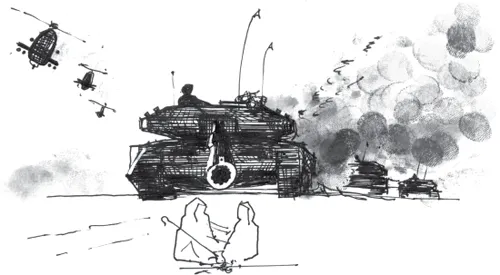
Illustration 1 Ask yourself, Father, what do we really mean by ‘power’?
This textbook concentrates on those research methods which seek to discern and interpret the underlying meanings, causes and consequences of conflict and power at the level of supra-state, state, government, party, class and other identity groups, and people in either the past or present-day. So a special characteristic of research in Politics is that it collects information from both archives (historical records) and fieldwork (field research).
Textbook structure and contents
The textbook is structured in five parts and their associated chapters which, generally speaking, follow the research process and degrees of complexity.
Part I (Introduction) begins with this scoping chapter. It is followed, in Chapter 2, by a review of power in research, ethics, data protection and the research effect. It concludes, in Chapter 3, with a review of the underlying philosophy and principles of research, including the concept of causality, provided by the main schools of positivism, empiricism, behaviouralism, naturalism and feminism newly mentioned and distinguishes between inductive, deductive and grounded research.
Part II (Methodologies) identifies the underlying principles and theories from which various methods have been developed. It begins, in Chapter 4, with a review of the dualism of qualitative and quantitative research, the claims and counter-claims of their disciples and the role of mixed methods. This concludes by identifying the main approaches to research design. This is followed, in Chapter 5, by a critical review of case studies, experimental, comparative, longitudinal and action research.
Part III (Collecting information) begins, in Chapter 6, with advice on how to critically evaluate published research. This is followed by guidance on how to test the quality of information in terms of the gold standards of validity, reliability and accuracy, the distinction between primary and secondary sources, and the use of triangulation and sampling in Chapter 7. The next chapter (8) concentrates on accessing secondary sources and completing an effective literature review. This is followed, in Chapter 9, by guidance on how to organise and complete interviews with political elites and other individuals, group meetings and focus groups, projective questions and vignettes. Chapter 10 provides practical advice on designing and conducting questionnaire surveys. Part III concludes with a critical review of other observational methods including the role of the new popular science of body language in Chapter 11.
Part IV introduces methods for analysing and interpreting the information collected. It begins, in Chapter 12, by reviewing the generic process of analysis, introducing a hierarchy of analysis and distinguishing between predominantly quantitative and qualitative methods of analysis.
Quantitative methods start, in Chapter 13, by reviewing the main descriptive statistics (mean, standard deviation, etc.) and their use. It is followed, in Chapter 14 by a review of the main inferential statistics (standard error of the mean, etc.) in which conclusions about populations are inferred from samples. The next chapter introduces the concepts of association, correlation, significance and regression analysis. The quantitative methods conclude, in Chapter 16, by introducing cluster and factor analysis (which enable underlying factors to be identified and labelled), time series analysis and the binomial distribution. The formulae built into MS Excel are used in the early chapters to calculate descriptive and inferential statistics. SPSS statistical software is used for the more sophisticated calculations in the later chapters.
Qualitative methods begins by offering guidance on how to transcribe and code ‘talk and text’ in Chapter 17. Chapter 18 introduces new approaches to content analysis. The section ends by introducing discourse analysis and narrative analysis and demonstrating their use in Chapter 19.
Finally, Part V provides advice on communicating research. In particular, it considers, in Chapter 20 the writing-up process from the initial research proposal to the final research report. Despite its (traditional) location at the end of the book, it argues that research begins by writing the research proposal and continues in parallel with the research process. So writing-up is both the ‘alpha’ (beginning) and ‘omega’ (end) of research. The text is supported by three appendices: a glossary of terms, statistical formulae and bibliography.
Questions for discussion or assignments
- What is Politics? Is ‘political science’ more appropriate, a misnomer or an oxymoron?
- What is research?
- What is the current research agenda of Politics? What topics would you wish to see added? Why?
- Is power central to Politics?
- Which research methods are generic to social science? Which others, if any, are specific to Politics?
- What are the implications of post-modernism for academic research? Is there a distinction between ‘truth’ an...