With a foreword by David Riesman, author of The Lonely Crowd.
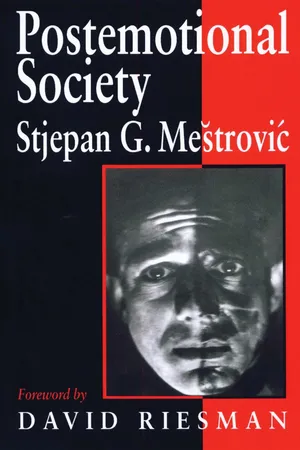
Introducing a new term to the sociological lexicon: ?postemotionalism?, Stjepan Mestrovic argues that the focus of postmodernism has been on knowledge and information, and he demonstrates how the emotions in mass industrial societies have been neglected to devastating effect.
Using contempoary examples, the author shows how emotion has become increasingly separated from action; how - in a world of disjointed and synthetic emotions - social solidarity has become more problematic; and how compassion fatigue has increasingly replaced political commitment and responsibility. Mestrovic discusses the relation between knowledge and the emotions in thinkers as diverse as Durkheim, Baudrillard, Ritzer, Riesman, and Orwell.
This stimulating and provocative work concludes with a discussion of the postemotional society, where peer groups replace the government as the means of social control.
- 192 pages
- English
- ePUB (mobile friendly)
- Available on iOS & Android
eBook - ePub
Postemotional Society
About this book
Trusted by 375,005 students
Access to over 1.5 million titles for a fair monthly price.
Study more efficiently using our study tools.
Information
1
Introduction
The following is a theoretical discussion that will attempt to introduce a new sociological concept, postemotionalism, to account for the lacunae and deficiencies of postmodernism as a theoretical construct, and to capture a distinct tendency in contemporary social life toward the mechanization of emotional life. Inspired by George Orwell’s1 and George Ritzer’s2 discussions of the mechanization of social life, I will extended their insights to include the mechanization of the emotions. I will also sociologize Orwell’s insight by situating it within a larger social theoretical context. I will do this by recontextualizing the works of David Riesman and Émile Durkheim in addition to those of Herbert Marcuse, Georg Simmel, Henry Adams, Fyodor Dostoevsky, and other intellectuals who wrote on the happy consciousness of a society without opposition, the blasé attitude, the cultural power of the dynamo, and the modernist disjunction between thought and feeling.
Pauline Rosenau is undoubtedly right that postmodernism, despite being difficult to define, has two faces, which she calls affirmative and skeptical. The affirmative postmodernist rhetoric includes multiculturalism, tolerance, communitarianism, an ethics of openness and inclusion,3 and the ‘salad bowl’ model of ethnic relations that is supposed to have replaced the old-fashioned ‘melting pot’ and assimilationist models. One should note immediately that these postmodern virtues have the ring of standardized formulas about them. Yet it is abundantly clear that something altogether different is occurring in the industrialized West in the 1990s. In fact, it is a great irony that President Clinton’s Presidency will be remembered not for the communitarianism4 and the overcoming of differences that he claimed he sought, but for the fission, divisiveness, and Balkanization – domestic and international – that has accompanied his Presidency.5 The most salient feature of this new development is the tendency for emotionally charged collective representations to be abstracted from their cultural contexts and then manipulated artificially by self and others in new and artificially contrived contexts. The two most dominant quasi-emotions extant in the West today seem to be curdled indignation and a carefully managed ‘niceness,’ both prophesied by David Riesman in The Lonely Crowd.6 So-called postmodern culture feeds parasitically on the dead emotions of other cultures and of the past in general. The result is that various groups become the reference point for synthetically created quasi-emotions and the notion of an all-encompassing cultural reference point such as Americanism has been replaced by Americanisms pertaining to women, Hispanics, African-Americans, other minorities, and various permutations of these and other groups.7 Arthur Spiegelman writes of a ‘catastrophic racial divide’ in the USA and of a possible ‘total racial meltdown’ in the future.8 A genuine Balkanization of the West9 seems to be occurring in other industrial countries as well, despite the loud yet routinized, even forced rhetoric of unity. For example, Quebec almost seceded from Canada. The assassination of Israeli Prime Minister Yitzhak Rabin as well as Benjamin Netanyahu’s very narrow election victory as his successor suggest that Israel has Balkanized over the issue of trading land for peace with the Palestinians. There are ominous signs that Scotland may wish to secede from the United Kingdom.
At first blush, this state of affairs seems to resemble the other, skeptical, even nihilistic version of the postmodern world conceived as a heap of contingent fictions, modelled after America as the dawning of the postmodern social universe.10 This view has been promulgated especially by Jean Baudrillard.11 It is true that the icons of American culture such as McDonald’s and Coca-Cola are slowly but surely taking over the rest of the world, and that they carry with them a cultural mind-set that deliberately displaces indigent cultures. For example, Parisian cafés are on the decline largely because of the McDonaldization of Paris.12 It is also true that a distinct neo-Orwellianism is emerging on the world scene, but: (1) in addition to Orwell’s original depiction of the almost exclusive manipulation of ideas, rational content, and habits of the mind, emotions and habits of the heart are also manipulated; (2) what appears to be postmodern disorder or the circulation of random fictions, as depicted by Jean Baudrillard,13 turns out to have a hidden order of its own, and to be highly automatized, rehearsed, and planned; (3) this internal and highly mechanized logic and order nevertheless lead to a larger pandemonium, as the title of one of Senator Daniel Patrick Moynihan’s books suggests.14
An important aspect of postemotionalism is the recycling of dead emotions from the past. In this sense, postemotionalism seems to be a part of the generalized tendency toward widespread simulation and cultural recycling that is evident to most observers of the current fin de siècle:15
Recycling is no longer confined to diet coke cans and evian water bottles. It’s become one of the dominant impulses in American culture today. . . . Whether you call it nostalgia, postmodernism or a simple vandalizing of the past, all this recycling essentially amounts to the same thing; a self-conscious repudiation of originality.16
Chris Rojek offers a similar assessment of the times in which we live in his Ways of Escape:
From a postmodernist standpoint the past bursts into the present through stage representations like Greenfield Village or the ‘Way We Were’ centre at Wigan Pier where actors wear the costume of turn-of-the-century schoolteachers and keep classes of day trippers in order. In addition, and more generally, branches of the mass media keep the past constantly ‘alive’ in the present. Nostalgia industries continuously recycle products which signify simultaneity between the past and the present. For example, hit television shows from the sixties are retransmitted in the 1980s and ’90s and reproduce or beat their original success; top pop songs from the fifties, sixties and seventies are re-released and become number one hits all over again; and fashions that were discarded as infra dig in our twenties are triumphantly championed by our children thirty years later. Increasingly, popular culture is dominated by images of recurrence rather than originality,17
It is easy to extend Rojek’s illustrations. Thus, a second Woodstock rock festival was held in 1994. Renaissance festivals are practically an institution in the United States with their re-engineering of the emotions that supposedly constituted the real Renaissance.18 Celebrities repackage themselves as intellectuals, and vice versa, in the information media.19 Journalists themselves have become celebrities.20 The terrorist who killed people through the use of mail bombs – nicknamed the ‘Unabomber’ – tried to present himself as a scholar and insisted that the New York Times or Washington Post publish his manifesto. (If the paper refused, he threatened to kill more people and ask Penthouse magazine to publish it.21 Penthouse was even willing to let him write a monthly column.)22 The Washington Post did finally publish the manifesto written by this terrorist-as-sociologist on 19 September 1995. Similarly, the indicted international war criminal Ratko Mladic tried to pass himself off as a patriot and victim.23 The United Nations continued to negotiate with other Serbian indicted war criminals, thereby putting them in the new and synthetic role of criminals-as-statesmen. Great Britain, which is losing its economic standing in the industrialized world, recently tried to repackage its image as a special nation by reminding the world that it is responsible for the Magna Carta, and is therefore still a great nation.24 Along these lines, French President Jacques Chirac expressed the view that the French gave the world civilization even as he ordered his government to attack defenseless Greenpeace protesters in the South Pacific, and went ahead with nuclear testing that had been banned by the civilized world. One could expand greatly this list of illustrations.
Yet the easily accepted notions of repackaging, recycling, and simulating objects of knowledge as staples of a postmodern world – noted by Theodor Adorno25 and other critical theorists long before the postmodernists arrived on the cultural stage – neglect the role of emotions, and beg important questions: (1) What is being recycled, intellectual content or emotion or both? The current literature in postmodernism seems to assume that cognitive representations are recycled, and that the world is basically a mental text. I am not satisfied with this assessment, and, through the use of the concept of postemotionalism, seek to incorporate the role of emotions in the postmodern discourse on the recycling of representations. It is more accurate to say that I seek to problematicize the age-old distinction between rationality and emotion, and to conceptualize a new hybrid of emotions-as-representations. (2) How is current cultural recycling different from authentic cultural experiences of emotion, and is this process of borrowing from the past different from rituals in traditional societies? Many participants in the postmodernist discourse assume that ‘authenticity is no longer an issue under postmodernism,’26 but I disagree. Our postmodern age is obsessed with the ‘real thing’ versus the phony in politics, leisure, advertisement, education, and other social arenas, even if most people cannot agree on how to make this distinction.27 (3) Who is responsible for the recycling? In other words, is the recycling random or is it committed by the ‘culture industry’, as Theodor Adorno28 argued? And if the culture industry is involved, the same question must be repeated: Is the process in the vast culture industry random and spontaneous, as argued by Baudrillard, or does it have a mechanized logic of its own? I question the now standard postmodernist claim that because of de-differentiation, former social, economic, and political distinctions are no longer valid.29 I will argue that the old distinctions have been transformed, but are still important. It is worth pondering how former distinctions still operate in new, artificial forms despite the appearance of postmodern chaos and de-differentiation. (4) Finally, why is postemotionalism occurring at a time in Western history that most social forecasters thought would be characterized by the end of ideology, the end of history, the triumph of democratic ideals, post-industrialization, and the end of racism, sexism, and other forms of oppression? Relying on a recontextualized reading of David Riesman’s The Lonely Crowd, I shall argue that the group-oriented social fission everyone is witnessing today is the logical next phase of what he called other-directedness. These are among the unresolved issues that I propose to problematicize and address in outlining the concept of postemotionalism.
Before turning to the theoretical scaffolding for apprehending this movement to postemotionalism, let us survey some more concrete examples with an eye on the issues discussed above. These are intended to serve as illustrations, not as proof of the existence of postemotionalism. While the illustrations I will use will eventually become dated, the underlying logic that I expose to describe them will probably remain relevant for many years to come. My intent in this section is to give the reader an intuitive, pre-theoretical feel for postemotionalism that will enable him or her to pick up a newspaper in the years to come and be able to discern postemotional logic in the description of events that will be ‘current’ in the future.
The Balkan War, for ...
Table of contents
- Cover Page
- Title Page
- Copyright Page
- Contents
- Foreword
- Preface
- Acknowledgements
- 1 Introduction
- 2 The End of Passion?
- 3 Recontextualizing David Riesman’s The Lonely Crowd
- 4 The Authenticity Industry
- 5 The Disappearance of the Sacred
- 6 Death and the End of Innocence
- 7 Conclusions: The Final Triumph of Mechanization
- Index
Frequently asked questions
Yes, you can cancel anytime from the Subscription tab in your account settings on the Perlego website. Your subscription will stay active until the end of your current billing period. Learn how to cancel your subscription
No, books cannot be downloaded as external files, such as PDFs, for use outside of Perlego. However, you can download books within the Perlego app for offline reading on mobile or tablet. Learn how to download books offline
Perlego offers two plans: Essential and Complete
- Essential is ideal for learners and professionals who enjoy exploring a wide range of subjects. Access the Essential Library with 800,000+ trusted titles and best-sellers across business, personal growth, and the humanities. Includes unlimited reading time and Standard Read Aloud voice.
- Complete: Perfect for advanced learners and researchers needing full, unrestricted access. Unlock 1.5M+ books across hundreds of subjects, including academic and specialized titles. The Complete Plan also includes advanced features like Premium Read Aloud and Research Assistant.
We are an online textbook subscription service, where you can get access to an entire online library for less than the price of a single book per month. With over 1.5 million books across 990+ topics, we’ve got you covered! Learn about our mission
Look out for the read-aloud symbol on your next book to see if you can listen to it. The read-aloud tool reads text aloud for you, highlighting the text as it is being read. You can pause it, speed it up and slow it down. Learn more about Read Aloud
Yes! You can use the Perlego app on both iOS and Android devices to read anytime, anywhere — even offline. Perfect for commutes or when you’re on the go.
Please note we cannot support devices running on iOS 13 and Android 7 or earlier. Learn more about using the app
Please note we cannot support devices running on iOS 13 and Android 7 or earlier. Learn more about using the app
Yes, you can access Postemotional Society by Stjepan Mestrovic,Author in PDF and/or ePUB format, as well as other popular books in Scienze sociali & Sociologia. We have over 1.5 million books available in our catalogue for you to explore.