![]()
Chapter 1
Strategic leadership
Brent Davies and Barbara J. Davies
This chapter considers:
- What is strategic leadership?
- What strategic leaders do.
- Characteristics strategic leaders display.
- A model for strategic leadership.
What is strategic leadership?
Strategic leadership is a critical component in the effective development of schools. The key foci for those who led schools in the last two decades, in many countries, have been school effectiveness and school improvement. These foci are set against an agenda of centralized curriculum and assessment frameworks with a primacy given to test results. While these developments may be welcomed or criticized, they probably have an inherent conceptual flaw in that they are attempting to improve current patterns of schooling within the existing paradigm of education. Even if such attempts at improvement are successful, the question that should be asked is, are they sustainable? This chapter puts forward the view that renewed attention needs to be paid to the strategic dimension of leadership to ensure this sustainability. Much of the orthodox perspective of leadership development suggests that new leaders tend first to address current administrative and managerial issues to build confidence and organizational ability before moving to a more strategic and futures activity. We argue that what is needed is a concurrent or parallel view of leadership development in which leaders not only improve on the ‘now’ of school improvement but concurrently build strategic capability within the school.
This chapter draws on insights gained from the National College for School Leadership (NCSL) research project, ‘Success and Sustainability: developing the strategically focused school’, which was based on detailed case studies of leaders in primary (elementary), secondary (high) and special schools to analyse their strategic processes, approaches and leadership. Our analysis of strategic leadership will be supported by the ‘leadership voices’ of the participants in the research project. The project identified, through initial survey data, inspection and evaluation reports, schools that were strategically led and sustainable for a detailed case study analysis. The focus was on the features of strategic leaders, in terms of what they did and what characteristics they displayed.
What do we understand by strategic leadership? Strategic leadership is not a new categorization or type of leadership such as transformational leadership or learning-centred leadership. Rather it is best considered as the strategic element within the broader leadership paradigm. Initially, a definition of strategy can make use of five concepts. First, it is concerned with the idea of direction-setting. To decide on the direction for the institution, it is necessary to understand its history and its current situation. This is articulated by Garratt (2003: 2) who gives an excellent definition of strategic thinking:
‘Strategic Thinking’ is the process by which an organisation’s direction-givers can rise above the daily managerial processes and crises to gain different perspectives of the internal and external dynamics causing change in their environment and thereby giving more effective direction to their organisation. Such perspectives should be both future-oriented and historically understood. Strategic thinkers must have the skills of looking both forwards and backwards while knowing where their organisation is now, so that wise risks can be taken by the direction-givers to achieve their organisation’s purpose, or political will, while avoiding having to repeat the mistakes of the past.
Second, strategy, while very often associated with planning in traditional definitions (Fidler, 1996) might better be thought of as a perspective, as a holistic way of looking at things. Third, strategy does not get involved in the detailed day-to-day activities but is concerned with the broad major dimensions of the organization. Fourth, a medium-to longer-term time framework is useful when considering strategy. A final useful concept is that strategy can be used as a template against which to set shorter-term planning and activities.
Defining leadership presents a challenge owing to the expanding amount of literature in the field from which to draw. The forms of leadership are extensive and other chapters in this book consider symbolic leadership, transformational leadership, learning-centred leadership, constructionalist leadership, emotional leadership, ethical leadership, distributed leadership, invitational leadership, entrepreneurial leadership and sustainable leadership. So where to start? Bush and Glover (2003: 10), in their review of the leadership literature for the NCSL, define leadership as ‘a process of influence leading to the achievement of desired purposes. It involves inspiring and supporting others towards the achievement of a vision for the school which is based on clear personal and professional values’. Building on this generic definition of leadership, Davies and Davies (2004) use a nine-point model of strategic leadership which combines five organizational abilities and four individual characteristics of strategic leaders. Using this model as a reference point this chapter is split into three parts:
- What strategic leaders do.
- Characteristics that strategic leaders display.
- A model for strategic leadership.
What strategic leaders do
We put forward the view that strategic leaders involve themselves in five key activities:
- direction setting
- translating strategy into action
- aligning the people and the organization to the strategy
- determining effective intervention points
- developing strategic capabilities.
Direction-setting
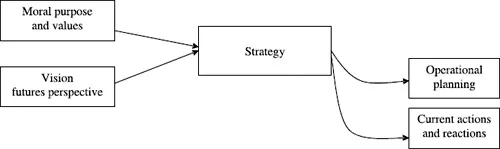
Strategic leaders are concerned with not just managing the now but setting up a framework of where the organization needs to be in the future, setting a direction for the organization. The function of strategy is to translate the moral purpose and vision into reality. A useful way to picture this is illustrated in Figure 1.1.
Figure 1.1 The function of strategy
School leaders articulate the definition of the organization’s moral purpose which can be considered as ‘why we do what we do’. The values that underpin this moral purpose are linked to the vision considering ‘where we want to be and what sort of organization we want to be in the future’. Strategy is the means of linking this broad activity to shorter-term operational planning, thereby imbuing the responses to immediate events with elements of the cultural and value system.
Strategy is defining that medium-term sense of direction. School leaders in the NCSL study characterized it as:
It’s talking about marshalling your resources and looking with a future perspective in order to achieve the maximum potential in an organization.
Your strategy is how you are going to get there, what kind of structures you put in place in the school, what measures you take to make things happen, how you use the money – all these things build up a strategy to getting where you want to get to.
A strategy to me is a plan of action, a conscious plan of action, that’s taken in the light of various information that I have available at the time but the strategy takes various forms.
Strategy for me is about where you are going and why you are going.
Strategy, therefore, is translating the vision and moral purpose into action. It is a delivery mechanism for building the direction and the capacity for the organization to achieve that directional shift or change. This translation requires a proactive transformational mindset which strives for something better rather than the maintenance approach of transactional leadership.
Translating strategy into action – develop strategic and organizational processes
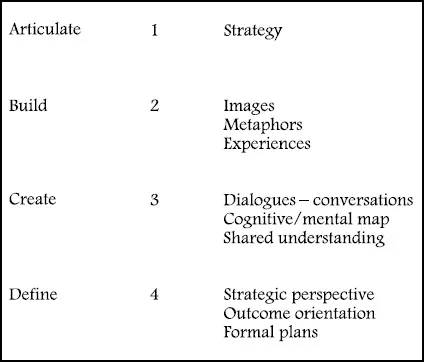
Davies, B. (2002) suggests a four-stage ABCD approach of translating strategy into action as shown in Figure 1.2.
Figure 1.2 The ABCD approach
Source: Davies, B. (2002: 204).
First the articulation of the strategy can take place in three ways; oral, written and structural. Oral articulation is the way leaders communicate, through strategic conversations, the strategic purpose and direction of the organization. This concept will be further developed in considering strategic conversations. Written articulations are the formal statements and plans that are clearly distinguishable from operational short-term plans. Structural articulation refers to the organizational infrastructure that supports and develops the strategic approach, for example, setting up futures or strategy meetings separate from the cycle of operational meetings. These three elements are reflected in the following school leader responses in the NCSL study:
I am constantly talking to the staff about where we are going and how they can contribute. I think it’s really, really critical that you find a way to communicate the basic organizational goals to the largest number of people possible.
We separate out our school development plan and our corporate longer-term strategic plan.
The operational management team looks after the here and now, the school development plan team looks at the duration of the plan and the research and development team actually looks a bit further into the future, outside of this.
Second, it is necessary to build a common understanding of what is possible through shared experiences and images. This building stage entails envisioning a clear and understandable picture of what this new way of operating would look like. This involves awakening the people in the school to alternative perspectives and experiences, and building an agreement within the school that a continuation of the current way of working is inadequate if the school wants to be effective in the future.
Third, the leadership needs to create through dialogue a shared conceptual or mental map of the future. What strategic leaders are able to do is step back and articulate the main features of the current organization, which might be called the ‘strategic architecture’ (Kaplan and Norton, 1996; 2001) of the school, and lead others to define what the future of the school and the new architecture will be. This may involve the process, described by Davies, B. (2003), of enhancing participation and motivation to understand the necessity for change, through strategic conversations. Significantly it draws on high-quality information both from within and outside the organization which is part of the strategic analysis that underpins the dialogue.
Fourth, the leadership needs to define desired outcomes and the stages of achieving those outcomes. This will establish a clear picture of the new strategic architecture of the school. Tichy and Sharman (1993) identify this stage as involving the identification of a series of projects that need to be undertaken to move the organization from its current to its future state. The significance of this approach is that stage 4 can be embedded in the organizational culture only if time is taken to work through stages 2 and 3.
Aligning the people and the organization to the strategy
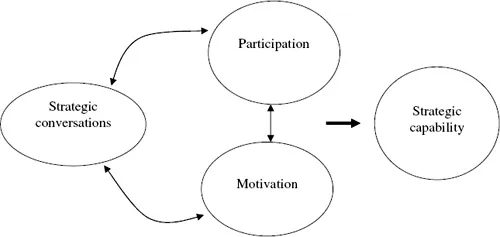
Wilson (1997: 1) states ‘organisational change has two principal aspects – change in mission and strategy and change in culture and behaviour’. We believe that it is impossible fundamentally to change mission and strategy without changing culture and behaviour. Key to this is changing the mindset and the behaviour of the people within the organization. The importance of aligning the people is recognized by Grundy (1998) and Gratton (2000). The research interviewees articulated a process based on strategic conversations which built participation and motivation within their school to improve strategic capability. These alignment processes work in an iterative way as in Figure 1.3.
Figure 1.3 The iterative nature of alignment and capability
Strategic conversations: developing strategic conversations and dialogue involves discussions about holistic whole-school issues and the trends that face the school over the next few years, as described by Hirschhorn, (1997: 123–4), Van der Heijden (1996: 41–2) and Davies, B. (2002: 21). These conversations enable people to develop a strategic perspective of what the school might become. Without such conversations, however tentative they might be at first, the future will, literally, not be articulated. As one school leader in the study put it: ‘We are constantly talking, large groups, small groups, individuals, a constant feast of two-way conversations bringing people in line with where we are going’.
Strategic participation: by definition, the conversations lead to greater knowledge and participation in discussions. It can be a difficult and slow process from the previous state of being concerned only with the short term to the new state of being involved in the broader and longer-term strategic issues. It can be a process of reculturing the organization (Fullan, 1993; Hargreaves, 1994; Stoll et al., 2002). The process of greater awareness and participation in discussion is a key way which develops the ability of the organization to build leadership in depth. The significant ability here is to build involvement in the longer-term development of the school. Strategic organizations use the abilities and talents of wider staff groupings to involve all in building and co...