Leading experts on each of these regions examine the current structures of social protection, consider the causes of the current welfare state crisis and highlight evolving trends for welfare policy. Different welfare states are shown to manifest different forms of crisis. Among the symptoms of crisis, Welfare States in Transition suggests that the effect of popluation ageing is exaggerated, and an at least equally fundamental challenge lies in the revolution of the modern family and the changing economic role of women. The contributors are sceptical about the neo-liberal formula for reform, not only because it increases inequality but also because it does not address the growing need for an active social investment policy to ensure against entrapment in poverty or low-paid jobs.
eBook - ePub
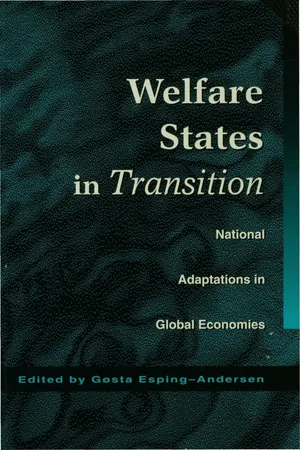
Welfare States in Transition
National Adaptations in Global Economies
- 288 pages
- English
- ePUB (mobile friendly)
- Available on iOS & Android
eBook - ePub
Welfare States in Transition
National Adaptations in Global Economies
About this book
This wide-ranging comparative analysis of contemporary and future changes in welfare states looks at the different trajectories of the welfare states of Europe, North America, the Antipodes, and the emerging scenarios in Latin America, East Asia and Central and Eastern Europe.
Information
1
After the Golden Age? Welfare State Dilemmas in a Global Economy
According to T.H. Marshall (1950), modem citizenship is the fruition of a democratization that spans three centuries. In the eighteenth century the foundations were laid with the principle of legal-civil rights; political rights emerged in the nineteenth century; and, as a preliminary culmination of the democratic ideal, we see the consolidation of social citizenship in the twentieth century.
On the threshold of yet another century, legal and political rights appear firmly entrenched in most parts of the advanced, industrialized world. The same, however, cannot be said for social rights. Many believe that the welfare state has become incompatible with other cherished goals, such as economic development, full employment, and even personal liberties – that it is at odds with the fabric of advanced postindustrial capitalism.
The case for the inevitability of a third historical stage of social citizenship also seems circumspect when we broaden our analysis beyond the old, mature democracies. Despite what modernization theory believed some decades ago, the new emerging industrial democracies do not appear set to converge along the Western welfare state path. Was T.H. Marshall, then, wrong to assume that modem civilization is cumulative and irreversible? Or, put differently, what kind of welfare state is likely to emerge in the future?
The modem welfare state became an intrinsic part of capitalism’s postwar ‘Golden Age’, an era in which prosperity, equality, and full employment seemed in perfect harmony. It cannot be for lack of prosperity that welfare states are in crisis. The dizzying levels of postwar economic growth are long gone, but nevertheless real gross national product in the rich OECD countries has increased by a respectable 45 per cent since the oil crisis in the mid 1970s. Public (and private) social outlays, of course, grew even faster but this trend was generally arrested in the 1980s. It is in the equality/full-employment nexus that the essence of the crisis must be found.
There seem to be as many diagnoses of the welfare state crisis as there are experts. Most can, nonetheless, be conveniently subsumed under three main headings. There is, firstly, the ‘market-distortion’ view which argues that the welfare state stifles the market and erodes incentives to work, save and invest. A second popular diagnosis focuses on the cataclysmic longterm effects of population ageing. And a third group of arguments focuses on the consequences of the new global economy, which mercilessly punishes profligate governments and uncompetitive economies.
Our study will not reject these arguments. We basically agree that a new, and quite fundamental, trade-off does exist between egalitarianism and employment; that global competition does narrow the field of domestic policy choice; and that ageing is a problem. At the same time, we feel that these standard accounts are exaggerated and risk being misleading. In part, the diversity of welfare state types speaks against too much generalization. In part, we must be very careful to distinguish what are chiefly exogenous and endogenous sources of the crisis. On the one hand, many of the difficulties that welfare states today face are caused by market failure: that is, badly functioning labour markets produce an overload on existing social programmes. Some, of course, insist that this is the fault of the welfare state itself. Thus, on the other hand, there is possibly also welfare state failure: that is, the edifice of social protection in many countries is ‘frozen’ in a past socio-economic order that no longer obtains, rendering it incapable of responding adequately to new risks and needs.
The malaise that now afflicts the advanced welfare states influences also strategic thinking on social security development within the emerging industrial democracies. Most pointedly, there no longer seems to be a Swedish ‘middle way’. The neo-liberals suggest that the road to growth and prosperity is paved with flexibility and deregulation. Their recommendation for Latin America and East-Central Europe is therefore to emulate Chilean privatization rather than Swedish welfare statism. Critics hold that such a choice causes too much polarization and needless impoverishment, and that it may prove counter-productive for modernization. Comprehensive social security, they hold, is necessary because traditional familial, communal, or private market welfare arrangements are wholly inadequate. It is also necessary because stable democracy demands a level of social integration that only genuine social citizenship can inculcate.
Indeed, these were the very same issues that dominated in postwar Europe. Then, welfare state construction implied much more than a mere upgrading of existing social policies. In economic terms, the extension of income and employment security as a citizen’s right meant a deliberate departure from the orthodoxies of the pure market. In moral terms, the welfare state promised a more universal, classless justice and solidarity of ‘the people’; it was presented as a ray of hope to those who were asked to sacrifice for the common good in the war effort. The welfare state was therefore also a political project of nation-building: the affirmation of liberal democracy against the twin perils of fascism and bolshevism. Many countries became self-proclaimed welfare states, not so much to give a label to their social policies as to foster national social integration.
Such issues are of pressing concern in contemporary Asia, South America, and East Europe precisely because economic modernization tears apart the old institutions of social integration. Yet, policy makers in these nations also fear that such moral and political aims might jeopardize their comparative economic advantage (cheaper labour), traditional elite privileges (non-taxation of the rich in Latin America), or social culture (Confucianism in East Asia).
The advanced Western nations’ welfare states were built to cater to an economy dominated by industrial mass production. In the era of the ‘Keynesian consensus’ there was no perceived trade-off between social security and economic growth, between equality and efficiency. This consensus has disappeared because the underlying assumptions no longer obtain. Non-inflationary demand-led growth within one country appears impossible; full employment today must be attained via services, given industrial decline; the conventional male breadwinner family is eroding, fertility is falling, and the life course is increasingly ‘non-standard’.
Such structural shifts challenge traditional social policy thinking. In many respects the symptoms of crisis are similar across all nations. In others, there is notable divergence. Europe’s single largest problem is chronically high unemployment, while in North America it is rising inequality and poverty. Both symptomize what many believe is a basic trade-off between employment growth and generous egalitarian social protection. Heavy social contributions and taxes, high and rigid wages, and extensive job rights make the hiring of additional workers prohibitively costly and the labour market too inflexible. The case in favour of deregulation seems validated in the North American ‘job miracle’ of the 1980s even if this occurred against the backdrop of greater inequalities.
Critics insist that the associated social costs of the American route are too high in terms of polarization and poverty. They suggest a ‘social investment’ strategy as an alternative. Rather than draconian roll-backs, the idea is to redirect social policy from its current bias in favour of passive income maintenance towards active labour market programmes that ‘put people back to work’, help households harmonize work and family obligations, and train the population in the kinds of skills that postindustrial society demands. The stress on human capital investment has, in the guise of ‘productivist social policy’, been official dogma in the Swedish model for decades. It is now also a leading theme in the Clinton administration, in the European Community, and also in East Asian countries (see European Community, 1993b; Freeman, 1993).
The debate within the ‘emerging’ economies is quite parallel. Since their perceived advantage lies in competitive labour costs, there is a natural reluctance to build costly welfare state programmes. Many of these nations – particularly Japan – also face unusually rapid population ageing and the spectre of unpayable future pension burdens. They recognize, however, that as their wage cost advantage evaporates (there is always a cheaper economy waiting on the horizon), they will have to shift towards higher value-added production: hence, the East Asian governments’ phenomenal stress on education.
What, then, are the prospects for the welfare state as we step into the twenty-first century? Will the advanced nations be forced to sacrifice some, or even most, of their welfare state principles? Will the new industrializing nations opt for a model without a welfare state or, alternatively, adopt some variant of Western style welfare states?
Overall trends, alas, give little comfort to those who adhere to the ideals of the welfare state, at least as it was traditionally conceived. The new conflict between equality and employment that the advanced nations confront is increasingly difficult to harmonize. The conditions that made the welfare state an essential part of economic development in the postwar Western nations may not apply to, say, contemporary Argentina, Poland, or South Korea. The causes of such pessimism are to be found in both international and domestic change.
The changing international environment
The harmonious coexistence of full employment and income equalization that defined the postwar epoch appears no longer possible. Many believe that North America’s positive employment performance could only be achieved by deregulation and freed markets which, in tum, reward the winners and punish the losers: hence, rising wage and household income inequalities, growing poverty rates, and maybe even the re-emergence of an ‘underclass’ (Gottschalk, 1993; OECD, 1993; Jencks and Peterson, 1991; Room, 1990). Western Europe, with its much more comprehensive industrial relations systems, welfare states, and also powerful trade unions, has maintained equality and avoided growing poverty, but at the price of heavy (especially youth and long-term) unemployment, and swelling armies of welfare dependants, the combination of which overburdens social security finances. Demand-led, reflationary strategies are no longer an option, partly because unemployment is not merely cyclical, and partly because income growth leaks out of the economy to purchase imported goods.1
The case for convergence: global integration
Integration in the world today almost automatically implies open economies. Sweden, Australia and New Zealand, Chile, and the ex-communist countries in Europe, are all shedding the protectionist measures that once upheld their respective welfare state arrangements.
Openness is said to sharply restrict nations’ capacity to autonomously design their own political economy. Both Australia and Sweden illustrate the erosion of national options. As Castles shows in Chapter 4, Australia could pursue what he calls the ‘wage earners’ welfare state’ model of job security, full employment and high wages only as long as it adhered to protectionist measures. The price that Australia paid was lagging growth. Sweden, as Stephens shows in Chapter 2, could balance (over-) full employment with the world’s most generous and egalitarian welfare state only as long as governments could control domestic credit and investments, and as long as the labour market partners could guarantee wage moderation consensually. Following liberalization in the early 1980s, the Swedish economy suffered heavy capital leakage abroad, thus undercutting domestic investment and job generation. At the same time, Sweden’s tradition of centralized national social pacts eroded. Enhanced openness in both countries has compelled governments (both left and right) to cut back social expenditure. Is it, then, the case that openness inexorably drives welfare states towards a lowest common welfare denominator?
Much of Latin America and East-Central Europe is presently undergoing harsh liberal adjustment strategies. In the short run this tends to cause heavy unemployment, an often dramatic fall in incomes, and more inequalities. In the longer run – as the case of Chile since the mid 1980s suggests – it can improve nations’ competitiveness, growth, and thus employment.2 The problem with radical liberalization is that its costs are unequally distributed and thus easily provoke organized resistance. The Chilean case is illustrative. Huber shows in Chapter 6 that Chile’s poverty rate rose from 17 per cent in 1970 to 38 per cent in 1986. In 1983, the unemployment rate reached a third of the labour force.3 In authoritarian Chile, organized resistance was effectively crushed. In liberal democracies, policy makers will have to rely on either persuasion or compensatory social guarantees. Persuasion assumes broad consensus, while compensation may strain governments’ already fragile finances. In Latin America, as in East and Central Europe, the gap between social need and financial means is deepened by rising ‘informalization’ of employment. Employers and workers exit from the formal employment relationship to dodge taxation and job regulations.
If global wage competition is a major source of welfare state crisis in the advanced nations, convergence may paradoxically emerge from two opposite responses. Lowering wage costs in Europe and America may, at least in the interim, safeguard otherwise uncompetitive domestic firms. The offshoot, of course, is an implicit sanctioning of poor productivity performance. The other source of convergence would come from rising labour costs among the main global competitors, such as Japan, Korea or Taiwan. Their relative labour costs have been rising, and will do so even more if, as our study believes, these countries are hard put to stall major social security reforms in coming years.
The case for divergence: the role of institutions
There are additional reasons why we should not exaggerate the degree to which global forces overdetermine the fate of national welfare states. One of the most powerful conclusions in comparative research is that political and institutional mechanisms of interest representation and political consensus-building matter tremendously in terms of managing welfare, employment and growth objectives.4 The postwar European economies were able to maximize both welfare and efficiency owing to the capacity of encompassing interest organizations to promise wage restraint in return for full employment. For these reasons, a strong social safety net had no major negative effects on economies’ adjustment capacities or, more generally, on growth (Calmfors and Driffill, 1988; Atkinson and Mogensen, 1993; Blank, 1993; 1994; Buechtemann, 1993).
But, countries with fragmented institutions will lack the capacity to negotiate binding agreements between contending interests. Opposed welfare, employment and efficiency goals more easily tum into zero-sum trade-offs, causing inflation and possibly an inferior capacity to adapt to change. Hence, a favourable institutional environment may be as capable as free markets of nurturing flexibility and efficiency. Thus, citing Ronald Dore, de Neubourg (1995: 6) points to the fallacy of wondering why, despite her rigid institutions, Japan manages to perform so well. Instead, the real question should be: ‘which features make the Japanese institutional arrangements s...
Table of contents
- Cover Page
- Title Page
- Copyright Page
- Contents
- Foreword by Dharam Ghai
- Editor’s Preface
- Notes on the Contributors
- 1 After the Golden Age? Welfare State Dilemmas in a Global Economy
- PART ONE: DECLINE OR RENEWAL IN THE ADVANCED WELFARE STATES?
- PART TWO: EMERGING NEW WELFARE STATES?
- CONCLUSION
- Index
Trusted by 375,005 students
Access to over 1.5 million titles for a fair monthly price.
Study more efficiently using our study tools.
Frequently asked questions
Yes, you can cancel anytime from the Subscription tab in your account settings on the Perlego website. Your subscription will stay active until the end of your current billing period. Learn how to cancel your subscription
No, books cannot be downloaded as external files, such as PDFs, for use outside of Perlego. However, you can download books within the Perlego app for offline reading on mobile or tablet. Learn how to download books offline
Perlego offers two plans: Essential and Complete
- Essential is ideal for learners and professionals who enjoy exploring a wide range of subjects. Access the Essential Library with 800,000+ trusted titles and best-sellers across business, personal growth, and the humanities. Includes unlimited reading time and Standard Read Aloud voice.
- Complete: Perfect for advanced learners and researchers needing full, unrestricted access. Unlock 1.5M+ books across hundreds of subjects, including academic and specialized titles. The Complete Plan also includes advanced features like Premium Read Aloud and Research Assistant.
We are an online textbook subscription service, where you can get access to an entire online library for less than the price of a single book per month. With over 1.5 million books across 990+ topics, we’ve got you covered! Learn about our mission
Look out for the read-aloud symbol on your next book to see if you can listen to it. The read-aloud tool reads text aloud for you, highlighting the text as it is being read. You can pause it, speed it up and slow it down. Learn more about Read Aloud
Yes! You can use the Perlego app on both iOS and Android devices to read anytime, anywhere — even offline. Perfect for commutes or when you’re on the go.
Please note we cannot support devices running on iOS 13 and Android 7 or earlier. Learn more about using the app
Please note we cannot support devices running on iOS 13 and Android 7 or earlier. Learn more about using the app
Yes, you can access Welfare States in Transition by Gøsta Esping-Andersen, Gøsta Esping-Andersen,Gosta Esping-Andersen in PDF and/or ePUB format, as well as other popular books in Social Sciences & Social Work. We have over 1.5 million books available in our catalogue for you to explore.