Lesson planning in line with the new Primary National Curriculum!
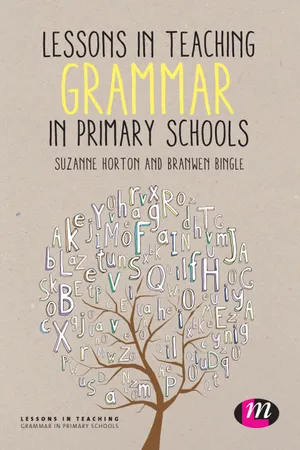
Outstanding grammar lessons are not about teaching children the mechanics of grammar but fostering a curiosity about language, words and clauses when explored within a meaningful context. This book offers practical ideas and lesson plans to help you plan and teach lessons that motivate, engage and inspire pupils to use grammar accurately and creatively to produce writing that is fluid, cohesive and purposeful. It will also help you to teach grammar confidently and effectively by addressing your own grammar questions and providing essential subject knowledge. The lesson ideas have all been tried and tested in the classroom, and you can adapt the lessons to teach other aspects of grammar or change the focus of the learning objective to reflect the needs of your classroom. Did you know that this book is part of the Lessons in Teaching series?
Table of Contents What is Grammar? / Grammar in context / Year 1: Teaching Sentence Demarcation / Year 2: Teaching Conjunctions / Year 3: Teaching Direct Speech / Year 3: Using the Perfect Tense / Year 4: Teaching adverbial phrases / Year 4: Teaching the Difference between the Plural and Possessive -s / Year 5: Teaching Modal Verbs / Year 5: Teaching Expanded Noun Phrases / Year 6: Using the Subjunctive Form in Speech / Year 6: Using the Passive Voice / Moving On / Glossary of Terms
WHAT IS THE LESSONS IN TEACHING SERIES?
Suitable for any teacher at any stage of their career, the books in this series are packed with great ideas for teaching engaging, outstanding lessons in your primary classroom. The Companion Website accompanying the series includes extra resources including tips, lesson starters, videos and Pinterest boards. Books in this series: Lessons in Teaching Grammar in Primary Schools, Lessons in Teaching Computing in Primary Schools, Lessons in Teaching Number and Place Value in Primary Schools, Lessons in Teaching Reading Comprehension in Primary Schools, Lesson in Teaching Phonics in Primary Schools
- 192 pages
- English
- ePUB (mobile friendly)
- Available on iOS & Android
eBook - ePub
Lessons in Teaching Grammar in Primary Schools
About this book
Information
Chapter 1
What is grammar?
Learning outcomes
The way that language is organised and structured, and how it can be utilised and manipulated to create meaning and aid communication, is a fascinating area of study in its own right. Much of the preparation for teaching deals with the skills, knowledge and understanding needed by children in order to apply these to their speech and writing; however, in order to understand truly the purpose for teaching explicit grammar skills in context, it is helpful for the teacher to have an awareness of the rich linguistic history of the English language.
This chapter will allow you to achieve the following outcomes:
• understand what grammar is and what it entails;
• understand how the historical context of the UK affected the development of grammar in the English language.
Teachers’ Standards
Working through this chapter will help you meet the following standard:
3. Demonstrate good subject and curriculum knowledge.
Making sense of grammar
When we come to literature we find that though it conforms to rules of grammar it is yet a thing of joy, it is freedom itself. The beauty of a poem is bound by strict laws, yet it transcends them. The laws are its wings, they do not keep it weighed down, they carry it to freedom. Its form is in law but its spirit is in beauty.
(Sadhana: The Realisation of Life by Rabindranath Tagore, 1913: https://archive.org/stream/sdhan00unkngoog#page/n19/mode/2up)
As the authors of this book, we make no apologies for our interest in grammar. It is not our intention to reduce it to a series of rules and laws that must be applied to all written communication, but neither do we wish to ignore the conventions of our language that enable people to manipulate texts to suit a range of audiences and purposes. Our interest comes from careers in education where we continually strive to help learners communicate, within an ever-changing educational landscape; however it is also indicative of our fascination with English language use and a love of the richness of the literature available to us using this medium.
In his book Mother Tongue, Bryson (1990, p2) states: The complexities of the English language are such that even native speakers cannot always communicate effectively and this is no truer than when discussing grammar. It has become a contentious issue, with grammarians often positioning themselves as supporters of prescriptive or descriptive approaches and dismissing the other out of hand. This discord affects the field of educational research into literacy and language: in Teaching English, Language and Literacy Wyse et al. (2013) describe the personal nature of some of the criticisms of studies into grammar teaching while unpicking some of the key research papers which have informed educational policy in the UK.
So why is the teaching of grammar so emotive? One of the issues, referred to above, is the debate over grammar as a prescribed set of dos and don’ts (prescriptive) and grammar as a description of the way speakers and writers structure and organise their language use (descriptive). The irony of a word in English being used to describe two apparently opposed ideas should not be lost on teachers often charged with explaining to pupils things such as sanction (to permit or to punish) or bolt (to run away/to fix in place); and yet this should not prevent a working definition being devised and applied in order to help children communicate effectively.
Activity
A Google search brings up some of the following information regarding grammar. Which of these statements do you agree with? Can any of them be challenged?
Grammar (noun)
1 [mass noun] the whole system and structure of a language or of languages in general, usually taken as consisting of syntax and morphology (including inflections) and sometimes also phonology and semantics.
(Oxford Online Dictionary, found at www.oxforddictionaries.com/definition/english/grammar?q=grammar)
English-speakers use many forms of grammar. Written English tends to be more standardised.
(BBC Skillswise: English and maths for adults website, found at: www.bbc.co.uk/skillswise/topic/varieties-of-english)
The unit begins with an exploration of the notion of stereotypes. Students then review and extend their knowledge of grammar focusing on the use of adjectives, onomatopoeia and alliteration.
(Ofsted, 2011)
Not one of Ofsted’s sample lessons suggests that teaching grammar explicitly is a good idea. It seems that Ofsted inspectors don’t even know what grammar is, as demonstrated in the quotation above. Adjectives are grammatical features. Onomatopoeia and alliteration are not: they are stylistic devices.
(Standpoint Magazine (citing Ofsted, 2011) http://standpointmag.co.uk/free-at-last-june-12-inspecting-the-inspectors-katharine-birbalsingh-ofsted-michael-wilshaw-english-grammar?page
=0%2C0%2C0%2C0%2C0%
2C0%2C0%2C0%2C0%2C0%2C1)
=0%2C0%2C0%2C0%2C0%
2C0%2C0%2C0%2C0%2C0%2C1)
• Write your own definition of what you understand grammar to include and involve. Use as many sources as you feel appropriate to help you.
The last quotation in the activity above comes from an article criticising Ofsted’s subject knowledge, but if we use the Oxford English Dictionary definition and include phonology then alliteration seems to be a part of grammar. Thus we begin to understand why teaching grammar seems so complex: no one can agree what it is!
The historical context
The complexity of the English language is unavoidably tied up in the history of the British Isles. One of the strengths of the language is the willingness of its speakers to absorb new terms and linguistic structures, to utilise the vocabulary and syntax of other peoples in order to aid communication. This has, in turn, led to a sprawling, sometimes unwieldy language that can baffle, bemuse and often irritate scholars, while at the same time becoming a global means of communication for entertainment, business and tourism.
The original languages of mainland Britain, Celtic and Gaelic, survived the Roman onslaught but found themselves pushed ever westward by the Germanic tribes, most notably, at least in linguistic terms, the Angles (from which we derive the name of our language) and the Frisians. Old English is thus not the original medium for communication of England, but already well travelled when it joined and then dominated the landscape, providing familiar terms still in use today.
However, the runic form of representing the language did not survive so well as the spoken terms: the Romans had left their mark in many ways, not least upon the alphabetic code devised for Latin which replaced the orthography of the runes. It is merely an accident of tradition and convention that has led us to the alphabet we know today, as runic inscriptions were saved for special occasions while the Latin alphabet was utilised more prolifically and spread through the religious writings of the time; with the spread of Christianity came the spread of graphemes we recognise today. Later still the Norman invasion brought scribes who had been using alternative spellings such as ‘qu’ rather than ’cw’, making words from different languages look as if they came from the same linguistic source. It was at this time that the grammatical structure of the language also began to change as French influenced the spoken and written mediums alongside Latin and the local vernaculars.
And herein lies the problem: the continual change brought about through invasion and expansion meant that the scribes keeping the records were often interlopers to Britain, brought along with a conquering army. It was their job to document local languages, which they did in ways recognisable to them and their readership (often a small number of scholars familiar with their alphabetic and syntactic codes). With the exploration of the globe, the scribes of the British Isles then took this abroad, bringing back new vocabulary or phraseology to describe the new places, inventions and discoveries experienced but embedded using familiar linguistic codes. This was further complicated by the rise of the printing press, when the printer and not the writer often had final say on how the text would appear in print. Local decisions regarding spelling, punctuation and syntax then had national impact, and provided the basis for many an anomaly discussed in modern classrooms. For example, William Caxton (c. 1420–1492), the man credited with bringing the printing press to England, was also the one responsible for choosing a Midlands/London dialect for the translations of the majority of the books he printed as he felt it would have wider appeal than regional dialects. He made decisions regarding spelling and grammar that affect what we read today, for example choosing between the words eggys and eyren to describe the oval object laid by birds. These decisions were not just down to personal preference: they were based on his need to print texts that would be marketable to as wide a readership as possible, as A standard language would have been much more important to Caxton, a publisher of printed books, than to a scribe who produced one copy at a time (www.bl.uk/treasures/caxton/english.html).
Until the fourteenth century the language of education had largely been that of Latin and Greek, languages with rigid and inflexible grammatical structures, especially in their classical forms. By the time of Caxton, English had finally taken over as the official and political language of the islands, although most published texts across the continent were still in Latin. The new mass production of texts in English led to the development of standardised written English and an increased opportunity for people to learn to read in English, but it wasn’t until 1586 that William Bullokar wrote a Pamphlet for Grammar, outlining how the ‘rules’ of the English language should be applied to writing. Thus it was that Shakespeare had rules to break by the time he began writing in the late sixteenth/early seventeenth century!
This preoccupation with the correct and often prescribed notion of a perfect grammar which surpasses all others has continued to influence discussions about language, literacy and education. During the eighteenth century the Age of Enlightenment saw an increased number of people reading more extensively than before, and many key thinkers of the time turned their attention to linguistics. As with all areas of study this led to argument and disagreement rather than consensus, fuelled by a growing middle class that wanted to be told how they should read and write in order to join the upper echelons of society. In other words, the main reason for wanting a set of grammatical rules was to enable social mobility, as your use of language could give away your poor social standing and prevent you moving upward in social and economic terms. This argument seems to have stayed with us into the twenty-first century, as education and effective language use are continually highlighted as potential ways to break down social barriers and enable aspiration.
The idea then that there was ever a perfect time when the rules of grammar and spelling could be applied without fear of change or disagreement is erroneous when applied to English. Language has changed and adapted over time, matching the speed of technological change and global influence. Success as a communicator in a range of environments, however, relies upon your ability to use the language of that environment as effectively as possible, and thus learning the syntax, semantics, phonology and morphology of those in power, be it employers, government or educators, can lead to greater achievement than doggedly stickin...
Table of contents
- Cover Page
- Halftitle
- Title
- Copyright
- Contents
- The authors
- Acknowledgements
- 1 What is grammar?
- 2 Grammar in context
- 3 Year 1: Teaching sentence demarcation
- 4 Year 2: Teaching conjunctions
- 5 Year 3: Teaching direct speech
- 6 Year 3: Using the perfect tense
- 7 Year 4: Teaching adverbial phrases
- 8 Year 4: Teaching the difference between the plural and possessive -s
- 9 Year 5: Teaching modal verbs
- 10 Year 5: Teaching expanded noun phrases
- 11 Year 6: Using the subjunctive form in speech
- 12 Year 6: Using the passive voice
- 13 Moving on
- 14 Glossary of terms
- Index
Trusted by 375,005 students
Access to over 1.5 million titles for a fair monthly price.
Study more efficiently using our study tools.
Frequently asked questions
Yes, you can cancel anytime from the Subscription tab in your account settings on the Perlego website. Your subscription will stay active until the end of your current billing period. Learn how to cancel your subscription
No, books cannot be downloaded as external files, such as PDFs, for use outside of Perlego. However, you can download books within the Perlego app for offline reading on mobile or tablet. Learn how to download books offline
Perlego offers two plans: Essential and Complete
- Essential is ideal for learners and professionals who enjoy exploring a wide range of subjects. Access the Essential Library with 800,000+ trusted titles and best-sellers across business, personal growth, and the humanities. Includes unlimited reading time and Standard Read Aloud voice.
- Complete: Perfect for advanced learners and researchers needing full, unrestricted access. Unlock 1.5M+ books across hundreds of subjects, including academic and specialized titles. The Complete Plan also includes advanced features like Premium Read Aloud and Research Assistant.
We are an online textbook subscription service, where you can get access to an entire online library for less than the price of a single book per month. With over 1.5 million books across 990+ topics, we’ve got you covered! Learn about our mission
Look out for the read-aloud symbol on your next book to see if you can listen to it. The read-aloud tool reads text aloud for you, highlighting the text as it is being read. You can pause it, speed it up and slow it down. Learn more about Read Aloud
Yes! You can use the Perlego app on both iOS and Android devices to read anytime, anywhere — even offline. Perfect for commutes or when you’re on the go.
Please note we cannot support devices running on iOS 13 and Android 7 or earlier. Learn more about using the app
Please note we cannot support devices running on iOS 13 and Android 7 or earlier. Learn more about using the app
Yes, you can access Lessons in Teaching Grammar in Primary Schools by Suzanne Horton,Branwen Bingle,Author in PDF and/or ePUB format, as well as other popular books in Education & Teaching Methods for Reading. We have over 1.5 million books available in our catalogue for you to explore.