This book is written for all students of the Early Years. It begins by examining the role of a parent in a child?s life and the importance of good working relationships between parents and Early Years practitioners. It goes on to discuss the preconceptions and assumptions that we all have about families and parents and considers the practical implications of working with parents in a respectful and trusting partnership. It explores both interpersonal and communication skills and the formal and informal ways of involving parents in the early years experience of their children.
About the Early Years series
This series has been designed to support students of degrees and foundation degrees in Early Years, Early Childhood and related disciplines. Each text takes a focused look at a specific topic and approaches it in an accessible and user-friendly way. Learning features help readers engage with the text and understand the subject from a number of different viewpoints. Tasks pose questions to prompt thought and discussion and further reading suggestions, including useful websites, are included to help students access extended learning in each topic.
Other titles in the series are Early Childhood Studies, Becoming a Practitioner in the Early Years, Child Observation for the Early Years and Exploring Play for Early Childhood Studies.
Ute Ward has been involved in the Early Years sector for more than 20 years in a range of different roles and contexts. In October 2011 Ute became Senior Lecturer in Early Years at the University of Hertfordshire where she teaches on Foundation Degrees and on undergraduate and postgraduate courses.
- 160 pages
- English
- ePUB (mobile friendly)
- Available on iOS & Android
eBook - ePub
About this book
Information
1 | The role of the parent in a child’s life |
CHAPTER OBJECTIVES
After reading this chapter you should be able to:
- analyse the contribution parents and the home environment make to children’s well-being, development and learning;
- assess critically the benefits of parental involvement in Early Years settings for the child and for the parent;
- examine the interrelatedness of parents’ involvement, teachers’ expectations and children’s achievements.
This chapter begins to develop your knowledge and understanding of parental involvement and examines your underlying approach to working with parents for the benefit of their children. It also explores individual circumstances which may influence children’s learning and development and encourages you to reflect on your practice to promote continuous improvement. You will explore what is meant by the term ‘parents’ and gain an understanding of the impact parents and their engagement in Early Years settings have on children. The chapter will consider how involvement in children’s learning and Early Years settings affects parents themselves and enhances their lives and how this influences your work as an Early Years practitioner.
Understanding the term ‘parents’
Parents and the home environment they create are the single most important factor in shaping their children’s well-being, achievements and prospects.
(Department for Education and Skills (DfES), 2007, p1)
In the document Every Parent Matters the Labour Government set out its vision for parents including an understanding of their roles, the support they may require at different times during their children’s development and the commitment to action from government departments, local authorities and others. The crucial role of the parent in a child’s life is also clearly acknowledged by the Coalition Government and ways of supporting this role are explored on its website ‘Supporting Families in the Foundation Years’ (Department for Education, 2012). There is a growing understanding, evidenced from research, that parents’ views need to be heard and taken into consideration more effectively in the Early Years sector and throughout children’s schooling (for example Desforges and Abouchaar, 2003; Siraj-Blatchford et al., 2002). To achieve this, parents will have to have the opportunity to engage actively with and become involved in meaningful and relevant ways in their children’s early experiences in pre-schools, toddler groups and schools. At the same time, you and other practitioners in the children’s workforce are aware that you need to understand the children’s home and family environment much better to be able to effectively nurture and support their learning, well-being and development. Much of the knowledge about the child which professionals require is held by the parents; hence you have to develop strong and trusting relationships with them to be able to access it.
Before exploring the relationship between you as the Early Years professional and parents it will be helpful to clarify the term ‘parent’. In 2008 the Guidance to the Standards for the Award of Early Years Professional Status (Children’s Workforce Development Council (CWDC), 2008) defined parents as:
Mothers, fathers, legal guardians and the primary carers of looked-after children.
(CWDC, 2008, p78)
The Guidance continued to point out that there may also be other significant adults in a child’s life, for example a grandparent, an aunt or the new partner of the child’s mother. These adults may spend a lot of time with a child, develop loving and supportive relationships with him and are generally seen as being responsible for him. They may also be your main contact with the child’s family and be able to tell you much about the child’s home environment. In legal terms, however, this does not mean they have parental responsibility which is defined much more strictly:
If the parents of a child are married to each other or if they have jointly adopted a child, then they both have parental responsibility. This is not automatically the case for unmarried parents.
According to current law, a mother always has parental responsibility for her child. A father, however, has this responsibility only if he is married to the mother or has acquired legal responsibility for his child through one of these three routes:
- (after December 1 2003) by jointly registering the birth of the child with the mother;
- by a parental responsibility agreement with the mother;
- by a parental responsibility order, made by a court.
Living with the mother, even for a long time, does not give a father parental responsibility and if the parents are not married, parental responsibility does not always pass to the natural father if the mother dies.
(www.direct.gov.uk/en/Parents/ParentsRights/DG_4002954, 2008)
This highlights the potential discrepancy between who may be seen as the parent of a child and who holds responsibility for the child. It also raises the question of whom you should work with and engage in the dialogue about the child’s learning, development and well-being. There may not be a general and clear answer to this and each child and her family may lead you to a different arrangement. It is important to be aware, though, that only parents with parental responsibility can sign consent forms and need to agree to others collecting their children. You may agree with the parents that, for example, the grandmother will bring and collect the child and also join the parent volunteer rota in your pre-school. Although the grandmother is playing a major role in supporting her grand-child’s learning and well-being, you will still have to find ways of engaging the parents in their child’s play and learning.
For the purposes of this book and your practical work of engaging with parents it will be useful to employ a wider definition of the term ‘parents’ than the one arising from the understanding of parental responsibility. In addition to mothers, fathers, legal guardians and the primary carers of looked-after children, we will therefore also include other significant adults in a child’s life in this term.
Parents and the home environment: their influence on young children
The quote at the beginning of the chapter stresses how important parents and the home environment are to a child. Before looking at the research evidence supporting this statement, you may want to do your own small research project.
REFLECTIVE TASK
Think about your own core values and beliefs. What is really important to you in your life? What do you hold to be absolutely true? You will have many values and beliefs but choose just a few and then start tracing them back through the years. Did you hold these values when you first started working? Were they there when you were at school?
Table 1.1 Core values and beliefs
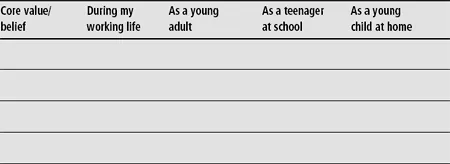
Also consider who influenced the shaping of your values: friends, teachers, brothers and sisters, parents and so on.
FEEDBACK
Your table is likely to show many ticks in the right-hand column: the values that define you today originated in your family and in your early childhood. Even as a teenager or young adult, your parents’ views and opinions had an impact on your thinking, either in the sense that you assimilated their values and beliefs or that you felt it necessary to distance yourself from them. Many values and beliefs may be implicit in what you do without you being fully aware of them – these, too, are likely to have been formed during your very early years and they still fundamentally shape you as a person.
Your own experience is likely to tell you that most of your beliefs and values originated in the family you grew up in. This stresses the importance of the experiences in early childhood and of the influence parents have on children’s lives. Research confirms that the home environment and parental involvement in learning activities have a substantial influence on a child’s attainment in the Early Years and beyond. Siraj-Blatchford et al. (2002) summarise that the involvement of parents in learning activities is closely linked to better cognitive attainment in the Early Years. In addition to supporting cognitive development, the quality of the learning environment in the home also has a strong influence on the social development of children (Daycare Trust, 2003). Desforges and Abouchaar (2003) whose research focussed on pupil achievement and attainment have found that parental involvement in children’s learning in the home has a significant effect on children’s achievements, in fact a greater effect than the quality of the schools. Apart from the correlation between higher parental involvement and higher attainment for the children, their research also highlights that parents get involved more when their children achieve more (see Figure 1.1 below).
Parents seem to be motivated by the success of their children and feel encouraged to continue and increase their involvement in their children’s learning and development. In addition to this motivational influence, parental participation has a positive effect on how teachers perceive a child: it increases the teacher’s expectations for the child (Einarsdottir and Gardarsdottir, 2009). This in turn encourages the child to do better and increases her academic achievements. The cycle in Figure 1.1 can therefore be extended to that in Figure 1.2.
This highlights how interrelated parent, child and Early Years practitioner are and how they influence each others’ behaviour. It leads to the conclusion that Early Years practitioners have to work closely with parents as this enhances their work with children and improves the outcomes for children. Siraj-Blatchford et al. (2002) expand further that where there is consensus and consistency between the learning at home and the curriculum at school, children achieve better outcomes. A joint approach from you and the parent will reinforce the learning in the one sphere with the same approach, expectations and strategies in the other, and children will not get different messages in their main care environments. How you can put partnership working with parents into practice will be explored further in Chapters 4–7.
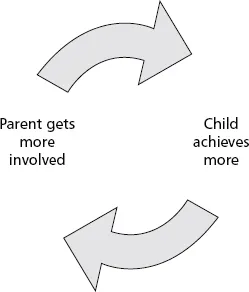
Figure 1.1 Motivational cycle with parent and child
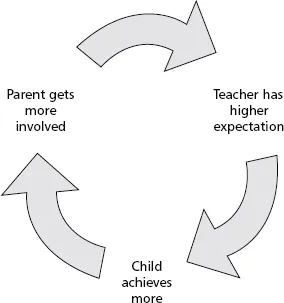
Figure 1.2 Motivational cycle with parent, teacher and child
What parents gain from getting involved
The research evidence in the previous section shows how vital the involvement of the parent is in a child’s learning and life. Most parents want to do the best for their children and are prepared to sacrifice their own interests, leisure time or convenience for this. Getting involved and being more active in their child’s life and in the community they live in has positive effects for the parents as well. In the two case studies below you can see how two parents became involved – Sharon in community activities for families with young children and Louise in learning activities for parents in her children’s nursery.
CASE STUDY
Sharon has been registered with Sure Start Cambridge since June 2004, after the birth of her second child. She wa...
Table of contents
- Cover Page
- Title
- Copyright
- Dedication
- Contents
- About the author and editors
- Acknowledgements
- Introduction
- 1 The role of the parent in a child’s life
- 2 Parents and what we think about them
- 3 The child–parent–practitioner triangle
- 4 Partnership working: involving parents in their children’s learning
- 5 Partnership working: involving parents in your setting
- 6 Partnership working: when parents are not in your setting
- 7 The learning partnership
- 8 When partnerships get difficult
- 9 Working with other professionals to support parents
- 10 Beyond the triangle
- Conclusion
- Appendix 1: answers to self-assessment questions
- Index
Trusted by 375,005 students
Access to over 1.5 million titles for a fair monthly price.
Study more efficiently using our study tools.
Frequently asked questions
Yes, you can cancel anytime from the Subscription tab in your account settings on the Perlego website. Your subscription will stay active until the end of your current billing period. Learn how to cancel your subscription
No, books cannot be downloaded as external files, such as PDFs, for use outside of Perlego. However, you can download books within the Perlego app for offline reading on mobile or tablet. Learn how to download books offline
Perlego offers two plans: Essential and Complete
- Essential is ideal for learners and professionals who enjoy exploring a wide range of subjects. Access the Essential Library with 800,000+ trusted titles and best-sellers across business, personal growth, and the humanities. Includes unlimited reading time and Standard Read Aloud voice.
- Complete: Perfect for advanced learners and researchers needing full, unrestricted access. Unlock 1.5M+ books across hundreds of subjects, including academic and specialized titles. The Complete Plan also includes advanced features like Premium Read Aloud and Research Assistant.
We are an online textbook subscription service, where you can get access to an entire online library for less than the price of a single book per month. With over 1.5 million books across 990+ topics, we’ve got you covered! Learn about our mission
Look out for the read-aloud symbol on your next book to see if you can listen to it. The read-aloud tool reads text aloud for you, highlighting the text as it is being read. You can pause it, speed it up and slow it down. Learn more about Read Aloud
Yes! You can use the Perlego app on both iOS and Android devices to read anytime, anywhere — even offline. Perfect for commutes or when you’re on the go.
Please note we cannot support devices running on iOS 13 and Android 7 or earlier. Learn more about using the app
Please note we cannot support devices running on iOS 13 and Android 7 or earlier. Learn more about using the app
Yes, you can access Working with Parents in the Early Years by Ute Ward,Author in PDF and/or ePUB format, as well as other popular books in Education & Early Childhood Education. We have over 1.5 million books available in our catalogue for you to explore.