A consideration of these binaries will define the concepts and situate students in the most current geographical arguments and debates. The text will be required reading for all modules on the philosophy of geography and on geographical theory.
eBook - ePub
Spaces of Geographical Thought
Deconstructing Human Geography′s Binaries
- 232 pages
- English
- ePUB (mobile friendly)
- Available on iOS & Android
eBook - ePub
Spaces of Geographical Thought
Deconstructing Human Geography′s Binaries
About this book
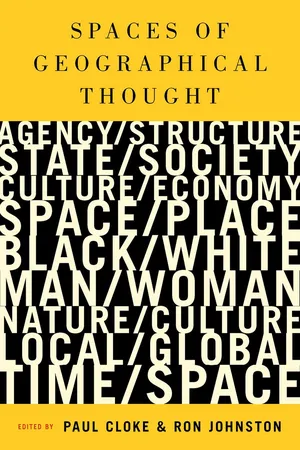
Spaces of Geographical Thought examines key ideas – like space and place - which inform the geographic imagination. The text: discusses the core conceptual vocabulary of human geography: agency: structure; state: society; culture: economy; space: place; black: white; man: woman; nature: culture; local: global; and time: space; explains the significance of these binaries in the constitution of geographic thought; and shows how many of these binaries have been interrogated and re-imagined in more recent geographical thinking.
Information
Publisher
SAGE Publications LtdYear
2005Print ISBN
9780761947325
9780761947318
Edition
1eBook ISBN
9781446224632
1 | Deconstructing Human Geography’s Binaries |
Paul Cloke and Ron Johnston |
Categorizing identity
To survive in the world we simplify it. This strategy is adopted by both individuals and collectives – although the distinction between the two is blurred because one cannot exist without the other, and so even the first sentence of this introductory chapter involves binary thinking! Our simplifications do not have to be binary, of course: binary divisions are a particular case of the wider activity of classification and categorization. But using too many categories denies the goal of simplification: psychologists argue that the average person can control her or his thinking along seven dimensions – hence the classic paper on ‘the magic number seven, plus or minus two’ (Miller 1956) – but most people, most of the time, use a coarser-grained structure to aid their thinking and decision-making.
Categorization – whether binary or not – is more than an aid to coping with complexity, however; it is also a means for creating our identities, again both individual and collective. Part of the determination of our essence – of our being in the world – involves defining ourselves: it is often assumed that ‘we are what we are because of who we are’, which involves us identifying with some type or category and, as a consequence, denying that we belong to other categories. This process of self-identification is continuous throughout our lives although it will be more intense at some times than others – when we are coming to terms with new contexts, for example, such as moving away from home for the first time, perhaps to university. As we encounter new stimuli and situations we have to place ourselves relative to them – to decide who we are; whom we identify with.
These processes of self-identification involve us joining groups and/or categories – not in the sense of applying to be a member and paying an entrance fee (although this may be the case). Many of the categories are vague and undetermined: we may identify with ‘the working class’ for example, a category that only exists as an abstraction – although social scientists have spent decades trying to define it precisely (and failing, because in the end it is just that – a vague abstraction – though one with a great meaning for many people). Others are presented to us by people who encourage us to join their categories, however: political parties, for example, claim to represent particular class fractions within society, and invite those who identify with a particular class to vote for them – if not to join them and work for their goals.
Almost all of the categories that we use are ‘social constructions’ – they are created, not given. A few – such as the distinction between human and non-human, or between animate and inanimate, or between land and water – may be considered natural in the sense of being pre-given, or existing outside any imposed categorization involving human thought, although even these pre-given distinctions have become the subject of considerable debate. The great majority of categories are not, however, pre-given; we live in worlds of human-created categories, which we modify when new situations arise that call for new responses.
Categorizations – into binaries or more complex structures – are not just ‘normal’ within society, therefore: they are necessary for it. Without such simplifications, societies could not exist: they could not operate without placing people and things into categories. (Think of who qualifies for free school meals, or a subsidized university education!) As such, the study of categories and of binary thinking is central to any intellectual activity, across all disciplines: we need to know about the categories being deployed in order to appreciate the society we are studying, and we need to deploy our own categories in order to undertake that study.
Geographical binaries
For geographers, this process of categorization (binary or otherwise) is of particular interest because basic themes within our particular subject matter – environment, space and place – are frequently used in creating collective and personal identities. Many of us identify with places (some very intensely), at a variety of scales – from our home, through our street and neighbourhood, town and region, up to a nation-state. In part, we are who we are because of what places we choose to associate with (which in most cases are places we have lived, worked or played in, even if we no longer do so). And we may express that identity in a variety of ways – as with supporting sports teams linked to those places, or political parties which represent their residents. Binary positions are then often taken up – us versus them, or ‘we here’ against ‘them there’.
Although much of this place-identification is informal, one aspect of it is not only very formal but is also to a large extent imposed upon us – and is inherently geographical. The great majority of people in the world are citizens of one of its nation-states. (Some are citizens of more than one, but they form a very small minority of the total.) To a large extent this is an aspect of our identity over which we have little control: most of us are citizens of a state because either we were born within its territory or, wherever we were born, our parents are citizens of that state and associate us with it as well. We can apply to move to another state and become one of its citizens – but that is a privilege that may be denied to us, and not a right.
This association with a state is not only central to most people’s identities, it is also geographical. One of the defining characteristics of a state in the modern world-system is that it is associated with a defined – and in almost all cases demarcated – piece of territory (possession of which may be disputed by other states). As social science theorists have argued, a system of states is necessary to the successful management of contemporary modes of production (including global capitalism): without them, collective action would be impossible and anarchy would prevail. Furthermore, in order to be effective, states must have a monopoly of certain types of power: in effect, they must be able to control their citizenry in order to operate, though it is rare for such control to be effected by a state apparatus for very long without some element of popular consent. For this reason, part of the operation of the state apparatus involves encouraging people to identify positively with their state – to feel part of it, to participate in its activities and to give it a central place in their processes of self-definition.
Membership of a state is therefore part of our identity; states are necessarily territorially defined, and processes of creating one’s self involve identifying with our state’s territory. Part of our very nature in contemporary society thus involves geography – in particular the ever-changing geography of territorial containers within which the management of that society is undertaken. By identifying with ‘our’ state, we are not only accepting the power of its state apparatus over our lives but also accepting – and indicating – that we do not identify with any other state. Geographically binary thinking, therefore, underpins a core feature of our human nature.
But that binary thinking – of ‘us’ versus ‘them’ – is rarely symmetrical: usually it involves ‘us’ considering we are superior to ‘them’, and in many cases and situations being encouraged (by the state apparatus, for example) to take such a view. Difference thus becomes more than something to be exalted: it is a potential basis for conflict – as world history has demonstrated to us so many times. Much geopolitical thinking involves promoting positive images of ‘us’ and negative ones of ‘them’: think of the theory of the ‘white man’s burden’ which underpinned much European colonization of the rest of the world, or Reagan’s portrayal of the Soviet Union as the ‘evil empire’, or the beliefs that underpin territorial conflicts in Palestine–Israel and many other parts of the contemporary world. Identity and difference, built on geographical foundations, thus become the bases for power relationships, foment inter-group tension and, potentially, conflict.
‘Them’ and ‘us’ is, of course, an over-simplification, and our views of the world are usually more nuanced: we recognize more than two categories and behave towards each accordingly. This sometimes involves allowing for ‘special cases’ – as in statements such as ‘some of my best friends are x’ which allow people to avoid being in difficult circumstances when negative images of x are being broadcast. But when simplicity is called for, and decisions have to be made, too often we slip into binary mode: all the world is either with us or against us!
Binary geographies
Just as geography forms the foundation of our identity, so our association with the discipline of geography adds to our processes of self-identification. One of the key areas in which categorization is necessary in dealing with the complexity of the world is in its study. Knowledge and its means of acquisition are divided up into another set of containers – academic disciplines. These are clearly not ‘pre-givens’: they are socially created divisions which we find necessary and useful. Some might seem almost pre-given because of their subject matter, such as mathematics – what we might term forms of knowledge; most are not, however – they form fields of knowledge which are the equivalent of tribal territories, covering areas of study that for some reason (usually lost in the past) have seemed sensible to put together into a separate discipline.
Those who identify with a discipline – either temporarily (as a student) or permanently (by becoming a professional and making one’s career in the discipline) – then often engage in binary thinking. This may not involve ‘them’ and ‘us’ representations – though often it does: people have ‘hierarchies’ of disciplines in terms of their assumed status, and these are often used in power-broking. Certainly among the professionals, their tribal territory has to be defended (which to a considerable extent means that their jobs have to be!). They want resources for their university departments, students to choose to take their courses, scholars from other disciplines not to ‘invade’ their intellectual niches, and so on. In academic life, just as everywhere else, we simplify by creating categories – and then people identifying with those categories come into conflict.
That happens within disciplines, too. Geography is the umbrella term usually deployed for the discipline we (the authors) work in and which you (the readers) study. But geography itself has its subdivisions – many of them binary: physical and human, for example; or qualitative and quantitative; or economic and cultural; or … And people in those subdivisions compete too – for status and resources within the discipline, for adherents. Part of their case for support involves portraying the value of their work which, in a zero-sum game of finite resources, means that implicitly (if not explicitly – and very often it is, as any study of changes within geography over the past 60 years will show) what ‘they’ do has to be portrayed as inferior to what ‘we’ are engaged in. And yet, as we all really know, such categorizations – whether binary or slightly more nuanced – are really over-simplifications, and if the categories were brought together the cross-fertilization would bring massive benefits.
What we have identified is very much a paradox, therefore: thinking in categories – of which binary thinking is the most extreme case – is necessary to simplify the world in order to begin understanding it. But using those categories can then not only impede that search for understanding – by acting as blinkers – it can also lead to unproductive tensions between those who adhere to one of the positions and are thus opposed to the other(s). Sadly, the working out of this paradox is rarely either easy or conflict-free: too often once territories are demarcated then people associated with them feel the need to defend them – if not attack others. Breaking down binaries is continually necessary, therefore, and this book is intended as a contribution to that continuing process.
A Binary world?
The history of human geography has been waymarked both by binary thinking and by exhortations to bridge between the philosophical and material polarities emerging from such thinking. Resultant landscapes of understanding have thereby exhibited a curiously double-edged character. Analysis and interpretation of human geographical phenomena have tended to fall easily into categories of seemingly distinctive opposition – urban/rural, economic/cultural, spatial/social, quantitative/qualitative and the like – and the professional paraphernalia of human geography, such as journals, books, courses and research specialisms and reputations, have served to render these categories more concrete. Yet alongside these categorical processes and practices there has been a naggingly consistent desire by some geographers at least to argue against the domination of polarized categories and to sponsor explorations of middle ground between them: to deconstruct the binaries and create new hybrid syntheses containing the best elements of both.
Nowhere is this double edge more clearly demonstrated than in the over-arching relationship between human and physical geography, within the context of which most human geographers ply their trade. Through the second half of the twentieth century, and now beyond, the ‘human’ and ‘physical’ sections of geography have been increasingly wedged apart by the forces of differential philosophy, methodology and mindset – to a considerable extent reflecting very different (and sensible) conceptions of the nature of science. As scientific practices and reputations grow ever more specialized technically, and as the human and physical ‘sides’ of geography reach out in very different interdisciplinary directions thus exacerbating a social science/arts–science divide, so the forces of binary categorization have tended to desert the potential middle ground in favour of the excitement of exploration at the binary edges.
It is worth noting here that these tendencies are by no means recent. For as long as it has been argued that geography’s distinctive role is in bridging the gap between physical and human phenomena, the dangers of binary tendencies have been warned against. Thus, Wooldridge and East writing in the United Kingdom in 1951 argued:
There is a degree of a false dichotomy here – a division of the subject into ‘physical geography’ and ‘human geography’. Such cleavage is the very thing geography exists to bridge, and it is false to its central aim wherever, and for whatever reasons it recognises two ‘sides’ in the subject. (p. 28)
This position was not replicated on the other side of the Atlantic, however, where it was argued that although the physical landscape was an important constraint to and opportunity for human action, appreciation of the formation of that landscape and the nature of its contemporary physical processes – how rivers erode their banks, for example – was not necessary in order to understand how people responded to their environments in the creation of ‘humanized landscapes’: in other words, it is not necessary to know how a stage is built in order to act on it (see James and Jones 1954). It is interesting to note, for example, that a special issue of the Annals to celebrate the Association of American Geographers’ 75th anniversary – published in 1979 – contained no papers on physical geography, a fact responded to by the then President of the AAG, who was a physical geographer (Marcus 1979).
Indeed, this lack of interest in how the stage was built extended to some human geographers in North America at that time. Hartshorne’s (1939) classic portrayal of The Nature of Geography – based very largely on German writings – not only took the position on physical geography just outlined but also argued that the study of historical geography was unnecessary except insofar as it threw light on the present. In this, he was very much at odds with geographers of the ‘Berkeley School’, led by Carl Sauer, whose own classic The Morphology of Landscape (Sauer 1925) took a very different view – one shared by historical geographers in the UK. Hartshorne was at least partly converted by some of his colleagues in the 1950s, and his later Perspective on the Nature of Geography (Hartshorne 1959) reflected this change of stance.
This brief excursion into the history of geography as an academic discipline during the twentieth century illustrates one of our earlier contentions – most binaries are human constructions and are not naturally ‘pre-given’. Indeed, it goes further, because it shows that binary const...
Table of contents
- Cover Page
- Title
- Copyright
- Contents
- Notes on contributors
- 1 Deconstructing human geography’s binaries
- 2 Agency:Structure
- 3 State:Society
- 4 Culture:Economy
- 5 Space:Place
- 6 Black:White
- 7 Man:Woman
- 8 Nature:Culture
- 9 Local:Global
- 10 Time:Space
- Index
Trusted by 375,005 students
Access to over 1.5 million titles for a fair monthly price.
Study more efficiently using our study tools.
Frequently asked questions
Yes, you can cancel anytime from the Subscription tab in your account settings on the Perlego website. Your subscription will stay active until the end of your current billing period. Learn how to cancel your subscription
No, books cannot be downloaded as external files, such as PDFs, for use outside of Perlego. However, you can download books within the Perlego app for offline reading on mobile or tablet. Learn how to download books offline
Perlego offers two plans: Essential and Complete
- Essential is ideal for learners and professionals who enjoy exploring a wide range of subjects. Access the Essential Library with 800,000+ trusted titles and best-sellers across business, personal growth, and the humanities. Includes unlimited reading time and Standard Read Aloud voice.
- Complete: Perfect for advanced learners and researchers needing full, unrestricted access. Unlock 1.5M+ books across hundreds of subjects, including academic and specialized titles. The Complete Plan also includes advanced features like Premium Read Aloud and Research Assistant.
We are an online textbook subscription service, where you can get access to an entire online library for less than the price of a single book per month. With over 1.5 million books across 990+ topics, we’ve got you covered! Learn about our mission
Look out for the read-aloud symbol on your next book to see if you can listen to it. The read-aloud tool reads text aloud for you, highlighting the text as it is being read. You can pause it, speed it up and slow it down. Learn more about Read Aloud
Yes! You can use the Perlego app on both iOS and Android devices to read anytime, anywhere — even offline. Perfect for commutes or when you’re on the go.
Please note we cannot support devices running on iOS 13 and Android 7 or earlier. Learn more about using the app
Please note we cannot support devices running on iOS 13 and Android 7 or earlier. Learn more about using the app
Yes, you can access Spaces of Geographical Thought by Paul Cloke, Ron Johnston, Paul Cloke,Ron Johnston in PDF and/or ePUB format, as well as other popular books in Physical Sciences & Geography. We have over 1.5 million books available in our catalogue for you to explore.