Thoroughly updated, with new chapters on: relating difficulty; "small media" technology and relationships, and practical applications, the Fourth Edition offers a fully up-to-date and authoritative review of the field.
- 312 pages
- English
- ePUB (mobile friendly)
- Available on iOS & Android
eBook - ePub
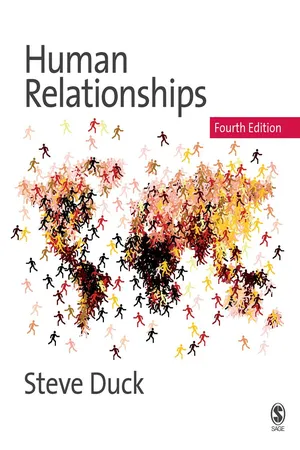
Human Relationships
About this book
The Fourth Edition of this highly successful textbook provides a unique and comprehensive introduction to the study and understanding of human relationships. Fresh insights from family studies, developmental psychology, occupational and organizational psychology also combine to bring new perspectives to this thorough survey of the field.
Information
Publisher
SAGE Publications LtdYear
2007Print ISBN
9781412929998
9781412929981
Edition
4eBook ISBN
9781446229910
1
Meaning and Relationships in a Biological and Cultural Context
Focus points for note taking when reading this chapter:
- How far is our relating determined by biology and how far is it created by our culture?
- How does culture interact with biology in our relationship activity?
- Everyday conduct is partly verbal and partly nonverbal: consider carefully the role of language and nonverbal body language in your relationships with other people.
- How does NVC [Nonverbal communication] ‘work’ such things as power, gender and identity into a relationship?
- How do NVC and language convey our sense of ourselves, our attitudes towards others and our sense of ease (or not) in a relational situation?
- How does our communication send both relational and content messages?
When those of us from a Western culture first think about human relationships we tend to assume that they are results of the emotions that two people have for one another. You like someone, so you become friends; you love someone, so you become romantically attached, or, stated differently, we are friends with someone because we like them; we get romantic because we love someone. These assumptions don’t place much emphasis on biology or culture, though we live our lives both as biologically animal and as culturally situated individuals. Our emotions might therefore have a biological basis, even if they are expressed in a culturally understandable way. Floyd (2004) for example, points out that many communication processes and outcomes have physiological markers, and that heart rate changes when we experience not only anger, but sexual arousal and love; that parts of the endocrine system regulate hormone production that can be tied to family conflict or marital depression; and that galvanic skin responses and pupillometry have been used to assess liking, preference, and aversion to both things and people. At a contrasting level of analysis, Manusov & Milstein (2005) recently analysed the vast media frame through which the historically important 1993 handshake on the White House lawn between Yassir Arafat and Yitzhak Rabin was interpreted. The handshake was seen as ‘sending a signal’ to various political groups about the reception that their views would receive from the powerful figures who played a major part in the interaction.
This simple pairing of examples brings up the fact that the analysis of relationships is available at many different levels, from the microbiological analysis of chemical changes wrought by sexual desire or depression and individual endocrine performance effects on a pair’s marital interaction to the oppressive cultural machinery that has historically directed women to a place of relational inferiority, treating them as the property of fathers and husbands for centuries, for example. Yet even now we do not think it odd that parents have the sort of relational power that allows them to take their children to a vacation spot of the parents’ choosing without the children being consulted, that children may be denied their choice of playmates by disapproving parents, and that some marriage ceremonies still ask ‘Who giveth this woman to be married to this man?’ The media may debate the ‘rightness’ of same-sex marriages and we may feel horror when a paedophile is convicted at the same time as we share with our friends mildly amused joking references to Michael Jackson who was acquitted of such charges. So even if relationships are based on biology it is clear that immediate individual psychological and social communicative processes combine with distant societal and sociological forces to influence our ways of looking at them in a living society where people do not satisfy themselves merely by passing around self-rating questionnaires or the contents of their catheters but actually talk to one another in a social context.
CONTEXTS FOR ANALYSING RELATIONSHIPS
The mystery that a book about human relationships must confront therefore is that there is simultaneously far too much to be said and far too little known about the nature of relationships, far too much that is commonsense and far too little that is understood about the reasons why relationship processes are either common or sense, and far too much that is personally important about the everyday practical consequences of understanding relationships for it to be left only to science, even if that could be restricted to one sort of science (from the physiological to the sociological).
In brief, then, both of these above levels, the physical/physiological and the media frames in a culture, affect human relationships and the ways in which behaviour in them is created and then understood. Accordingly, we must not allow our first thoughts about human relationships to overlook either the biological or the many contexts that create and modify expression and interpretation of personal preferences. Even if desire has a physical basis, real life practical constraints limit our ability to act on our emotions and ‘Why can’t we do it in the road’ even with our spouse. Culture constrains expression of biologically-based desire. This book explores research on relationships with an emphatically contextual lens and teaches that even individual liking is not just individualistic and desire is only infrequently the simple origin of actual relational behaviour. Biology and culture, personal meaning systems created in early childhood, communication, ‘audiences’ for the performance of our relational behaviour, and nonverbal communication which goes beyond – and modifies the meaning of – the felt emotion and the spoken word modify relationships. Other contexts (the papers or TV, for instance) both facilitate and limit this apparently most private of areas – personal relationships. Human relationships are not simply created by liking or attitudes about another person. They are based on many other features which a rich field of research has uncovered in the last 25 years.
Biology: the animal background
Since human beings tend not to think of themselves primarily as animals, we assume that when it comes to mating, there may be more at work than simple individual biochemistry. All the same we understand that in the animal world there are dark forces at work which limit the opportunities for mating success. Darwin (1859) observed that most organisms reproduce very rapidly, and that even slowly reproducing animals such as elephants could cover the globe in a few centuries if there were not other factors that limited their reproductive success. One of the things which influences success is competition within a species (the stags with the strongest muscles mate more frequently than other stags). Another factor is the availability of the resources that the animal needs to survive, such as their specific foods and habitats. A third element that limits reproductive success results from competition for the same resources: for example, if elephants and goldfish both need water, the fact that elephants can drain the pond makes life difficult for the goldfish.
As we look around at the people on our bus, can we see such relational principles essentially still at work, even if they have been modified by thousands of years of social civilization? Yes, say Kenrick & Trost (2000) who point to a sociobiological basis for human mate selection. In competition with other members of the species, those human beings who possess particularly attractive characteristics will be at an advantage in the selection of reproductive mates. Likewise, those people who command more resources than others (the strong versus the weak or the wealthy versus the poor) will be at a reproductive advantage. Finally, those humans who are able to brush aside the competing attractions of competitors for attention will be more likely to secure the attachment of their beloved. A large amount of research has been accumulated to demonstrate that human beings are subject to their biological impulses in ways that many people fail to recognize or take into account sufficiently. For example, dominance hierarchies evident in human relationships where some people are on top and some occupy a lower position, can be related to animal dominance hierarchies, and are based on reproductive characteristics such as strength and testosterone. Buss & Dedden (1990) suggested from an evolutionary perspective that even the way in which humans comment negatively about other individuals reflects evolutionary concerns. They found a tendency for women to derogate other women in terms of their looseness, implying that men would not be able to know whether any resultant offspring was theirs (i.e. the suggestion is that the competitors are genetically unreliable because they sleep around); the corresponding tendency for men is a derogation of the reproductive abilities of competitors, such that women could not rely on rewarding reproductive activity (i.e. the suggestion is that competitors have limited apparatus and relevant skills). Similar sociobiological and evolutionary claims have been made to explain tendencies towards rape, jealousy and spouse abuse (‘mate retention’ as they call it) which Shackelford, Goetz, Buss, Euler & Hoier (2005: 447) describe as ‘designed to solve several adaptive problems such as deterring a partner’s infidelity and preventing defection from the mating relationship’. In short, the emphasis on biological explanations for human relational behaviour has a substantial basis.
Culture: the large overlay
Although one cannot deny the relevance of such work, you might feel that in an evolved social world, the biological impulses are not crudely animalistic but are shaped by membership of organized and ‘civilized’ society. Thus, although our biological bases cannot be denied neither should they be allowed to obscure the ways in which our distinction from the apes has brought us TV, the police, and the rituals of Valentine’s Day. Atop an undoubted biological base is constructed a superstructure of social conventions that also has to be given due weight in any full analysis of human relationships.
On a personal note, the first lectures I ever attended as an undergraduate were from Niko Tinbergen, who won a Nobel Prize for his work on animal ethology, and I won a Distinction in an exam on animal behaviour at Oxford. My general drift has since been towards the social and away from the biological, and this book will reflect that. I do not deny that biological factors play out in relationships, but I choose to focus on the socially developed forms of influence, and in particular I attend most specifically to the social psychological and communicative aspects of human behaviour that make relationships more than the pheromones or biological resources from which they undoubtedly draw.
For me it is less important that human relationships are sourced from biological urges than that the presentation of such urges takes a socially modified form. The Chinese, Arabs and Canadians manifest desire differently, although they share animal biology with one another. What, I therefore ask, makes human relationships specific to a culture and how can we explain the fact that humans driven by the same stirrings in their loins and the same micro chemicals surging through their veins, nevertheless manifest a staggering range of marriage ceremonies? Even between such similar cultures as the USA and UK the styles of relating are noticeably different in certain respects, such as the degree of initial ‘openness’ in conversations with strangers.
Daily practices and everyday experience
Start by looking at things we tend not to notice: the cycles of daily life, that differ between cultures (which organize themselves around different sorts of time frames, different religious festivals, even different arrangements for ‘the week’ some starting it on Sunday some on Saturday). Begin by thinking about the humdrum activities in our own culture and the structures of social experience that bring people together whether they like one another or not (Wood & Duck, 2006) and also ask whether your relational behaviour might be influenced by subtleties of the calendar. Okay, not subtleties – we all get bombarded with information about birthdays, and the necessity of acknowledging anniversaries – but what about things like day of the week? Are Wednesdays good for relationships? Alberts, Yoshimura, Rabby & Loschiavo (2005) say no. In a study of daily reports of individuals’ relational activities, it became clear that Wednesdays are actually bad for relationships, confirming Duck, Rutt, Hurst & Strejc (1991) who showed a tendency for greater conflict on Wednesdays. Perlman & Serbin (1984) likewise showed that days of the week are not relationally neutral, and that people experience greater loneliness on the weekend than they do on other days, even if the number of interactions that they have are actually the same on all of these days. People expect more ‘action’ on weekends, and are more disappointed when it doesn’t happen then than they are on other days of the week.
Let’s assume that relationships are not experienced as the same all the time, on all days, at any point in the calendar. This might not seem like a particularly important observation at this moment, because it feels like common sense, but when you read further into the book and find that researchers are reporting about relationships as if the calendar did not exist, then we may want to return to this observation. We all knew already that relationships are variable, and that even when we are reading research that acts as if a relationship is the same through all time, we know that our own relationships are not like this. When we read research, however convincing the statistics, we need to connect it with our everyday experience, and ask whether it fits. When it does not, then either we are learning something exciting, or the researchers got it wrong.
Uncertainty and practicality
So far we have three such contexts: biology, culture, and everyday life variation. A fourth is uncertainty: we may be very confident that a date will go well before it happens, but afterwards, we might end up sobbing on the bed. Things don’t always work out as we hoped. This is something to bear in mind when we discuss research based on questionnaires which assess only people’s guesses about hypothetical scenarios. In every imaginary scenario things always go well, there are no problems, just roses, bluebirds and sunsets, and nobody changes their mind. Surprisingly, researchers very often base sweeping conclusions on such imaginary reports (Dragon & Duck, 2005), and although there will be many examples pointed out to you during the course of this book, you should keep an eye out for it when reading research for yourself.
LISTEN TO YOUR OWN CONVERSATIONS
Pick two days and a couple of hours randomly selected in the future (next Thursday 10.00 am–1.00 pm and Friday 6.00 pm–9.00 pm, for example) and then when those times come, keep an informal record of the people you happen to be talking with and the subjects of conversation and also the ways you felt about it. Identify similarities and differences between the different times. Are there any major patterns? Do you talk with particular people about particular sorts of things? Is it harder or easier to list the topics covered with friends than with strangers? Does time of day appear to make any difference or no difference to the topics and styles of conversations?
Some relationships are composed by circumstances over which partners have little emotional control. The workplace, the living place, and the social environment are all made out of passages, offices, rooms, buildings that are close to buildings, rooms, offices, and passages where other people live and work. These environmental contexts shape our relationships, influence the kinds of people we meet, and constrain or facilitate relationships: we are likely to know people we meet a lot, yet even those we love deeply may never be real partners if we live in different countries. The fact is that relationships are conducted at a distance as a feature of modern life (Sahlstein, 2004) and email, instant messaging, and mobile phones have all affected, for large parts of our population anyway, the ways in which relationships are conducted and conceptualized (see Chapter 6). Such movements in society are part of what we need to explore in understanding human relationships: changes in the way that relationships get done are important, because changes in the way we do things can result in changes in the way we experience things (Duck, in press SAGE CA, see refs).
Society also contains blueprints that shape our thoughts about relationships and how to do them. For example, we all know what a ‘mother’ or a ‘friend’ is, but we would not understand relationships of obligation that are familiar in Japan such as amae where each partner identifies with the self-interest of the partner and sees a direct connection between outcomes for other and self. Also we probably wouldn’t assume that a relationship like ‘wife of a brother’ could be more important in some culture...
Table of contents
- Cover Page
- Title Page
- Copyright Page
- Contents
- Preface
- Acknowledgements
- Publisher’s Acknowledgements
- 1 Meaning and Relationships in a Biological and Cultural Context
- 2 Attachment and Emotion
- 3 Daily Life: The Everyday Conduct and Management of Relationships
- 4 Relationships within other Relationships: Social Networks and Families
- 5 Influencing Strangers, Acquaintances and Friends
- 6 Technology and the Boundaries of Relationships: it’s all Geek to me
- 7 The Management of Relationship Difficulty
- 8 Some Applications of Relationship Research
- References
- Author Index
- Subject Index
Trusted by 375,005 students
Access to over 1.5 million titles for a fair monthly price.
Study more efficiently using our study tools.
Frequently asked questions
Yes, you can cancel anytime from the Subscription tab in your account settings on the Perlego website. Your subscription will stay active until the end of your current billing period. Learn how to cancel your subscription
No, books cannot be downloaded as external files, such as PDFs, for use outside of Perlego. However, you can download books within the Perlego app for offline reading on mobile or tablet. Learn how to download books offline
Perlego offers two plans: Essential and Complete
- Essential is ideal for learners and professionals who enjoy exploring a wide range of subjects. Access the Essential Library with 800,000+ trusted titles and best-sellers across business, personal growth, and the humanities. Includes unlimited reading time and Standard Read Aloud voice.
- Complete: Perfect for advanced learners and researchers needing full, unrestricted access. Unlock 1.5M+ books across hundreds of subjects, including academic and specialized titles. The Complete Plan also includes advanced features like Premium Read Aloud and Research Assistant.
We are an online textbook subscription service, where you can get access to an entire online library for less than the price of a single book per month. With over 1.5 million books across 990+ topics, we’ve got you covered! Learn about our mission
Look out for the read-aloud symbol on your next book to see if you can listen to it. The read-aloud tool reads text aloud for you, highlighting the text as it is being read. You can pause it, speed it up and slow it down. Learn more about Read Aloud
Yes! You can use the Perlego app on both iOS and Android devices to read anytime, anywhere — even offline. Perfect for commutes or when you’re on the go.
Please note we cannot support devices running on iOS 13 and Android 7 or earlier. Learn more about using the app
Please note we cannot support devices running on iOS 13 and Android 7 or earlier. Learn more about using the app
Yes, you can access Human Relationships by Steve Duck in PDF and/or ePUB format, as well as other popular books in Psychology & Social Psychology. We have over 1.5 million books available in our catalogue for you to explore.