- 200 pages
- English
- ePUB (mobile friendly)
- Available on iOS & Android
eBook - ePub
Art Therapy
About this book
This bestselling introduction to art therapy brings theory to life through case material and examples of real artwork produced during therapy sessions. Practising art therapist Dave Edwards explains key theoretical ideas - such as symbolism, play, transference and interpretation - and shows how these relate to practice.
As well as providing useful information on training, employment and the role of the HPC, the book offers extra practical guidance on:
- assessing clients
- establishing and maintaining boundaries
- ending therapy
-Â private practice. Â
Now even more practical and accessible, this fully updated Second Edition includes a glossary, chapter summaries and other learning features. Case studies from a variety of settings shillustrate the application of art therapy in real-life scenarios. Â
This book offers an excellent foundation on which to build future knowledge and skills and should be on the shelf of every art therapy trainee and new practitioner.
David Edwards is an experienced HCPC registered art therapist who lives and works in Sheffield, UK.
Â
Frequently asked questions
Yes, you can cancel anytime from the Subscription tab in your account settings on the Perlego website. Your subscription will stay active until the end of your current billing period. Learn how to cancel your subscription.
No, books cannot be downloaded as external files, such as PDFs, for use outside of Perlego. However, you can download books within the Perlego app for offline reading on mobile or tablet. Learn more here.
Perlego offers two plans: Essential and Complete
- Essential is ideal for learners and professionals who enjoy exploring a wide range of subjects. Access the Essential Library with 800,000+ trusted titles and best-sellers across business, personal growth, and the humanities. Includes unlimited reading time and Standard Read Aloud voice.
- Complete: Perfect for advanced learners and researchers needing full, unrestricted access. Unlock 1.4M+ books across hundreds of subjects, including academic and specialized titles. The Complete Plan also includes advanced features like Premium Read Aloud and Research Assistant.
We are an online textbook subscription service, where you can get access to an entire online library for less than the price of a single book per month. With over 1 million books across 1000+ topics, weâve got you covered! Learn more here.
Look out for the read-aloud symbol on your next book to see if you can listen to it. The read-aloud tool reads text aloud for you, highlighting the text as it is being read. You can pause it, speed it up and slow it down. Learn more here.
Yes! You can use the Perlego app on both iOS or Android devices to read anytime, anywhere â even offline. Perfect for commutes or when youâre on the go.
Please note we cannot support devices running on iOS 13 and Android 7 or earlier. Learn more about using the app.
Yes, you can access Art Therapy by David Edwards,Author in PDF and/or ePUB format, as well as other popular books in Psychology & Psychotherapy Counselling. We have over one million books available in our catalogue for you to explore.
Information
1
What is art therapy?
Chapter summary
This chapter defines what art therapy is and discusses the value and importance of working therapeutically with images. Case material is presented by way of illustration.
What is art therapy?
Numerous and often conflicting definitions of art therapy â or art psychotherapy â have been advanced since the term, and later the profession, first emerged in the late 1940s. In the UK, the artist Adrian Hill is generally acknowledged to have been the first person to use the term âart therapyâ to describe the therapeutic application of image making.
For Hill, who had discovered the therapeutic benefits of drawing and painting while recovering from tuberculosis, the value of art therapy lay in âcompletely engrossing the mind (as well as the fingers) ⌠[and in] releasing the creative energy of the frequently inhibited patientâ (Hill, 1948: 101â02). This, Hill suggested, enabled the patient to âbuild up a strong defence against his misfortunesâ (1948: 103).
At around the same time, Margaret Naumberg also began to use the term art therapy to describe her work in the USA. Naumbergâs model of art therapy based its methods on
Releasing the unconscious by means of spontaneous art expression; it has its roots in the transference relation between patient and therapist and on the encouragement of free association. It is closely allied to psychoanalytic theory ⌠Treatment depends on the development of the transference relation and on a continuous effort to obtain the patientâs own interpretation of his symbolic designs ⌠The images produced are a form of communication between patient and therapist; they constitute symbolic speech. (Naumberg in Ulman, 2001: 17, bold added)
Although the approaches to art therapy adopted by Hill and Naumberg were very different, and have been superseded by subsequent developments within the profession, their pioneering work has nevertheless exercised a significant and enduring influence. This is because art therapy in the UK has developed along âtwo parallel strandsâ (Waller, 1993: 8): art as therapy, as advocated by Hill, and the use of art in therapy, as championed by Naumberg. The first of these approaches emphasises the healing potential inherent in the process of making art, whereas the second stresses the importance of the therapeutic relationship established between the art therapist, the client and the artwork.
The triangular relationship
The importance accorded to these respective positions is central to the whole question of where healing or therapeutic change in art therapy takes place. That is to say, whether this is due primarily to the creative process itself, to the nature of the relationship established between client and therapist or, as many UK art therapists would now argue, to a combination of these factors.
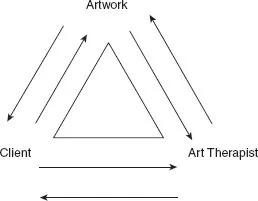
In art therapy this dynamic is often referred to as the triangular relationship (Case, 1990; Schaverien, 1990, 2000; Wood, 1990) (see Figure 1.1).

Figure 1.1
Within this triangular relationship greater or lesser emphasis may be placed on each axis (between, for example, the client and their artwork or between the client and the art therapist) during a single session or over time.
Towards a definition of art therapy
As the profession of art therapy has established itself, definitions have become more settled. From a contemporary perspective, art therapy may be defined as a form of therapy in which creating images and objects plays a central role in the psychotherapeutic relationship established between the art therapist and client.
The British Association of Art Therapists (BAAT), for example, currently defines art therapy as follows:
Art Therapy is a form of psychotherapy that uses art media as its primary mode of communication.
Clients who are referred to an art therapist need not have previous experience or skill in art, the art therapist is not primarily concerned with making an aesthetic or diagnostic assessment of the clientâs image.
The overall aim of its practitioners is to enable a client to effect change and growth on a personal level through the use of art materials in a safe and facilitating environment.1
Other national professional associations provide similar, but also subtly different, definitions. The American Art Therapy Association (AATA), for instance, defines art therapy as follows:
Art therapy is the therapeutic use of art making, within a professional relationship, by people who experience illness, trauma or challenges in living, and by people who seek personal development. Through creating art and reflecting on the art products and processes, people can increase awareness of self and others cope with symptoms, stress and traumatic experiences; enhance cognitive abilities; and enjoy the life-affirming pleasures of making art.2
In a similar vein, the Canadian Art Therapy Association (CATA) defines art therapy in the following terms:
Art Therapy ⌠Uses the creative process of art-making and client-reflection to improve and enhance mental, physical and emotional well-being of individuals.3
While these collective, officially sanctioned definitions help clarify what art therapy is, as the following examples illustrate, individual art therapists often have their own.
Art Therapy is quite hard to describe succinctly. For some it is about the art itself as the main agent of therapeutic experience. For others it is the relationship with the therapist that is considered the crucial element. I like to think both have a place and neither is better or more important than the other. I think it depends on the client, and how they work. (MA)
Art making may or may not happen in art therapy with me. Sometimes clients use art making as a way to manage the awkwardness of the encounter, and they are quite able to talk about things as they work. Sometimes it is more actively defensive, and in fact helps keep things stuck. Sometimes it is truly creative and full of lively meaning and symbolism. However, images can come from ideas talked about, as well as actually on paper. It is possible to explore and âplayâ with images that arise in this way. (AM)
Art therapy as a form of psychotherapy that uses image making to explore and alleviate thought processes and conflicts causing emotional distress. (DE)
The essence of art therapy lies in the relationship it is possible to establish between art and therapy. That this relationship between the two disciplines might contain the potential for conflict, as well as healing, has resulted in its being described as an âuneasy partnershipâ (Champernowne, 1971). As M. Edwards comments:
It seems that sometimes one or other partner gives up the struggle so that we have art without much therapy or therapy without much art. In either case the specific advantage of the relationship between these two disciplines is lost. (Edwards, 1981: 18)
It is important to note here that in art therapy this relationship is very specifically focused on the visual arts (primarily painting, drawing and sculpting) and does not usually include the use of other art forms such as music, drama or dance. While there may be some overlap between these different disciplines (see Hamer, 1993; Jennings and Minde, 1995; Levens, l994) in the UK the therapeutic application of these arts is undertaken by therapists who, like art therapists, have received a specialised training (Darnley-Smith and Patey, 2003; Langley, 2006; Meekums, 2002; Wilkins, 1999). This is not the situation elsewhere in Europe. In the Netherlands, for example, âthese professions are known as creative therapy and are much more closely linked in terms of training and professional developmentâ (Waller, 1998: 47â8).
The aims of art therapy
In practice, art therapy involves both the process and products of image making (from crude scribbling through to more sophisticated forms of symbolic expression) and the provision of a therapeutic relationship. It is within the supportive environment fostered by the therapist-client relationship that it becomes possible for individuals to create images and objects with the explicit aim of exploring and sharing the meaning these may have for them; and it is by these means that the client may gain a better understanding of themselves and the nature of their difficulties or distress. This, in turn, may lead to positive and enduring change in the clientâs sense of self, their current relationships and in the overall quality of their lives. As Storr (1972: 203) observes, creativity offers a means of âcoming to terms with, or finding symbolic solutions for, the internal tensions and dissociations from which all human beings suffer in varying degreeâ.
How can art therapy help?
The aims of art therapy vary according to the particular needs of ...
Table of contents
- Cover Page
- Halftitle
- Creative Therapies in Practice
- Title
- Copyright
- Dedication
- Contents
- About the Author
- Preface to the second edition
- 1Â Â Â What is art therapy?
- 2Â Â Â The historical background to art therapy
- 3Â Â Â The emergence of art therapy as a profession in the UK
- 4Â Â Â Frames of reference â psychoanalysis, art and art therapy
- 5Â Â Â Art therapy in practice
- 6Â Â Â Training â from apprentice to practitioner
- 7Â Â Â Professional issues
- Glossary of terms
- References
- Index