eBook - ePub
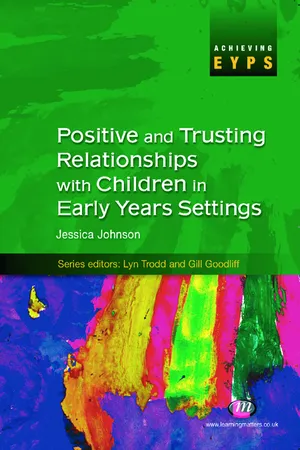
Positive and Trusting Relationships with Children in Early Years Settings
- 144 pages
- English
- ePUB (mobile friendly)
- Available on iOS & Android
eBook - ePub
Positive and Trusting Relationships with Children in Early Years Settings
About this book
To attain EYPS, candidates must demonstrate that they can establish fair, respectful, trusting and constructive relationships with children. This book helps those on EYPS pathways to understand and develop these important relationships. It begins by examining trust as a key theme and goes on to discuss how to ?tune in? to individual children and how to ?tune out? or say goodbye. It gives practical advice on helping children build resilience and take risks. Positive relationships with children are examined within the context of relationships with others and the text also considers how practitioners can support other professionals in their setting.
Information
1 Why trust? The key to positive relationships
Each generation begins anew with fresh, eager trusting faces of babies, ready to love and create a new world.
L. De Mause (2002) cited in The Next Generation report
(The Centre for Social Justice, 2008)
CHAPTER OBJECTIVES
This chapter provides a rationale for Positive and Trusting Relationships with Children in Early Years Settings.
Definitions of key terms, including trust and positive relationships, provide an underpinning for the more detailed, specific explorations in further chapters.
Links between current research and daily Early Years practice acknowledge the growing awareness of the impact of these relationships on the physical, emotional, social and intellectual development of the young child.
Reflective and practical tasks, case studies and self-assessment activities are included to help Early Years practitioners identify these links, with reference to the Early Years Foundation Stage (EYFS) and the following Standards for Early Years Professional Status (EYPS):
S18: Promote children’s rights, equality, inclusion and anti-discriminatory practice in all aspects of their practice.
S25: Establish fair, respectful, trusting, supportive and constructive relationships with children.
S26: Communicate sensitively and effectively with children from birth to the end of the Foundation Stage.
S27: Listen to children, pay attention to what they say and value and respect their views.
S28: Demonstrate the positive values, attitudes and behaviour they expect from children.
After reading this chapter you should be able to:
- reflect on levels of trust within past and present experiences of relationships with children, parents and colleagues;
- appraise critically some of the strategies used within Early Years practice to establish relationships with babies and young children;
- begin to apply models of relationship behaviour as you prepare to meet the Standards for EYPS.
Introduction
Do the babies and young children we meet with every day come with fresh, eager trusting faces? Do we sense they are ready to love? Are we, as Early Years Professionals (EYPs), consciously able to respond with trust and love, encouraging their curiosity, allowing them to take risks and building up their resilience, which is essential if they are to create a new world? We know babies at birth are totally dependent on adults to survive but how can we create positive relationships with young children and extend this innate, calculated trust as they grow and develop?
This book will explore these questions, along with others, that acknowledge the vital, yet challenging, role Early Years practitioners play as babies and young children establish, maintain and develop their trust in others, building up trust in themselves in the process. The focus, initially, will be the baby and child, trying to identify what they need, seek and bring to relationships with adult carers and other children. The adult chooses, whether consciously or not, ways to both receive the communications, interpret and understand the message and respond, creating active dialogue. Competent Early Years practitioners tune-in to the needs of the individuals – babies, children and adults. Chapter 2 will acknowledge why this ‘tuning-in’ is crucial to the brain development of babies and young children, acknowledging the power of these early relationships on the long-term social and emotional development of children. This, in turn, enables children to make the most of cognitive learning opportunities – opening up a holistic approach to child development within these secondary relationships (Chapter 5). Tuning-in to the primary attachment figures – parents/carers – also requires astute observation and active listening skills, often hard when time together is at a premium. There is scope within Chapter 4 to see if the term ‘trust’ can describe practitioner/child relationships in a way that safely encompasses love and care, acknowledging professional boundaries.
The key EYPS Standard S25: Establish fair, respectful, trusting, supportive and constructive relationships with children requires evidence from an EYP of their ability to create and build up positive relationships, with trust as a central attribute. Here, the responsibility appears to move to the EYP to start and maintain the relationship within their setting.
The case studies and reflective and practical tasks throughout this book will provide opportunities to explore these interplays between child and adult, both having an effect on the establishment of the constructive relationships. Each of the descriptive terms – fair, respectful, supportive and constructive – will be considered throughout, with trust identified as underpinning them all. The umbrella term often used is ‘positive relationships’ but the supportive and constructive elements required within Standard 25 acknowledge that neutral and negative relationships may also exist. An EYP, as a skilful, co-operative communicator, may be able to lead and support other practitioners in recognising early signs of these and try to instigate change (Chapter 6). This book seeks to go under the ‘positive relationships’ umbrella and value what often seem to be commonplace interactions, linking them to current research and theories. The hope is that EYPs will be empowered to confidently select from a variety of communication strategies, building on whatever level of trust babies and children come with from relationships with their primary carers.
REFLECTIVE TASK
Learning from a baby or child
It is the babies and young children who, when we found ways to listen carefully enough, taught us most about what matters in nurseries, often long before they could talk.(Elfer et al., 2009, page v)
Think back to an experience where you learnt from a baby or child.
- What were you trying to do at the time e.g. feed them, play, clear up?
- What did they do or say that had an impact on you?
- What did you learn from this, and did it bring about any change – short or long term?
- Can this experience be seen, like those in the above quote, to say anything about what mattered to your baby or child?
- What skills did you require to enable you to learn from them?
An EYP requires the energy, commitment, knowledge and expertise to match and encourage the motivation of expectant children in the setting. EYPs can act as role models to their colleagues. An exploration of ways to build trust within positive relationships will now follow.
What is ‘trust’?
Trust and relationships take time to form: you cannot do them in a fast food way.
(Seldon, 2009a, page 2)
Trust is defined in the Penguin English Dictionary (1992) as confident belief in or reliance on the ability, character, honesty of somebody or something. We may trust the chair we are sitting on to stay firm and not let us down. We have learnt this through a mixture of knowledge about what a chair is, observation of others using a chair and our own personal experience – for better or for worse! For most of the time we trust chairs to carry out their role, only likely to be consciously aware when they are not doing what we expect – collapsing or being uncomfortable!
The content of this book will explore how babies and young children gain confident belief or reliance on the ability, character and honesty of their Early Years practitioners/Key Person. Starting with ‘tuning-in’ to the needs of the individual baby or child, the developing relationship will have to be nurtured until finally bringing about closure. Throughout, the young child should be protected in order to do or be without fear or misgiving – also within the definition of trust. These supportive and constructive practitioner skills within professional boundaries should allow for risk-taking and the building up of resilience, to be covered in Chapter 4. The practitioner must seek to be trustworthy: dependable, reliable (the Penguin English Dictionary, 1992).
However, it takes years to build up trust and only seconds to destroy it (anon).
Babies and young children may well be meeting with a number of different carers. One of the attributes of an EYP is to lead and support others (CWDC, 2008, page 5). As catalysts for change they are in a prime position to help other practitioners understand the impact on relationship building of daily interactions with under 5s. This becomes a relationship-based approach to Early Years practice.
What are positive relationships?
Positive relationships tend to be portrayed in terms of interactive behaviour e.g. ‘J. smiled back at 6 month old C., mirroring her happy expression’. These seemingly small responses impact on brain development, with the creation of new neural pathways (Trevarthen, 2009). Evidence from neurological research shows how these ‘mirror moments’ lead to implications for physical, social, emotional and cognitive achievement.
The second principle of the EYFS states:
Positive Relationships – children learn to be strong and independent from a base of loving and secure relationships with parents and/or a Key Per...
Table of contents
- Cover
- Title
- Copyright
- Contents
- Foreword from the series editors
- Acknowledgements
- About the author and the series editors
- 1 Why trust? The key to positive relationships
- 2 Time to tune-in … and out
- 3 Respect for self and others
- 4 Understanding relationships with children in the context of professional boundaries
- 5 Trusting relationships as a secure foundation for children’s learning
- 6 Supporting other Early Years practitioners to build positive relationships
- 7 Reflection and learning as an Early Years Professional
- References
- Index
Trusted by 375,005 students
Access to over 1.5 million titles for a fair monthly price.
Study more efficiently using our study tools.
Frequently asked questions
Yes, you can cancel anytime from the Subscription tab in your account settings on the Perlego website. Your subscription will stay active until the end of your current billing period. Learn how to cancel your subscription
No, books cannot be downloaded as external files, such as PDFs, for use outside of Perlego. However, you can download books within the Perlego app for offline reading on mobile or tablet. Learn how to download books offline
Perlego offers two plans: Essential and Complete
- Essential is ideal for learners and professionals who enjoy exploring a wide range of subjects. Access the Essential Library with 800,000+ trusted titles and best-sellers across business, personal growth, and the humanities. Includes unlimited reading time and Standard Read Aloud voice.
- Complete: Perfect for advanced learners and researchers needing full, unrestricted access. Unlock 1.5M+ books across hundreds of subjects, including academic and specialized titles. The Complete Plan also includes advanced features like Premium Read Aloud and Research Assistant.
We are an online textbook subscription service, where you can get access to an entire online library for less than the price of a single book per month. With over 1.5 million books across 990+ topics, we’ve got you covered! Learn about our mission
Look out for the read-aloud symbol on your next book to see if you can listen to it. The read-aloud tool reads text aloud for you, highlighting the text as it is being read. You can pause it, speed it up and slow it down. Learn more about Read Aloud
Yes! You can use the Perlego app on both iOS and Android devices to read anytime, anywhere — even offline. Perfect for commutes or when you’re on the go.
Please note we cannot support devices running on iOS 13 and Android 7 or earlier. Learn more about using the app
Please note we cannot support devices running on iOS 13 and Android 7 or earlier. Learn more about using the app
Yes, you can access Positive and Trusting Relationships with Children in Early Years Settings by Jessica Johnson in PDF and/or ePUB format, as well as other popular books in Éducation & Éducation de la petite enfance. We have over 1.5 million books available in our catalogue for you to explore.