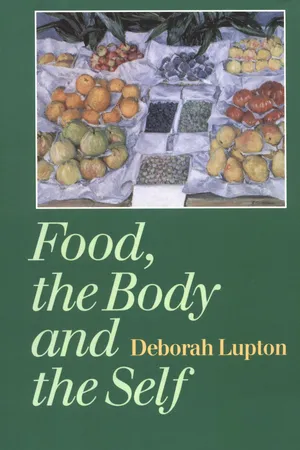
Food, the Body and the Self?s strong interdisciplinary approach incorporates discussion of the work of a number of major contemporary social and cultural theorists, including Bourdieu, Elias, Kristeva, Grosz, Falk and Foucault.
- 192 pages
- English
- ePUB (mobile friendly)
- Available on iOS & Android
eBook - ePub
Food, the Body and the Self
About this book
In this wide-ranging and thought-provoking analysis of the sociocultural and personal meanings of food and eating, Deborah Lupton explores the relationship between food and embodiment, the emotions and subjectivity. She includes discussion of the intertwining of food, meaning and culture in the context of childhood and the family, as well as: the gendered social construction of foodstuffs; food tastes, dislikes and preferences; the dining-out experience; spirituality; and the `civilized? body. She draws on diverse sources, including representations of food and eating in film, literature, advertising, gourmet magazines, news reports and public health literature, and her own empirical research into people?s preferences, memories, experiences and emotional responses to food.
Information
1
Theoretical Perspectives on Food and Eating
Conceiving of the experience of embodiment as socially produced, and of food and eating practices as always mediated through social relations, requires a sophisticated awareness of the ways in which society, subjectivity and the body are interrelated. Over the past two decades or so, increased attention has been paid by sociologists to the meanings, beliefs and social structures giving shape to food practices in western societies. The ‘sociology of food and eating’ has become recognized as a legitimate sub-discipline, even though it remains a comparatively minor and little-explored area in mainstream sociology, contrasted with, for example, the sociology of the body, which has burgeoned over the last decade. There are also other important areas of sociocultural research that have addressed the social dimensions of food and eating, including anthropology, history and cultural studies. Such research has explored the complex interaction between those phenomena that are traditionally separated in academic thought: physiology and society, mind and body, micro and macro. This chapter reviews the insights offered by these perspectives on food, preparing the theoretical ground for the chapters that follow.
The nutritional science perspective
The nutritional or sociobiological perspective has traditionally dominated research into eating practices. This approach has tended to take a highly instrumental view on food and eating, relating habits and preferences to the anatomical functioning of the human body. Thus, eating practices are generally understood either as conducive to physical functioning and development, and therefore to be encouraged, or serving to debilitate the body and therefore to be frowned upon. The sociobiological perspective represents food preferences as emerging from a ‘natural’ basis for the human diet which is guided by both genetic predispositions and culturally structured preferences. Food choice is viewed as being directed towards optimizing physiological survival within the given ecological context: ‘In this idyllic “state of nature” . . . the palatable and nutritional quality of food was one and the same thing’ (Falk, 1991: 763). That is, it is assumed that humans choose certain foodstuffs to eat because they are programmed to ‘know’ that the foods are physiologically good for them.
The nutritionist is interested in prescription as well as description, gathering data to construct scientific universals of the human diet and to pronounce on the appropriate foods, evincing a ‘utopian’ idea of the ‘perfect human diet’ to achieve perfect health (Khare, 1980: 526–7). Indeed, the very notion of ‘nutrition’ is a health and functionally oriented one: food is for nourishing, for fuelling the body, for building bones, teeth and muscle, a means to an end. Food preferences, tastes and habits are considered secondary to what food does biologically to the body, important only in their shaping of what types of food enter the stomach. This is demonstrated by the recent coining of the term ‘nutritional pharmacology’ by nutritionists to denote the concept of food as medicine or drug, used to prevent or treat diseases. For the majority of nutritionists, therefore, the sociocultural factors around food are of interest only in terms of the barriers or enhancements they pose to allow people to adopt the ‘correct’ diet. Culture is most often viewed as an impediment to the goals of nutrition.
There are thus major conceptual differences between the concerns of nutritionists and those of anthropologists and sociologists of food. The entry of food into the stomach represents different things for each perspective:
For the nutritionist, nutrients are released at this point to interact with the physiological characteristics of the eater; for the anthropologist, it is the completion (most usually) of a culturally appropriate sequence of interpersonal cooking, feeding, and eating, involving social intercourse that leads towards culturally recognized consequences on bodily and mental life. (Khare, 1980: 534)
While nutritionists are primarily interested in bodily functioning and state of health, anthropologists and sociologists are concerned with the symbolic nature of food and eating practices; what they mean in the context of a culture. Although most anthropologists and sociologists acknowledge that the practices surrounding the preparation and consumption of food may be governed by biological needs and the availability of foodstuffs in the first instance, they argue that these practices are then elaborated according to cultural mores. Food practices are therefore far more complex than a simple nutritional or biological perspective would allow.
It is highly problematic to separate food preference from social contact. For example, it has been argued by sociobiologists that human infants demonstrate a predisposition for sweet substances that appears to be innate, genetically encoded. However, from earliest infancy, the experience of eating is intertwined with their experience of close human contact with the provider of the food – the bodily warmth, the touch of the other’s flesh, their smell, the sounds they make – and the emotions and sensations aroused by this experience. The sweetness of milk means goodness and pleasure not simply because of its taste, but because of all the pleasurable associations with it. The experience of satisfying hunger, thus, comes to mean much more than the physical sensation of tasting the milk or enjoying filling the stomach, but is bound up with the infant’s emotional and sensual responses to the person or people who provide the food. These sensations and emotional states experienced in early infancy are unlikely to be conscious, or remembered, but will influence the response of the individual in later life to food. From infancy then, into childhood and adulthood, a thick layer of meaning is accreted around every food substance, and the physiological dimension of food is inextricably intertwined with the symbolic – we cannot say where one begins and the other ends.
The model that assumes humans’ ‘innate disposition’ to certain types of food also fails to take into account the dynamic nature of food preferences and the tendency of humans to incorporate new tastes into their repertoire of foods deemed edible. How are human food preferences and habits generated, reproduced and diffused throughout a society? How do they change? How do we account for major differences between human cultures in their food practices and preferences? What is the interaction between tastes in food and cultural shifts in eating? How do such tastes become internalized and inscribed upon the body? What role do structural features of society such as gender and socio-economic privilege and power relations play in shaping food habits and preferences? What are the symbolic meanings of food and how do they develop? It is these questions that anthropologists, sociologists and historians of food practices have explored, adopting a variety of approaches.
Functional structuralist approaches
The structuralist perspective in general is interested in the ways in which individuals’ actions, values, thoughts and identities are largely structured through social norms and expectations, which are in turn linked to the broader organization and structure of societies. From a functional structuralist approach, these norms and social institutions act to maintain social order. Their existence means that individuals are able to hold certain expectations about the behaviour of others and to meet others’ expectations. Societies are viewed as being largely consensual, predictable and stable, bolstered by the moral order kept in place by cultural and social systems. Sociologists and anthropologists who have adopted the functional structuralist perspective have tended to view food practices and habits as if they were linguistic texts with inherent rules to be exposed. The aim of such research is predominantly to explore the uses to which food is put as part of social life; for example, the ways in which food practices serve to support cooperative behaviour or structures of kinship in small groups.
It has been mainly scholars from within the anthropological tradition who have devoted the greatest attention to the latent meanings of food and eating habits. For the most part, however, western anthropologists have tended to explore these dimensions of food and eating in exotic, small-scale, non-urbanized societies rather than their own culture. The socio anthropological perspective on food has developed three main foci: ‘food as a sociocultural context for illustrating the logic and principles of different cultural systems’, ‘food as a mediating material and moral system within societies’ and ‘food as a set of nutriments representing the overlapping work of ecological, biological and cultural systems in human societies’ (Khare, 1980: 525). The well-known anthropologist Claude Lévi-Strauss’ understanding of food beliefs as cosmological has informed many contemporary cultural analyses of food. Lévi-Strauss (1970) treated food practices as a language, identifying the primary binary opposition, common to all cultures, between ‘nature’ and ‘culture’. Culture, according to Lévi-Strauss, is the complex of those practices which distinguish humans, rendering them unique. Food practices exemplify this binary opposition, particularly in concert with other binary oppositions, such as those between the raw and the cooked, and between food and non-food. According to Lévi-Strauss, cooked food is a cultural transformation of the raw, in which nature is transformed and delimited. The ways in which this transformation is carried out as part of everyday life serve to define cultures.
Mary Douglas, another influential anthropologist, has also approached the process of ‘deciphering a meal’ with the premise that food categories encode, and therefore structure, social events. For Douglas, in western as well as non-western cultures, the consumption of food is a ritual activity. She argues that food categories constitute a social boundary system; the predictable structure of each meal creates order out of potential disorder. The meal is thus a microcosm of wider social structures and boundary definitions: ‘the ordered system which is a meal represents all the ordered systems associated with it’ (Douglas, 1975: 273). Douglas analysed the British diet using linguistic terms such as grammar, taxonomy, syntagm, paradigm and lexicon. Her analyses demonstrated the rules dictating the definition of a traditional British meal, its grading as ‘a major or minor one of its class’ and the order in which foods of different tastes and textures are served (see Douglas, 1975; Douglas and Nicod, 1974; Douglas and Gross, 1981). For example, the evening meal in working-class families was described as following these rules: it consists of a hot and savoury main course, with a staple serving of potato, a centre-piece of meat, fish or eggs, doused in brown gravy, followed by a sweet course with a pale, creamy, sweet dressing. Cold water is drunk with the meal, and hot tea or coffee after the meal is eaten. Hot and cold foods are kept separate: no addition of cold foods to a hot plate is permitted, or vice versa (Douglas and Gross, 1981: 6–8). A similar analysis undertaken Anne Murcott (1982) of the rules and formal structure of the cooked dinner (described as a ‘proper meal’) in South Wales outlined the following: the meat in such a meal must be flesh (not offal), white or red, from a warm-blooded animal (not a fish, for example). Potato is also a constant, representing a carbohydrate from below the ground, in contrast to the other essential vegetable (peas, beans, brussels sprouts, cabbage, broccoli) which comes from above the ground and is green. If there is an additional vegetable, it is usually a colour other than green (carrots, parsnip, pumpkin, sweet corn, tomato). Gravy is the essential, but last, ingredient of the plate of food, the element which links the other components together to form a ‘plateful’.
The attempts by functional structuralists to determine the unwritten rules underlying food consumption in western cultures expose the ritualized and apparently ‘fixed’ nature of taken-for-granted everyday activities. Such analyses therefore highlight the difficulties of introducing ‘foreign’ elements into established diets, the rules of which have been passed on as a naturalized part of everyday life since earliest childhood. They suggest that to attempt to usurp the rules by introducing other options (for example, by substituting the meat in the British main meal with another vegetable), is to risk social disharmony and instability. These analyses tend to be descriptive rather than analytical, and often do not engage with the broader social, political and economic context in which food is produced, prepared and consumed. Functionalist research has been criticized by sociologists for being biologically reductive and ethnocentric, assuming, for example, that westernized taste preferences are universal (Mennell et al., 1992: 7). There is also little sense of history in such accounts; they tend to suggest that this is the way ‘things have always been’ without exploring the contingent nature of food practices and preferences. The analyses described above, for example, beg the questions of why is meat such a central feature of the British main meal and for how long has this been the case?
Critical structuralist approaches
A number of sociologists and anthropologists have adopted a Marxist-influenced approach to analyse the social nature of food production, distribution and consumption. While these approaches may also be categorized as ‘structuralist’, they focus on macro-rather than microstructures, and on social inequality rather than social consensus. They are therefore far more critical than functionalist perspectives, intent on highlighting the ways in which the social order fails and creates conflict between social groups. In such studies, social class and the economic system are generally privileged as the major determinants of food and eating practices. The concept of power is central to these explanations of food patterns. Power relations are generally represented as unequal in relation to the production, distribution and consumption of food. Thus, it is argued, the populations of developed countries are exploitative in their food consumption practices by consuming foods produced in developing countries in ways that damage the eco-system and economies of such countries (Singer, 1992; Heldke, 1992b).
One example of this perspective is Robin Jenkins’ book Food for Wealth or Health?: Towards Equality in Health (1991), in which he argues that the agricultural policies of western countries serve to destroy wildlife and create pollution and ill-health in the quest for profit. Jenkins contends that the food eaten in countries such as Britain is over-processed and overpriced because of food producers and manufacturers’ greed and lack of state intervention and regulation over their activities. He contrasts the diet of humans’ ‘Stone Age ancestors’ with that of latter-day residents of western countries, arguing that ‘our bodies have exactly the same nutritional needs as they had 100 000 years ago’ but because these needs are now not met, disease is rife (1991: 8). Jenkins thus harks back to a nostalgic ‘noble savage’ concept of diet and food production. He implies that individuals eat ‘unhealthy’ foodstuffs because they have no other choice, and if provided with greater access to ‘wholesome’ and less ‘processed’ foods, would change their preferences: ‘People would simply not eat a whole lot of processed food is they knew what was in it or how it was made’ (1991: 42). Jenkins therefore uncritically accepts certain scientific ‘knowledges’ and assumptions about ‘nature’ to construct his argument. In his critique, scientific and nutritional knowledges are politically neutral and are not implicated in his analysis of the vested interests around food production, manufacture and distribution. Jenkins takes an overtly principled stance in privileging good health as the main reason why people should choose some foodstuffs over others. For example, he criticizes people who prefer to purchase meat, fish and dairy products rather than the grains and pulses he claims are more ‘natural’ and more inducive to good health (1991: 18). The food consumer is represented as ignorant and powerless, at the mercy of an uncaring government and avaricious industry.
Other researchers, particularly those adopting a feminist perspective, have explored other social structural and organizational aspects affecting patterns of food consumption and preparation such as gender and the family. Feminist critics have called attention to the ways in which women have historically been deprived of food in comparison with men and have been assigned the major responsibility for preparing food, among other domestic tasks, to the detriment of their participation in public life. They have also focused in detail on the linkages between the construction of femininity and the dietary practices of women, including the quantity of food eaten. For critics such as Orbach (1988), women in western societies are subject to continuing social pressures to limit their food intake for the sake of conforming to norms of appropriate feminine body size, and thus develop a pathological relationship with food. The emphasis that is placed upon women’s body size and shape, it is argued, serves to distract them and absorb their energies, thus preventing women from achieving positions of power in society. One feminist critique links the production and eating of meat with the low status of women within patriarchy. Carol Adams, in her book, The Sexual Politics of Meat (1990), argues that the assumption that meat is ‘good for you’ is an inherently patriarchal discourse, associating meat with the male role. For Adams, the notion that animals should be objectified and the violence perpetuated towards them in the name of meat production are masculinist. She contends that there is little difference between men’s treatment of animals and their treatment of women, for both animals and women are objectified and subjected to violence by men: ‘Specifically in regard to rape victims and battered women, the death experience of animals acts to illustrate the lived experience of women’ (1990: 42). Thus, she asserts, it is logical that all feminists should be ethical vegetarians, for to eat meat is to support the assumptions of patriarchal society, and to comply tacitly in their own oppression. According to Adams, to agitate for the rights of animals, therefore, is also to work towards the liberation of women.
Critical structuralist approaches have been criticized for extreme cultural relativism in their avoidance of taking into account the function and purpose of food habits (Mennell et al., 1992: 8). Both the functional and critical structuralist approaches tend to be somewhat essentialist, assigning a single meaning to food-as-text without fully acknowledging the dynamic, highly contextual and often contradictory meanings around foodstuffs. While structuralism is insightful in describing static patterns in food preferences and habits, it has little explanation for change, human agency and the ‘lived experience’ of eating (Mennell, 1985: 13–14; Lalonde, 1992). Furthermore, as I note in greater detail below, critical structuralist approaches tend to discuss power relations and social change in a rather simplistic way. Critical structuralism argues that state authorities and the food industry in western countries are deliberately acting to oppress and exploit food workers and manipulate consumers, particularly women, in the single-minded pursuit of profit and the maintenance of positions of power. For such critics, social change comes about only through struggle and conflict challenging the repressive economic organization and patriarchal structure of society. Yet it is evident that food habits and practices are constantly changing, often rapidly, and not necessarily by virtue of conscious resistance or political struggle (see, for example, the historical accounts of changes in eating habits in western societies by Driver, 1983; Symons, 1984; Mennell, 1985; Mintz, 1986; Levenstein, 1988, 1993).
Poststructuralist approaches
The primary focus of this book is upon the interaction between food, embodiment and subjectivity. I am interested in exploring the changeable and contextual nature of meaning, taking a social constructionist approach to understand the ways in which preferences for food develop and are reproduced as sociocultural phenomena. The theoretical orientation of the book is therefore largely poststructuralist. Poststructuralist perspectives draw on inquiries into the socially constructed nature of knowledges, emphasizing the centrality of language in meaning. This is combined with a critical emphasis on the broader historical and political contexts in which knowledges and meanings are produced and reproduced. The concept of discourse, a patterned system of language and practices around phenomena such as food, eating and embodiment, is a useful way of understanding the production and reproduction of meaning. Therefore, attention is paid in the book to the ways that discourses on food are articulated in a number of diverse sites, including popular culture, medical and public health texts and individuals’ accounts of their own food preferences and habits. I argue that it is through these discourses, in conjunction with non- or pre-discursive sensual and embodied experiences, that individuals come to understand themselves, their bodies and their relationship to food and eating. Touch, taste, smell, hearing and sight are our entrées into culture. Food, of course, has a supremely physical presence, and we interact with this presence through our senses: we smell, taste, see and touch food, and sometimes hear it (for example, the sizzling of frying food). We do not necessarily need language and discourse to experience food. However language and discourse are integral to the meanings we construct around food – how we interpret and convey to others our sensual experiences in preparing, touching and eating food – which in turn shape our sensual responses.
Poststructuralist approaches generally privilege the notion of the fragmented and contingent rather than the unified self, adopting the term ‘subjectivity’ to describe the manifold ways in which individuals understand themselves in relation to others and experience their lives. Subjectivity is a less rigid term than identity, as it incorporates the understanding that the self, or more accurately, selves, are highly changeable and contextual, albeit within certain limits imposed by the culture in which an individual lives, including power relations, social institutions and hegemonic discourses. As Mouffe (1989: 35) argues, the consequence of this understanding of the subject is the acce...
Table of contents
- Cover Page
- Title
- Copyright
- Contents
- Acknowledgements
- Introduction
- 1 Theoretical Perspectives on Food and Eating
- 2 Food, the Family and Childhood
- 3 Food, Health and Nature
- 4 Tastes and Distastes
- 5 The Asceticism/Consumption Dialectic
- Conclusion
- Appendix: Details of Research Strategies and Participants References
- Index
Trusted by 375,005 students
Access to over 1.5 million titles for a fair monthly price.
Study more efficiently using our study tools.
Frequently asked questions
Yes, you can cancel anytime from the Subscription tab in your account settings on the Perlego website. Your subscription will stay active until the end of your current billing period. Learn how to cancel your subscription
No, books cannot be downloaded as external files, such as PDFs, for use outside of Perlego. However, you can download books within the Perlego app for offline reading on mobile or tablet. Learn how to download books offline
Perlego offers two plans: Essential and Complete
- Essential is ideal for learners and professionals who enjoy exploring a wide range of subjects. Access the Essential Library with 800,000+ trusted titles and best-sellers across business, personal growth, and the humanities. Includes unlimited reading time and Standard Read Aloud voice.
- Complete: Perfect for advanced learners and researchers needing full, unrestricted access. Unlock 1.5M+ books across hundreds of subjects, including academic and specialized titles. The Complete Plan also includes advanced features like Premium Read Aloud and Research Assistant.
We are an online textbook subscription service, where you can get access to an entire online library for less than the price of a single book per month. With over 1.5 million books across 990+ topics, we’ve got you covered! Learn about our mission
Look out for the read-aloud symbol on your next book to see if you can listen to it. The read-aloud tool reads text aloud for you, highlighting the text as it is being read. You can pause it, speed it up and slow it down. Learn more about Read Aloud
Yes! You can use the Perlego app on both iOS and Android devices to read anytime, anywhere — even offline. Perfect for commutes or when you’re on the go.
Please note we cannot support devices running on iOS 13 and Android 7 or earlier. Learn more about using the app
Please note we cannot support devices running on iOS 13 and Android 7 or earlier. Learn more about using the app
Yes, you can access Food, the Body and the Self by Deborah Lupton in PDF and/or ePUB format, as well as other popular books in Social Sciences & Sociology. We have over 1.5 million books available in our catalogue for you to explore.