![]()
1
Introduction: the natural challenges of supply teaching
O, how full of briers is this working-day world!
(Shakespeare, ‘As You Like It’ I: iii)
You’re not our normal teacher!
(Every tenth student to a supply teacher)
I began teaching many years ago as an ET (an emergency teacher as we were then called in the 1970s). The current term in Victoria (Australia) is CRT – casual relief teacher, equivalent to a ‘supply teacher’. The term ‘supply’ conjures up for me a teacher bringing relief supplies to ‘the beleaguered garrison …’.
My first day as an ET is well remembered. I drove into the car park of the school, a rather shabby looking primary school with many students already at play, by 8.15 a.m. As I headed for the office several ‘lads’ came over and noisily started hassling me, ‘Ay; you gonna be our teacher?!’ ‘What’s your name?’ ‘Why you here?’ ‘You gonna take Ms Snaggs’s class …?’ (‘I hope not,’ I thought.)
As I walked to the front office I saw a mother yelling at another adult – who I assumed was a teacher – ‘Yeah well you never cared for our Jayson did yuh! You never gave him a break! This is a sh-t school …!’ I walked past hoping her Jayson wasn’t in my class that day. The principal (head teacher) looked really frazzled already; he was glad to see me. ‘Are you the ET? Sorry. What’s your name?’ We chatted all too briefly. ‘Yes.’ ‘You’ve got 6F. All the best. Room 17. See Richard or Judy, OK – staff room.’ He had that short-sentence way of speaking, like morse code. He hurried off in the direction of Jayson’s mum who could still be heard even inside the building ‘Sorry. Got to go.’ 6F were noisy, brash, challenging, fractious and attentional – and that was in the corridor ‘lining’ up! It seemed to takes ages for them to settle down, but we eventually got going and actually got some work done. There were students who were brought some unusual and provocative toys to class that day; students who were skilled at task-avoiding, who called out repeatedly; students who seemed to think that classroom conversations could be conducted at playground noise level. Several students came late to class that morning, had forgotten or mislaid pens and personal equipment (I quickly wondered how much of that was intentional). Calling out, butting in and talking while I was trying to gain whole-class attention was a repeated challenge throughout the day but mostly in the first 15–20 minutes. One student jumped out of the window and ‘did a runner’, just before morning recess (ground floor thankfully!).
I asked myself many questions that day; some quickly, some at the day’s end:
- What sort of discipline language should I use? What is a better way of making my leadership firm, clear, without looking ‘bossy’, ‘mean’ or ‘weak’?
- Should I confiscate toys – how?
- What do I do/say when students are late? Do I notify the office?
- The boy who ‘did a runner’ – how could I deal with that kind of incident more effectively next time?
I was a mature-age ‘beginning’ teacher and that helped a little (at least I didn’t look like a neophyte).
I had many students ask me, as a matter of course, when I was going to become a ‘real teacher’. They had in their minds a comparative conception between ‘regular’ and ‘occasional’ teacher; as ‘real’ is to ‘non-real’. I taught in many, many schools like this one over the early years as a supply teacher before I became a ‘real’ teacher. What I learned as a supply teacher became my proving ground as a so-called ‘full-time’ teacher.
Many of the skills, and approaches, I eventually learned I have outlined in this book. Experience can be a helpful teacher but experience of itself does not tell you what to do in the sorts of situations typically faced by supply teachers. This book does not so much tell you ‘what’ to do, but it does share the issues faced by all supply teachers and outlines particular approaches – even specific skills of discipline – that my colleagues and I have found helpful and supportive.
A typical day?
You arrive early, you go to the front office to find out which class you have. You received a phone call last night (or even at 8.00 a.m. that morning!).
You look through the little glass sliding door under the sign that says ‘Office’. The school secretary looks distracted – very distracted. ‘Yes?’ (the voice is jaded, sighing, – ‘busy’).
‘My name is …, I’m the supply teacher.’ You smile in the hope it will be returned. It isn’t. Already you sense it will be an ‘interesting’ day.
‘Look, I don’t know what class you’ve got – ask the cleaner he normally knows what’s going on around here.’ (Actually the secretary doesn’t say that, but for all the help she is she might as well have done.) She eventually finds out what class you’ve ‘got’ and time is ticking on. You want to find your classroom, or at least get the ‘lay of the land’ and focus for the day.
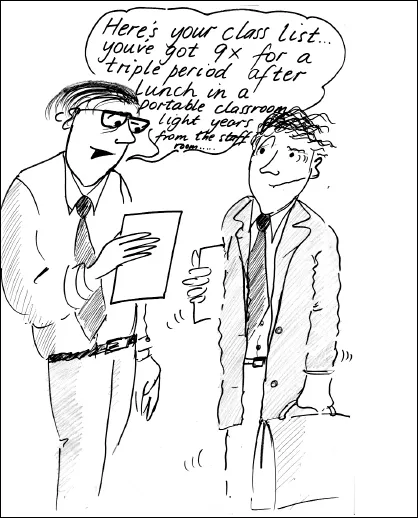
A brief visit to the staffroom and you notice the typically busy terminal between ‘partial freedom’ and ‘professional responsibility’. A few teachers look your way. No one says ‘Hi.’ You say ‘Good morning, I’m …’ as you approach a ‘colleague’ and ask where room 12A is, and get a hurried commiseration. ‘You’ve got 7A … double period … watch your back …’ He hurries off.
Does this sound contrived? No – but fortunately it’s not too common. Most schools, these days, are quite supportive of supply teachers.
You’ll cope. You’ll survive. You’ll even teach! You’re a supply teacher.
Chapter 2 outlines a different kind of typical day of supply teaching. Building on that case study in the subsequent chapters are the sorts of skills, approaches and necessary qualities that enable more effective (and enjoyable) supply teaching.
Being the professional
I have seen some supply teachers:
- who seem bent on doing the least amount of work possible for that day – merely ‘supervising’ not engaging, teaching, giving encouragement and feedback; in short not being a teacher;
- reading a novel while the class was effectively ‘doing their own thing’. This teacher did not even flinch when I walked into ‘her class’; she appeared oblivious to the reality that most of the class were skilfully off-task;
- sit in a high-school class using a personal mobile phone doing business that has nothing to do with their professional responsibilities for that class (and I’m not talking about emergency use of mobile phones here);
- doing work at the teacher’s desk, that has, clearly, nothing to do with that lesson.
Thankfully I haven’t seen too many supply teachers who will take good money yet behave as unprofessionally as this.
When we walk into a school as a supply teacher we have the same rights and obligations as our regular teaching peers. We don’t have the benefit of having a longer-term role as our regular colleagues but we do not need to play down, minimize, apologize or excuse the fact we are teachers here, today. We need to relate to our collegial peers, students and parents as the professional. However, if we want to be treated as the professional we need to evidence those behaviours that will accord that normative status.
Some of the common concerns I hear from supply teachers include:
- I’m often concerned about what I might face with student behaviour whether or not I’ll be able to ‘handle things’, whether or not I’ll ‘lose control’.
- I don’t know their names, they sometimes give me false names and laugh and ‘carry on’; it’s not a good start.
- I feel like a glorified ‘babysitter’ in some schools, like I’m not taken seriously by other staff or even the students.
- I have to take so many different subjects; things I wasn’t trained for like Art, Phys. Ed. even Music. (This secondary teacher, on the day in question, was trying his best to take a very restless group of students for ‘ball-handling’ skills in the gym.)
- Going into a new class every day I teach, seeing a sea of new faces and not having any relationship with them at the outset and having to go through that ‘testing-out’ time.
I have worked with many supply teachers in Australia, New Zealand and the UK in in-service education, professional development and mentoring (one to one). In sharing the sorts of comments listed most supply teachers are not negative about their role, just naturally anxious, aware of the special challenges faced by going to new school settings each day or week. There are times when we might even feel especially vulnerable, such as when we are asked to take a known hard class; the year head frowns, grimaces and swallows hard as they pass us the class list and pat us on the shoulder: ‘8D … do your best.’
The recurring concern that supply teachers commonly voice is that they want a genuine, practical, degree of colleague support (even for their brief ‘tenure’). Their role is enhanced when they are acknowledged, affirmed and supported as a professional – as a fellow teacher – by their colleagues in their host schools.
All the examples and cases in this book are drawn from my mentoring work in Australian and British schools over the last five years. I have addressed the typical and normal concerns about behaviour management and discipline that always face ‘supply’ teachers. I have also addressed some of the more ‘thorny’ issues faced by supply teachers, such as very hard to manage classes and issues of harassment of teachers. I trust you will find the book practical, encouraging and enabling. I hope you will seek out the support options detailed in this book.
A supply teacher is not merely or just a supply teacher, he or she is an indispensable member, a professional member, of any colleague team in any school. It is crucially important that our profession acknowledges and supports supply teachers as fellow professionals. How supply teachers are treated by their full-time collegial peers also depends on how the supply teachers perceive their role in schools; how they professionally carry themselves; how they carry out their professional obligations as a teacher – on any given day, week or term.
Chapter 7 outlines how schools can more actively, consciously, support supply teachers within their school; how they can enable their supply colleague more effectively to engage their professional role in their school.
The issue of ‘colleague watchfulness’ is developed in this text with special reference to a supply teacher plan that advocates school-wide expectations for supply teacher colleagues.
![]()
2
A normal teaching day?: A case example of supply teaching
You come most carefully upon your hour.
(Shakespeare, Hamlet, I: i)
Liz Smith is a supply teacher in her mid-thirties; she’s back teaching (after a break for family commitments). She enjoys a few days’ teaching, in different schools most weeks; sometimes she gets several straight days at one school. She’s had an early morning call from the ‘supply provider’. Sometimes she gets the call the night before. Today she’s got a grade 6.
Liz gets to school early – East London. She has not taught in this particular school before. It’s 8.15 a.m. She knows how important it is to get to a school early; paperwork, directions, check out the classroom, get focused etc. She parks in a place far from any spot that looks like it is reserved, or those that the regular teachers will want to use. (It’s just early ‘protocol’.)
She unpacks her ‘gear’ – a large plastic tub and a bag. She has brought the normal supply teacher’s ‘kit’: extra pens, rulers, pencils and paper; chalk, duster and whiteboard markers just in case (she’s been caught before); a range of user-friendly worksheets (just in case – for ‘early finishers’ and the few ‘bored’ students); several ‘largish’ laminated rule-posters outlining, in bold colourful lettering, the basic rules she’ll remind the class of at the outset of the day. She’s even brought her own cup (not as a ‘Linus blanket’ but another just-in-case ‘protocol’). At one school, some years back, she’d gone into the staff room at morning tea, reached for a cup from the shelf and some miserable person had said ‘That’s my cup!’ She felt like telling her to … She didn’t, she ‘apologized’.
‘What kind of class will I have?’ Liz muses as she heads for the administration. She knows she’s got 11–12-year-olds (grade 6); she’s a little anxious (naturally) she hasn’t worked at this school before. As a supply teacher she’s had a wide range of classes – mostly at the hard-to-manage end of the distribution through to the ‘lunatic’ (she rarely goes back to those schools).
The office secretary is inviting, helpful – she welcomes her and hands her a ‘pack’. Smiling she says, ‘I’m sure you’ve seen one of these before?’ The ‘pack’ contains a user-friendly map of the school,...