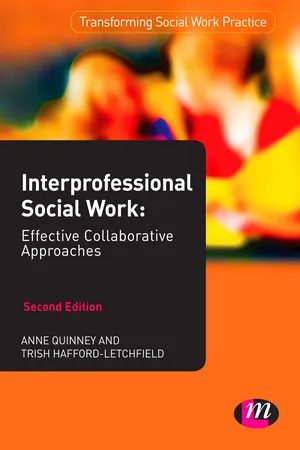
eBook - ePub
Interprofessional Social Work
Effective Collaborative Approaches
- 208 pages
- English
- ePUB (mobile friendly)
- Available on iOS & Android
eBook - ePub
Interprofessional Social Work
Effective Collaborative Approaches
About this book
All Social Work students are required to undertake specific learning and assessment in partnership working and information sharing across professional disciplines and agencies. Increasingly, social workers are also finding that they need to deal with a wide range of other professions as part of their daily work. It is essential therefore that social workers can work effectively and collaboratively with these professions while retaining their own values and identity. This updated second edition will prepare social work students to work with a wide variety of professions including youth workers, the police, teachers and educators, the legal profession and health professionals.
Information
Publisher
Learning MattersYear
2012Print ISBN
9781844453795
9780857258267
Edition
2eBook ISBN
9781844457243
Chapter 1
The importance of interprofessional and inter-agency practice
ACHIEVING A SOCIAL WORK DEGREE
This chapter will help you to develop the following capabilities, to the appropriate level, from the Professional Capabilities Framework.
- Contexts and organisations. Understand the inter-agency, multi-disciplinary and interprofessional dimensions to practice and demonstrate effective partnership working.
- Knowledge. Demonstrate a critical understanding of social welfare policy, its evolution, implementation and impact on people, social work, other professions, and inter-agency working.
- Rights, justice and economic well-being. Recognise the impact of poverty and social exclusion and promote enhanced economic status through access to education, work, housing, health services and welfare benefits.
See Appendix 1 for the Professional Capabilities Framework diagram.
It will also introduce you to the following standards as set out in the 2008 social work subject benchmark statement.
5.1.1 Social work services, service users and carers.
5.1.3 Values and ethics.
5.1.5 The nature of social work practice.
5.7 Skills in working with others.
Introduction
In this chapter we will be considering the factors that create the framework for the renewed emphasis on, and importance of, interprofessional and inter-agency working and for developing effective collaborative approaches. You will also be introduced to some of the key terms and models developed to explain and describe the concepts that underpin working with other professionals in order to prepare for effective practice in this area. We identify the relevant aspects of the Professional Capability Framework (College of Social Work 2012) and the Benchmarks for Social Work (QAA 2008). These sources emphasise the importance of learning about interprofessional and interagency social work practice as part of your social work qualifying course, for example:
Contemporary social work increasingly takes place in an inter-agency context, and social workers work collaboratively with others towards interdisciplinary and crossprofessional objectives.
(QAA 2008 para 3.7)
In addition students are expected to develop
accurate knowledge about the respective responsibilities of social welfare agencies, including those in the public, voluntary/independent and private sectors, and acquire skills in effective collaborative practice.
(QAA 2008 para 3.7)
In the workplace setting collaborative social work practice which seeks to develop effective working across agency boundaries continues to receive a great deal of attention. This approach was embodied in the ‘joined-up’ and ‘cross-cutting’ approaches taken by the New Labour administration in its attempt to develop an integrated approach to the organisation and delivery of services to reduce inequalities and social exclusion, break down barriers between agencies and encourage the forging of new partnerships. Changes were made to education, health and social services structures in an attempt to focus on the service user and their need for a seamless service rather than having to negotiate the traditional service boundaries that are neither helpful to, nor easily understood by, the person in need of services. Examples of integrated approaches developed were Sure Start projects, Youth Offending Teams and Community Mental Health Teams.
When social workers are working with service users whose needs are complex the opportunities to work across traditional service boundaries are increasingly seen as one of the strategies for meeting complex and multiple needs. As a social work student you may find that you undertake a practice learning placement in an agency where there are workers from a range of professional backgrounds as well as social work and where a collaborative approach to the needs of service users and carers is taken.
This is represented in the Professional Capability Framework (PCF) (see Appendix 1) in the domain of contexts and organisations, by the statement that at the point of qualification students must ‘Understand the inter-agency, multi-disciplinary and interprofessional dimensions to practice and demonstrate effective partnership working.’
The changing landscape of social work
Evidence from a wide range of sources, and in particular the Laming Report (2003) into the circumstances surrounding the death of Victoria Climbié, and the subsequent Laming Report (2009) into the death of Peter Connolly has highlighted the importance of working closely with people from other professional groups and with a wide range of agencies in the effective delivery of social work services, in order to protect and safeguard vulnerable children.
In particular, the following statements from the first Laming Report (2003) emphasise this:
It is clear that the safeguarding of children will continue to depend upon services such as health, education, housing, police and social services working together.
(para 17.112)
The skills involved in working successfully across organisational boundaries must be given proper recognition in both the basic training and in the continuing training of staff. It cannot be left only to those individuals who have the motivation to do it. Working across boundaries should be an expectation placed on all staff, and it must be reflected in training programmes.
(para 17.113)
Following the publication of Lord Laming’s Report the Secretary of State for Health at the time, Alan Milburn, addressed the House of Commons emphasising how services providing care for children must work together rather than in conflict. (The Guardian 2003). He drew attention to the need for closer co-operation, co-ordination and communication across and between services, to prevent a reoccurrence of the administrative, managerial and professional failures by social workers, police and health professionals that contributed to Victoria’s death. The second Laming Report (2009 para 4.1) after the death of Peter Connolly included the following observation in the section which specifically addresses inter-agency working.
It is clear that most staff in social work, youth work, education, police, health and other frontline services are committed to the principle of interagency working, and recognise that children can only be protected effectively when all agencies pool information, expertise and resources so that a full picture of the child’s life is better understood. Cooperative working is increasingly becoming the normal way of working
However, while it is clear that a lack of collaborative working can contribute to failures to protect vulnerable people there is not yet a body of research evidence to demonstrate when and how learning and working together with other professionals leads to more effective and safer practice.
The Social Work Taskforce and Social Work Reform Board
With the remit to undertake a comprehensive review of frontline social work practice, the Social Work Taskforce was created by the Department for Children, Families and Schools and the Department of Health in January 2009, chaired by Moira Gibb, Chief Executive of the London Borough of Camden. Following the publication of the Taskforce recommendations in 2009 for social work practice and social work education, the Social Work Reform Board was established in January 2010, in order to implement the Taskforce recommendations. All 15 recommendations were accepted by the government and five key areas of reform were identified.
- An overarching Professional Standards Framework.
- Standards for employers and a supervision framework.
- Principles that should underpin a continuing professional development framework.
- Proposed requirements for social work education.
- Proposals for effective partnership working.
The proposals for partnership working between employers and universities are informed by principles that should underpin all forms of partnership working.
The Social Work Reform Board was made up of representatives from higher education, the social work profession, social work employers, service user organisations and government, and addresses all aspects of children’s and adults’ services. An important theme was the raising of the profile of the positive role social workers play with the public, service users, the media and other professions. Parallel to these developments, the Secretary of State for Education and the Children and Families Minister established the Munro Review in July 2010 with the remit to improve child protection, including interprofessional working.
In order to improve the gap between expectations and actual standards the previous New Labour government had identified six areas to be addressed. These were:
- protection of vulnerable children and adults;
- co-ordination between agencies and authorities;
- flexibility to ensure the delivery of person-centred services;
- clarity of role with greater understanding of the role social services should undertake;
- consistency of service delivery across the country;
- efficiency of service delivery, to ensure best use of public money.
(Horner 2012)
These themes continue to be central to effective collaborative working with other professionals and are recurring themes in this book.
It is clear from the statements in the PCF and the Benchmarks that social workers are expected to know how to work effectively with other professions from a range of agencies in order to provide effective and appropriate services. In addition, as social workers are increasingly employed in a range of diverse settings in statutory, voluntary and independent organisations and agencies, social work students are expected to learn how to practise social work effectively and maintain a strong professional identity when social workers may be in the minority in that organisation or team, and how to work with people from a range of professional backgrounds in those organisations.
Defining the terms
As you have already seen in the chapter so far, a wide range of terms are used to describe the process of working together with other professions, including joint working, interprofessional w...
Table of contents
- Cover Page
- Title
- Copyright
- Contents
- About the authors
- Series editors’ preface
- Acknowledgements
- Introduction
- Chapter 1: The importance of interprofessional and inter-agency practice
- Chapter 2: Preparing to work with other professionals
- Chapter 3: The youth work context
- Chapter 4: The health context
- Chapter 5: The education context
- Chapter 6: The housing and neighbourhood context
- Chapter 7: The justice context
- Appendix 1: The Professional Capabilities Framework
- Appendix 2: Subject Benchmark For Social Work
- References
- Index
Trusted by 375,005 students
Access to over 1.5 million titles for a fair monthly price.
Study more efficiently using our study tools.
Frequently asked questions
Yes, you can cancel anytime from the Subscription tab in your account settings on the Perlego website. Your subscription will stay active until the end of your current billing period. Learn how to cancel your subscription
No, books cannot be downloaded as external files, such as PDFs, for use outside of Perlego. However, you can download books within the Perlego app for offline reading on mobile or tablet. Learn how to download books offline
Perlego offers two plans: Essential and Complete
- Essential is ideal for learners and professionals who enjoy exploring a wide range of subjects. Access the Essential Library with 800,000+ trusted titles and best-sellers across business, personal growth, and the humanities. Includes unlimited reading time and Standard Read Aloud voice.
- Complete: Perfect for advanced learners and researchers needing full, unrestricted access. Unlock 1.5M+ books across hundreds of subjects, including academic and specialized titles. The Complete Plan also includes advanced features like Premium Read Aloud and Research Assistant.
We are an online textbook subscription service, where you can get access to an entire online library for less than the price of a single book per month. With over 1.5 million books across 990+ topics, we’ve got you covered! Learn about our mission
Look out for the read-aloud symbol on your next book to see if you can listen to it. The read-aloud tool reads text aloud for you, highlighting the text as it is being read. You can pause it, speed it up and slow it down. Learn more about Read Aloud
Yes! You can use the Perlego app on both iOS and Android devices to read anytime, anywhere — even offline. Perfect for commutes or when you’re on the go.
Please note we cannot support devices running on iOS 13 and Android 7 or earlier. Learn more about using the app
Please note we cannot support devices running on iOS 13 and Android 7 or earlier. Learn more about using the app
Yes, you can access Interprofessional Social Work by Anne Quinney,Trish Hafford-Letchfield in PDF and/or ePUB format, as well as other popular books in Social Sciences & Social Work. We have over 1.5 million books available in our catalogue for you to explore.