"A conceptually power-packed volume that is at once erudite and accessible, expansive and focused, true to sociological traditions yet stimulatingly exploratory. Scholars and students will be served very well by this absorbing, far-reaching enquiry into ethnicity and race."
- Raymond Taras, Tulane University
"This concise, profound, and beautifully written book offers a tour de force across the landscape of race and ethnicity by a young author who masters them all."
- Per Mouritsen, Aarhus University
This book offers an accessible discussion of both foundational and novel concepts in the study of race and ethnicity. Each account will help readers become familiar with how long standing and contemporary arguments within race and ethnicity studies contribute to our understanding of social and political life more broadly.
Providing an excellent starting point with which to understand the contemporary relevance of these concepts, Nasar Meer offers an up-to-date and engaging consideration of everyday examples from around the world.
This is an indispensable guide for both students and established researchers interested in the study of race and ethnicity.
- 176 pages
- English
- ePUB (mobile friendly)
- Available on iOS & Android
eBook - ePub
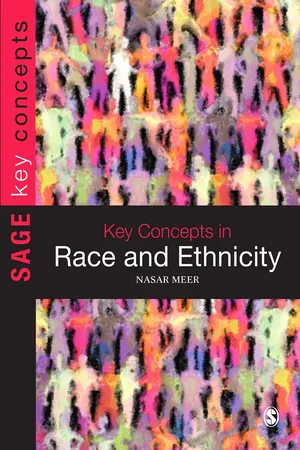
Key Concepts in Race and Ethnicity
About this book
Information
Publisher
SAGE Publications LtdYear
2014Print ISBN
9780857028686
9780857028679
Edition
1eBook ISBN
9781473906044
1 Antisemitism
Antisemitism describes the suspicion, dislike or hatred of Jewish individuals or groups. This can be attitudinal or structural, and proceeds from a real or assumed ‘Jewishness’. It therefore reflects a racial and not just theological character (as in anti-Judaism), and can take a number of forms spanning behaviours, discourse and state policies.
The term antisemitism (also spelled anti-Semitism) can be traced to a publication penned in 1873 by a German polemicist named Wilhelm Marr. This was entitled The Victory of the Jewish Spirit over the Germanic Spirit, and in it Marr used the word ‘Semitismus’ interchangeably with ‘Judentum’ to describe what he understood as the relationship between ‘Jewry’ (Jewish people) and ‘Jewishness’ (the content and culture of Jewish people). Marr was motivated by the view that Jews in Europe posed a subversive threat to national cultures, a reading that arguably drew upon a much deeper historical current that came to assume a particular role in twentieth-century European nation-states, and which sanctioned intellectual and political support for enormous violence and discrimination towards Jewish minorities. These included pogroms and forced expulsions from Eastern Europe, restrictions on participation in public life in Western Europe, a widespread public discourse characterising Jews as a pernicious and deleterious presence, and of course the planned genocide of Jews and others in the Holocaust (known in Hebrew as the Shoa).
The Object–Subject Distinction
In contemporary discussion the prevailing convention is not to use a hyphen in antisemitism as no phenomenon such as Semitism has ever existed. This is so even though there is a racial-linguistic genealogy of Semites that some trace to Noah’s son Shem in the Old Testament, and of course this includes other ethno-religious groups too (see Firestone, 2010). So while hostility towards Jews is a great deal older than the nineteenth-century term antisemitism, the work of Brian Klug (2004) has been helpful in unpicking what is valuable about the term at a deeper level and in a more generalised sense. Specifically, Klug maintains that the logic of antisemitism is ‘a priori’ in so far as antisemites do not generalise from specific instances but are disposed to see Jews in a certain negative light. That is to say that our working definition of antisemitism as suspicion, dislike or hatred of Jews should be understood as suspicion, dislike or hatred of Jews ‘as Jews’, ‘in which Jews are perceived as something other than what they are. Or, more accurately, hostility towards Jews as not Jews’ (Klug, 2003: 123). He elaborates:
For the ‘Jew’ toward whom the antisemite feels hostile is not a real Jew at all. … Antisemitism is best defined not by an attitude to Jews but by a definition of the ‘Jew’. … Wilhelm Marr, who founded the Antisemitism Liga in Germany in 1879, described Jews as … ‘a flexible, tenacious, intelligent, foreign tribe that knows how to bring abstract reality into play in many different ways. Not individual Jews, but the Jewish spirit and Jewish consciousness have conquered the world.’ … In short, anti-Semitism is the process of turning Jews into ‘Jews’.
So the emphasis is not on religion or religious doctrine per se – on Judaism – but on an imagined and generalised ‘collective Jew’. While this allows us to differentiate antisemitism from what Iganski and Kosmin (2003) term ‘Judeophobia’, which focuses more on the object of Judaism than the subject of Jews as people, it should not confer the impression the anti-Jewish sentiment commences with antisemitism. For as Jacobson (2009: 305) reminds us, ‘the history of racial Jewishness is not merely the history of antisemitism; it encompasses the ways in which both Jews and non-Jews have construed Jewishness … over time.’ Indeed, on surveying the nineteenth century, the philosopher Hannah Arendt (1968: xiv) once quipped that ‘whereas anti-Jewish sentiments were widespread among the educated classes of Europe throughout the nineteenth century, antisemitism as an ideology remained, with very few exceptions, the prerogative of crackpots in general and the lunatic fringe in particular’.
From Bigotry to Racism
What is interesting therefore is the role of racial mechanics, especially racialisation, in how ‘the move from Judenhass (Jew hatred) to antisemitism marks a crucial turning point of the late 19th century... as a shift in alterity from religion to race’ (Bunzl, 2005: 537). Yet this question remains understudied, and in their wide-ranging reader on theories of race and racism, Back and Solomos (2000: 257) remark that ‘one of the regrettable features of much contemporary theorising about race and racism has been the tendency to leave the question of anti-Semitism to one side, treating it as almost a separate issue’. This is unfortunate, because as Mosse (2009: 260) describes: ‘The mystery of race transformed the Jew into an evil principle. This was nothing new for the Jews; after all, anti-Christ had been a familiar figure during the Middle Ages.’ A good example of how we might begin to address what has been overlooked is by revisiting the experiences of Jewish minorities in Elizabethan England, who were yet to be formally readmitted following their expulsion in 1290 by a decree of King Edward I. As such there was no ‘official’ Jewish presence in Britain until 1656 during the Interregnum of Oliver Cromwell (though some people practised Judaism secretly). Nonetheless, the most celebrated Elizabethan playwright, William Shakespeare, in his play The Merchant of Venice, imbues his Jewish character, Shylock, with many of the prevailing negative characterisations of Jews: deceiving, money grabbing, constantly plotting, etc. This is because the character of Shylock was at least partly sustained by a mythology and ‘threat of Jews circumcising Englishmen, taking Christian servants, and racially contaminating the English nation’ (Shapiro, 2000: 128). In the terms of Pnina Werbner, this would be analogous to the ‘malevolent witch’ who ‘crystallises fears of a hidden, disguised, malevolent stranger, of a general breakdown of trust, of a nation divided against itself’ (Werbner, 2005: 6). The point is that, for Shakespeare no less than his audiences, these ideas of ‘the Jew’ had achieved traction as corporeal shorthand for non-Christian difference, and in so doing problematise the familiar Atlantic-centred narrative of race. As Thomas (2010: 1738–9) summarises:
Mo...
Table of contents
- Cover
- Half Title
- Acknowledgements
- Title Page
- Copyright Page
- Acknowledgements
- Contents
- About the Author
- Acknowledgements
- Introduction Please Read this First!
- 1 Antisemitism
- 2 Blackness
- 3 Citizenship
- 4 Diaspora
- 5 Equalities And Inequalities
- 6 Ethnicity
- 7 Euro-Islam
- 8 Health and Well-Being
- 9 Hybridity
- 10 Integration
- 11 Interculturalism
- 12 Intersectionality
- 13 Islamophobia
- 14 Migration
- 15 Mixedness
- 16 Multiculturalism
- 17 Nationalism
- 18 Orientalism
- 19 Political Participation
- 20 Post-Colonialism
- 21 Race
- 22 Race Relations
- 23 Racialisation
- 24 Recognition
- 25 Secularism
- 26 Super-Diversity
- 27 Transnationalism
- 28 Whiteness
- Index
Trusted by 375,005 students
Access to over 1.5 million titles for a fair monthly price.
Study more efficiently using our study tools.
Frequently asked questions
Yes, you can cancel anytime from the Subscription tab in your account settings on the Perlego website. Your subscription will stay active until the end of your current billing period. Learn how to cancel your subscription
No, books cannot be downloaded as external files, such as PDFs, for use outside of Perlego. However, you can download books within the Perlego app for offline reading on mobile or tablet. Learn how to download books offline
Perlego offers two plans: Essential and Complete
- Essential is ideal for learners and professionals who enjoy exploring a wide range of subjects. Access the Essential Library with 800,000+ trusted titles and best-sellers across business, personal growth, and the humanities. Includes unlimited reading time and Standard Read Aloud voice.
- Complete: Perfect for advanced learners and researchers needing full, unrestricted access. Unlock 1.5M+ books across hundreds of subjects, including academic and specialized titles. The Complete Plan also includes advanced features like Premium Read Aloud and Research Assistant.
We are an online textbook subscription service, where you can get access to an entire online library for less than the price of a single book per month. With over 1.5 million books across 990+ topics, we’ve got you covered! Learn about our mission
Look out for the read-aloud symbol on your next book to see if you can listen to it. The read-aloud tool reads text aloud for you, highlighting the text as it is being read. You can pause it, speed it up and slow it down. Learn more about Read Aloud
Yes! You can use the Perlego app on both iOS and Android devices to read anytime, anywhere — even offline. Perfect for commutes or when you’re on the go.
Please note we cannot support devices running on iOS 13 and Android 7 or earlier. Learn more about using the app
Please note we cannot support devices running on iOS 13 and Android 7 or earlier. Learn more about using the app
Yes, you can access Key Concepts in Race and Ethnicity by Nasar Meer,Author in PDF and/or ePUB format, as well as other popular books in Social Sciences & Sociology. We have over 1.5 million books available in our catalogue for you to explore.