![]()
CHAPTER 1
Understanding your role and where you are at present
This chapter will put you in a positive frame of mind to set about changing the culture of CPD practices in your school and give staff morale a boost at the same time. You can use the self-evaluation models as a quick and easy way to establish where you are in your school/institution in terms of CPD and begin to put together your own vision of where you would like to go. A selection of easily adaptable tools will get you off on the right foot along the road of best practice principles as set out by the Department for Education and Skills (DfES). Challenge the mindset of your staff to broaden their outlook on what constitutes effective CPD; boost confidence as colleagues realize just how much they have to offer as the new model of shared expertise takes hold and staff really value learning from each other. A series of ready-made PowerPoint slides will save you time as you articulate your vision clearly to the whole staff and can be effortlessly adapted to a variety of contexts. Support the practices of middle leaders/team leaders to gain extra momentum in managing and leading CPD for their own departments/teams by encouraging them to think through some key issues using the simple pro formas designed specifically for them.
Positive thinking
So – you are a CPD co-ordinator. Great! Welcome to what is perhaps the most exciting, if a little daunting, role in any school. Speaking from one co-ordinator to another, it is through our work and our vision of what constitutes creative and dynamic CPD practices that we can transform the learning culture in our schools. We can help to engage students more effectively so that they make even better progress in our classrooms and, at the same time, support staff to model lifelong learning practices for pupils which will equip them with the skills and knowledge they need to lead happy, successful and fulfilled lives. What a privilege!
The need to model cost-effective approaches to CPD, rather than providing us with a constant headache, can become a driving force for those of us lucky enough to be given the role, as it forces us to think more imaginatively. The challenges we face in meeting and supporting the training and developmental needs of a diverse range of highly skilled support or teaching staff can become a catalyst for forcing us to think ‘outside the box’ and, by doing so, to take forward the practices in our schools to satisfying new places.
The overwhelming importance of our work to the stakeholders of the school or educational establishment where we are working is summed up succinctly by Roland Barthes: ‘Probably nothing within a school has more impact on students in terms of skills’ development, self confidence or classroom behaviour than the personal and professional development of their teachers’ (Earley and Bubb, 2004: 17).
At a recent workshop I led for emerging CPD co-ordinators, I asked the delegates to sum up in one word how they felt about the huge responsibility of being in such a key role in their schools. The responses included such words as ‘daunted’, ‘overwhelmed’ and ‘terrified’. Being in the position of CPD co-ordinator can make us feel all of those things but it can also make us feel excited, empowered and privileged, and that’s why in my view it’s the best job in the school.
So for those CPD co-ordinators who are still quite new to the role, those who may be interested in pursuing this as a next step in their career or who have been landed with the job, or for those who are dissatisfied with CPD practices in their school but have little idea of how to move them forward, or simply for experienced practitioners looking for some new ideas, the practical tools, advice and tips in this toolkit will provide something for everyone looking to build on current practices. The CPD co-ordinators I have spoken to who are anxious about their role in some way, have, without exception, found some comfort, motivation and a boost to their confidence in just knowing that they are not alone and that many of the experiences and challenges they face were exactly what I faced when I first began the job.
There are many interesting books on the subject of staff development written by people who, without doubt, understand the theory and the issues involved far better than I could ever hope to, but for those of us who are CPD co-ordinators out there doing the job there is little substitute for practical ideas and support from others in the same position. By sharing our ideas, as this book aims to do, we are already on the road to modelling effective CPD practices. It is as simple as that!
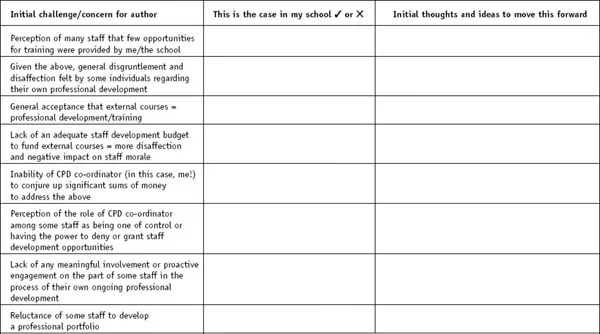
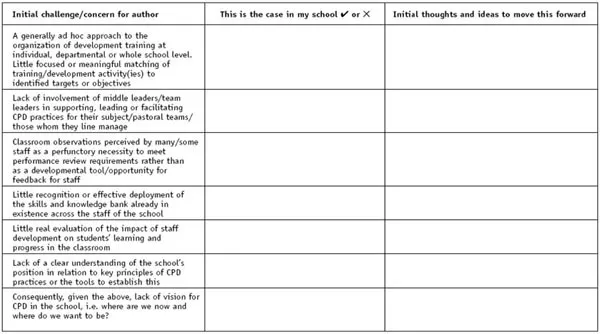
I have outlined in Figure 1.1 some of the challenges I faced initially when I took on the role of staff development co-ordinator in my school, many of which may be instantly recognizable to new or more experienced CPD co-ordinators. By judging your own school context against these simple indicators you can begin to gauge in practical and straightforward terms what areas of practice in your school may need some consideration to begin to shape your vision of where you wish CPD practices to go.
By spending a few minutes considering the challenges presented in
Figure 1.1 and capturing your initial thoughts of how to begin to address them, you have the makings of your personal vision for CPD in your school/institution and the beginnings of a plan to effect some immediate, medium- and long-term changes. If you are not on the senior leadership team of your school, engage the support of someone who is and use the ideas or issues outlined above to open a dialogue for change; few things can be more important than this, given the potential impact on student learning and the improvement, if needed, on staff morale.
Figure 1.1 is a handy and easily referenced evaluation guide designed to get you thinking about CPD practices and how to tackle them. As a complement to it and as a more in-depth approach to considering current practices, I have found the self-evaluation table produced by London’s Learning Emerging, Developing, Establishing (EDE) project (see Figure 1.2 on the CD-ROM that accompanies this book) to be invaluable in moving forward areas of my practice in school.
There are obviously many ways of using such a model to support whole-school development practices. Although I have given some ideas here, your own school context will dictate how you might most successfully employ such a tool in identifying an area or areas which can form a part of your whole-school development plan to drive forward your vision successfully.
Figure 1.1 Informal self-evaluation of CPD leadership
| Photocopiable: The CPD Co-ordinator’s Toolkit
Paul Chapman Publishing 2006 © Sue Kelly |
An individual approach
Use your knowledge of staff development practices in your school to gauge your school’s position across the areas of CPD and, drawing on Figure 1.2, establish whether these are ‘emerging’, ‘developing’ or ‘establishing’. Record any evidence of CPD practices for each section and where this can be found if appropriate. Use this information to feed into a draft CPD action plan with clearly identified future objectives, realistic timescales and guaranteed success criteria. Include an idea of who will be involved and what their role(s) will be. Take this to your senior leadership team as a draft proposal and request their comments, feedback and support. Seek commitment to areas identified for change, that is, inclusion of key areas in the school improvement or development plan.
A consultative approach
Engage middle and senior leaders in reflecting on CPD practices in your school by sharing the self-evaluation with them and asking for feedback. Use the responses to set up some cross-curricular teams linked to seni...