![]()
Chapter 1
Gifted Children in the Primary Classroom
In this chapter we will:
- Help you think about how your own beliefs about what giftedness is can influence pupil performance.
- Offer a circular model to consider giftedness in the primary classroom.
What teachers and pupils believe about gifts and talents
In primary school we have a huge advantage over our secondary colleagues. We see the children every day for whole days at a time. We, therefore, have ample opportunity to build important, long lasting and robust relationships with our pupils. Every primary school teacher recognises that this is vital, not only to create a positive and pleasant working environment, but because it makes a huge impact on how well pupils perform in our class.
The way that we build these relationships is affected by what we believe a ‘good’ pupil to be. The way that we build relationships, the way that we talk to pupils and the expectations that we have of individuals are deeply affected by how we believe the human mind worksi. Researchii suggests that what we believe about how the human mind works is often built on unquestioned assumptions.
Implicit theories…reside in the minds of individuals, whether as definitions or otherwise. Such theories need to be discovered rather than invented because they already exist, in some form, in people’s heads.iii
Forming these implicit theories, while often done unconsciously, is essential because they help us to function effectively in life. The way that they help us is by guiding the way we behave; both what we say and what we do. It is not just teachers, however, who hold implicit beliefs. Children in our classes will hold these beliefs too. They are formed as a result of the way that parents and teachers talk to them and give them feedback about their behaviours and achievements.
In the primary classroom, beliefs are particularly important. Pupils are still forming their beliefs and the primary teacher can have a huge influence on how these develop. They are important to think about because what individuals believe about their own and others’ abilities:
- can account for differences in achievement between pupils and by individual pupils over time;
- make a difference to the amount of effort a learner might put into an activity;
- can help to explain depressive reactions by pupils (yes, even in the primary school), to bad experiences in learning;
- and can be used to judge and label both ourselves and others.
There are two very different implicit theories of intelligenceiv.
- Intelligence is fixed.
- Intelligence is changeable.
What does believing that intelligence is fixed mean for pupils?
If pupils believe intelligence is fixed it means that they are likely to believe that they were born either clever or stupid and that they will stay that way for the rest of their lives. They also tend to believe that school success and school tests are a good indicator of who is clever and who is not. As a result of this they will predict their future success on the basis of today’s performance. They will offer reasons for success and failure that are related to personal adequacy or inadequacy. For example, failure may be accounted for by poor memory or low intelligence (I just can’t do maths!). Likewise success is because they have a natural aptitude for such things or because their parents were good at them. Such pupils are more likely to show aversion to tasks that they do badly in by saying they are bored or through feelings of anxiety.
Believing intelligence is fixed means that undertaking activities is about performance. Pupils with this belief might worry about how much ability they have or don’t have to complete a task. They calculate this by comparing themselves with others. These pupils are more likely to be competitive and can become driven with the need to show that they are the cleverest in the class. They may develop a tendency to choose the easy option and avoid harder tasks that might show them up to be less ‘clever’ than they thought they were (or that they would want others to perceive them to be). They believe that being clever means that all tasks and activities should be completed very easily therefore having to work hard at something indicates that they are not very clever. Only success that comes easily is valued because this is what indicates high ability.
Questions to consider
- Can I recognise any pupils who might have a fixed view of intelligence?
- To what extent do I have a fixed view of intelligence of my own learning?
What does believing that intelligence is changeable mean for pupils?
If a pupil believes that intelligence is changeable it means that they are likely to believe that how intelligent they can become is in their own hands. If they work hard they can become better at things and this improvement is an indicator of their intelligence. They rely less on test scores to give them a measure of their abilities and do not believe that test scores and school success will predict their future success or failure. Believing that intelligence is changeable means that failure is more likely to be put down to environmental or temporary contributors such as choosing the wrong topics to study. Equally success is generally attributed to sheer hard work.
Believing in changeable intelligence means that undertaking activities is about mastery. Pupils with this belief strive for personal improvement and so tend to be less competitive. They compete with themselves rather than other people. These pupils may develop a tendency to choose challenging work, rather than easy work, because that means they will learn more. Getting things wrong – within reason – does not bother them because failure is perceived as part of the learning process. These pupils have a belief that if you work hard you can become more able. Trying something really hard and achieving even only part of it shows you that you have improved and have learned new abilities that you did not have before. These pupils are more likely to be able to identify some things that they good at and some things that they are not so good at, believing that people are different and there are lots of ways of being able. These pupils seek to try lots of things because the experience of trying is enjoyable.
Teachers sometimes assume that gifted and talented pupils hold a belief that intelligence is changeable. They can be identified because of characteristics such as willingness to choose hard activities, and willingness to work hard. In fact some gifted and/or talented pupils believe strongly that intelligence is fixed. They will avoid hard work, try to do things with the minimum effort, and can be highly competitive. In this way the idea of implicit theories might help us to understand some aspects of underachievement, disaffection and disengagement.
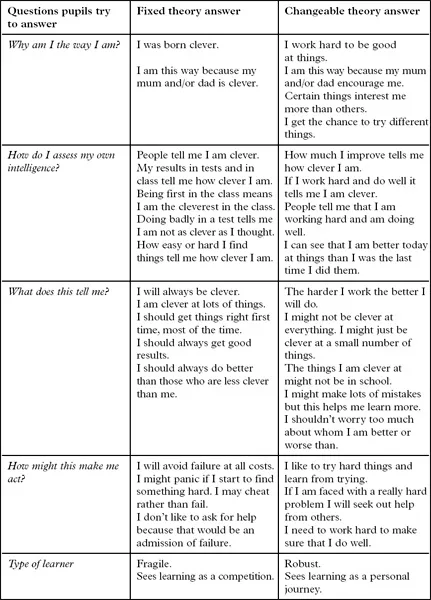
I have presented here characteristics of the extreme positions that implicit theories can create and these two positions mean very different things for individuals (see Table 1.1). You may have started to recognise a few pupils. We need to be careful, however. We don’t want to start labelling pupils as one type of theorist or another; labelling has not helped us in the past. Rather let us be aware that believing certain things can impact on how pupils learn in our classrooms and that as teachers we have the power to support or change their implicit theories. Whether we support or change implicit theories of intelligence in a positive way, however, will depend on the theory that we ourselves hold.
Table 1.1 Comparison of pupils’ implicit theories
Questions to consider
- Can I recognise any pupils who might believe that intelligence is changeable?
- To what extent do I believe that my own intelligence is changeable?
It can be useful to find out a little more about what the pupils in your class believe. Asking pupils the questions on the sheet on page 6 will provide you with some more information.
Think about your own beliefs by considering the questionnaire on page 7.
The more that you have agreed with the statements in the questionnaire on what you believe, the more you are likely to believe that intelligence is fixed. The more you have disagreed with the statements in the questionnaire, the more likely it is that you believe intelligence is changeable. What might this mean for how we teach? The examples below describe the extremes of holding one view or another. Most teachers are – quite rightly – somewhere between the two.
What does believing that intelligence is fixed mean for teachers?
Teachers who believe strongly that intelligence is fixed are likely to believe that some pupils have more innate ability than others. It is the teacher’s job to bring out the best in the children; in other words, help them to make the best of what they were born with. These teachers believe that the best way to provide for gifted and talented pupils is to identify which pupils were born with particular gifts and talents and to educate them accordingly. Although they do not believe education can make children more intelligent and that each child has a limit, they do believe that all children can improve their performance.
What am I good at?
- In school I am good at______________________________________
________________________________________________________ - Outside school I am good at_________________________________
________________________________________________________ - I am good at these things because_____________________________
________________________________________________________ - In school I am not so good at__________________________________
________________________________________________________ - Outside school I am not so good at_____________________________
________________________________________________________ - I am not good at these things because__________________________
________________________________________________________ - Do you think you could become good at these things? If yes, how?______
________________________________________________________ - Is there anything that you think you will never be able to do well? If yes, why is this?
________________________________________________________ - What is more important – to be the best in the class or do better than you did last week?____________________________________________
________________________________________________________
© Chris Smith, Teaching Gifted and Talented Pupils in the Primary School, Paul Chapman Publishing 2005. Photocopiable.
What do you believe?
Try answering the following questions.
What do I believe?
- Gifted individuals form a group that can be identified early in their school career and remains the same over time.
- Gifted individuals are born with high intelligence.
- Gifted and talented children need different forms of teaching and support from other children.
- Because of their differences gifted children need to be educated separately from other children.
- Teachers need special training and skills to teach gifted children.
- Giftedness is genetic and cannot be changed.
- Gifted and talented children need competition to keep them on their toes.