![]()
PART 1
UNDERSTANDING
COLLABORATIVE PRACTICE
![]()
1
INTRODUCING INTERPROFESSIONAL COLLABORATIVE PRACTICE
Chapter summary
When you have worked through this chapter, you will be able to:
- Understand the overall purpose, aims, scope and features of this book.
- Recognise how the book is aligned with a range of national standards related to professional social work practice.
- Be familiar with how the book is structured and the brief content of each chapter.
- Be aware of the key themes that underpin the whole book.
- Understand the range of terms, words and phrases used to describe aspects of working together.
INTRODUCTION
This introductory chapter will provide you with an overview of the whole book, laying out its purpose, aims and scope through an outline of the structure and key themes. This chapter will also identify how the contents of the book are related to key national standards for practice and social work education. Also, to inform your studies through the book, this chapter includes discussion about the different terminology employed to describe similar aspects of working together in social work practice; the language, terms and discourse we use are significant to how we understand and interpret the world around us. As an introduction to your learning across the book, this chapter can be likened to a course induction process.
Interprofessional Collaboration in Social Work Practice is, as they say, everyone’s business. The transition from a position of multi-professionalism, where there are many people from different disciplines working in isolation, to a state of interprofessionalism, where those professionals work collaboratively, is not as straightforward as it may sound: it impacts on everyone involved and everyone involved influences the progress. Written primarily for social work students and practitioners, although having relevance across the wider range of stakeholders, this book explores the issues, benefits and challenges that interprofessional collaborative practice can raise, with a particular emphasis on its impact on social work practice.
BOOK PURPOSE, AIMS, SCOPE AND FEATURES
As long ago as 1959, following an inquiry into the role, recruitment and training of social workers, the Younghusband Report stated that:
People do not normally feel part of a team unless they appreciate the effect of the combined operation, and the working method and function of each member. The elements in good team-work are, therefore, an administrative structure which facilitates co-operation, good working relationships between different types of officer and departments, and opportunities for regular meetings and discussion at all levels. (Younghusband 1959: 35)
Through the chapters of this book, you will read about how interprofessional collaborative practice has continued to be a policy and practice imperative. The book provides discussion and activities to help you learn about and reflect upon the ways in which collaborative working across professional and agency boundaries can impact upon the experiences of service users, carers and practitioners. Taking a broad, inclusive view of all aspects of social work and social care practice, this book emphasises the significance of social work as a profession in the collaborative environment. Your study through these chapters will help you look at the way social work and social work care agencies develop a professional and an agency culture and how this can both impede and assist working across organisational boundaries. It therefore encourages you to develop your skills as a critical, reflective interprofessional social worker.
The book requires you to critically examine the political, legal, social and economic context of interprofessional practice, exploring consistencies and contradictions evident in policy and procedure, through an analysis of their influence on the reality of professional practice. Within this, the background of current collaborative working practices, the continuities and changes will be considered. A principal theme throughout your reading will be the impact of interprofessional and collaborative working practices on the experiences of, outcomes for, and participation of service users and carers. Through concepts of participation and empowerment, the book will examine changes in the balance of power and infl uence between service providers and service users. Within an exploration of related research and theoretical models, you will critically examine the tensions inherent in interprofessional practice so as to be able to identify frameworks and components that typify effective collaboration.
This book focuses on relationships at different levels: between organisational or structural levels, interprofessional or interdisciplinary, and the individual levels of practice within the ‘helping professions’. Whilst it has a focus on ‘what this means’ for social work practice, you should be aware that collaborative working is not only limited to health and social care, but can involve a vast range of ‘stakeholders’. The term ‘stakeholders’ refers to any person who may have an interest or be affected by the relevant practice or service. As you study the materials in this text and work through the various activities and questions, it is important that you keep this range of possible ‘stakeholders’ in mind. To help you start thinking about the people and organisations you might work with in social work practice, take a moment to work through Activity 1.1.
Activity 1.1
- Think broadly about your knowledge and, if you have it, experience of social work practice. Make a list of all the different individuals, professions and organisations that might be considered to be ‘stakeholders’ – those who have an interest in, or are affected by, social work services and practice.
Whilst this activity is useful if you work through it on your own, it becomes even more interesting and expansive if you have the opportunity to work together with other students or colleagues from practice.
COMMENT
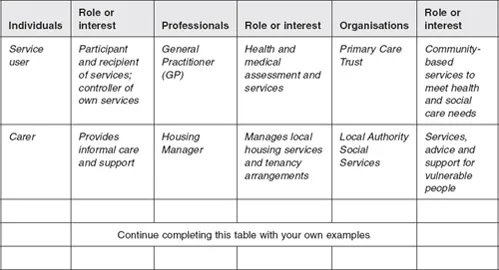
You are likely to have a long list of people and organisations, which may differ from another student as the lists may reflect different experiences and different knowledge of practice. I imagine that you may have started by including service users, carers and perhaps volunteers, local communities and neighbourhoods more widely. You are likely then to have moved on to think about various professions such as nurses, midwives, school teachers, careers advisors, probation officers, police officers, general practitioners (GPs) and so on. You may also have thought about the many organisations involved, ranging from statutory agencies such as local authorities, probation services and various National Health bodies, to private profitmaking services, social enterprises, voluntary or charitable groups (some of which are small, local agencies, while others might be affiliated to national groups), and user-led organisations. There are also wider national bodies, such as government departments and national research institutions. This is also not to forget the role of agencies and individuals who provide education and training for the various professions, not only in universities and colleges, but also from private and voluntary organisations. One way to try and represent the massive scope of this is to tabulate them. Figure 1.1 shows the beginnings of a table setting this out. As you will see, I have added columns to identify the role or interest that the person or organisation has in practice. You could complete the table by adding your list to it and completing the additional columns.
Figure 1.1 Identifying the stakeholders in the interprofessional, collaborative environment
However you undertake this activity, it will help you become more aware of the people and organisations you might collaborate with and the potential scope of interprofessional practice. You are encouraged to keep your notes from this activity, as you may need to refer back to them later as you work through this book. Whilst it is not possible in a book of this size to examine each of these many aspects of interprofessional collaboration, throughout the book I acknowledge the range of settings where collaborative working practices are being embedded. Through case studies, reflective activities, research examples and further reading, all of which focus on different areas and levels of practice, you will develop transferable knowledge, skills and awareness of values relevant across all practice contexts, to support you as you develop as an interprofessional social worker. Furthermore, with regard to the scope of this book, you will find that, as far as possible, the materials and concepts relate to social work practice across the four countries of the United Kingdom, however the legislation discussed is largely English.
Given the fast pace of political and policy change, though, and the increasingly differing approaches that the devolved governments are developing, Chapter 2 of this book offers a broad overview of the context for collaborative practice with many suggestions and references that you might explore for more knowledge on specific contemporary issues for each country. Beyond Chapter 2, the book explores concepts, theories, research and practices which are broadly applicable, not only across professional and organisational boundaries, but, crucially, geographical boundaries as well.
In each chapter, you will have the opportunity to further your learning and understanding through interacting with a range of features, which as you have read above, include activities and reflective practice questions, followed by my own thoughts and comments on the issues that might be raised as you undertake the tasks. There are also case studies, annotated further reading with links to relevant Internet Web pages and ideas of ways in which you might take your learning further. Please note that there are ongoing changes in governmental structures and the Internet sources that reflect them, references to the Department for Children, Schools and Families and Every Child Matters websites may be sourced through the Department for Education at http://www.education.gov.uk. At the end of the book, you will find a Glossary of terms and abbreviations. This is not an exhaustive list as I have defined and explored many terms throughout the text, but you may find this useful if you are seeking a succinct definition of a particular concept discussed in the chapters. It is my intention that by working through this book and engaging with the interactive experience I offer you, you will build up a portfolio of notes, diagrams, reflective records and tables that will support your further learning and development. Finally, to support your learning through this book and to provide educators and tutors with additional materials to support you, this book has a companion website (www.sagepub.co.uk/crawford).
ALIGNMENT WITH THE NATIONAL STANDARDS
As you study the contents of the chapters in this book, your learning and development will be closely associated with the national requirements for social work practice as set out in the National Occupational Standards for Social Work (TOPSS UK Partnership 2002), the Common Core of Skills and Knowledge for the children and young people’s workforce (CWDC 2010) and the General Social Care Council Codes of Practice for Social Care Workers (GSCC 2002). The approach taken across the text is also related to the academic subject benchmark statements for social work (Quality Assurance Agency 2008), which set out the nature and characteristics of social work education at Bachelor’s (with honours) degree level. It is important to note that national standards and requirements of this nature are always subject to change, as social work education and practice is continually under review. Therefore, whilst the overall themes are always likely to be relevant, as a student or practitioner, you should ensure that you are aware of the most current principles and standards for social work practice and education. One way to start achieving this is to work through Activity 1.2.
Activity 1.2
- For the first part of this activity, select to focus on either the National Occupational Standards for Social Work, the Common Core of Skills and Knowledge for the children and young people’s workforce, the GSCC Codes of Practice for Social Care Workers or the academic subject benchmark statements for social work.
- Using the links and references provided in this section of the chapter, examine the full details of the area you have chosen.
- As you examine the range of statements, make a note of those that you feel have relevance or support int...