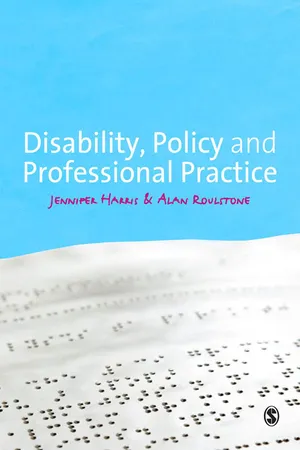
This is the first book on working with disabled people to take an aspirational, outcomes-focused approach to professional practice. It forms the first attempt to grapple with the massive legislative and policy shifts in the Disability field in the last 15 years and provides an up-to-date, positive approach to professional practice, based on the social model of disability. Importantly, the book translates both adult and children?s? disability legislation and policy guidance into positive, creative, enabling practice methods for professionals in social care, health, employment and independent living.
The book takes a practical approach that challenges professionals to confront key issues in disability studies, policy and practice. The key topics covered are:
o The Historical Legacy, Legislation, Policy and Guidance
o Community Care and Beyond
o Pivotal Moments in the development of disability policy
o Independent Living, Choices and Rights
o Life course Issues
o Valuing Diversity
o Key Challenges for an aspiring social model practitioner
This book is an indispensable resource for all professionals and students working with disabled people.
There has never been a more interesting time to study the convergence of disability with social policy and professional practice. This book distils the many and various legislative and policy changes that have occurred over successive years since the inception of the welfare state to the present into a readable form for both practitioners and students working with disabled people.
Disability studies is an evolving discipline, largely borne from the discontent of members of the Disabled Peoples Movement, allied academics and professionals with traditional forms of health and social care services that have served to individualise disabled people’s issues and consequently produce isolating forms of service provision. This book seeks to demonstrate how disabled people and their allies have undertaken a journey from a time when they and their services were shaped by legislators and policy makers, to the present time when disabled people have turned the tables and are now participating in the shaping of disability policy.
With this new shaping possibility, has come the requirement to rethink modes of working with disabled people. Traditional service forms based on ‘expert power’ wielded by cohorts of unenlightened professionals are no longer relevant in this new era. There is a pressing need instead for new forms of practice such as those described here, based on facilitation and advocacy and acknowledging the primacy and centrality of service users’ choice and control. Such practice should be personalised and outcome-focused. There is a unique defining moment here for professionals involved with disabled people to utilise their professional skills to support, facilitate and advocate for disabled people in a new form of positive practice described in this book.
Disabled people have in modern times had an increasingly fraught relationship with ‘professionals’ from Health and Social Services – the ‘caring professions’. We aim to show in this book that many if not all of these issues have been either directly or indirectly caused by adherence to the individual model of disability (Oliver, 1990), inappropriate and unwieldy bureaucratic structures and an obsession with expert power, at the expense of focusing on disabled people’s requirements. Although many disabled people and commentators have bemoaned this situation (Davis in Swain et al., 2004), little by way of solution has been suggested.
It is widely thought that professionals that act in these ways are unhelpful, that the lack of choice (Davis, in Swain et al., 2004) that is endemic in traditional service provision is lamentable and that basically everything takes too long owing to the creaking top-heavy structures in place, but very few acceptable suggestions and models of professional practice have been put forward by disabled people and their allies. Yet these pockets of non-stigmatising, helpful and assistive models and practice do exist, albeit in isolated and not well publicised formats (Harris et al., 2005; Silburn in Swain et al., 2004). It is an aim of this book to capitalise on these models and frameworks in order to demonstrate that assistance can be provided in ways that allow for choice and control to be retained and that are based on relationships of equality and respect. The term ‘professional practice’ in our title therefore, does not reflect an endorsement of professional statuses, traditional service provision or ‘expert power’; in fact the opposite. Instead we seek to both problematise the concept and explore the tenets of (what we term as) ‘positive practice’ – ways of working with disabled people to achieve the desired outcomes of choice.
Importantly and centrally, this book is written by two allies of the British Disabled Peoples Movement who take their perspective from the social model of disability:
For many years doctors, social workers and other people have told disabled people that they are disabled because of ‘what is wrong with them’ – their legs don’t work, they can’t see or hear or they have difficulty learning things, just to give a few examples. This is known as the medical model of disability. It says that it is the person’s ‘individual problem’ that they are a disabled person.
What we say is that yes, we do have bits of us that don’t work very well, this we call our impairment: for example a person who cannot hear very well has a hearing impairment. What we say is that it is not this impairment which makes us a disabled person, it is society which makes us disabled. Society does not let us join in properly – information is not in accessible formats, there are steps into buildings, people’s attitudes towards us are negative. So society puts barriers before us which stop us from taking part in society properly – it disables us. This is known as the social model of disability. (Greater Manchester Coalition of Disabled People, Young Disabled People’s Group, 1996; quoted in Morris, 1999: 5)
Thus the social model of disability (Oliver, 1990) is far more than a guiding principle, it is a political commitment that informs and directs action. Much is written in this book about the social model of disability; its aims and reach and the pervasive and profound ways in which it has altered the public consciousness concerning disability and impairment.
Positive practice, as described here, is firmly rooted in the social model of disability and the ‘seven needs’ (information; access; housing; technical aids; personal assistance; counselling; and transport) (Harris et al., 2005; Silburn in Swain et al., 2004).
Throughout this book, we use the term ‘disabled people’ in a social model of disability sense – to refer to people disabled and/or oppressed by the majority society of non-disabled people. In the majority of the discussions below, we do not distinguish disabled people on the grounds of individual impairment types, except when discussing service silos set up for particular groups.
In setting out the stall for positive practice, we aim to influence a new generation of workers who will be involved in disabled people’s lives. Whilst much of the bedrock of positive practice is philosophical therefore, we aim to show that working positively with disabled people is equally about personal attitude and political commitment to the goals and outcomes of the Disabled Peoples Movement. It is assumed that professionals will wish to develop such positive attitudes through direct experience and through an ongoing willingness to learn from disabled people and a willingness to pass this on to colleagues. Only in this way will new forms of assistance flourish.
We wrote this book because we were concerned that very few authors (especially within disability studies) appear to write about positive ways of working with disabled people and yet the statutory system of Health and Social Care, as well as housing, employment and training, is full of practitioners who do work every day with disabled people. Whilst it is comparatively easy to level criticism at service providers who fail to aspire to the high quality standards of service provision that disabled people rightly demand, it is more difficult to synthesise core messages of good practice that they can use to improve their work. However, such models do exist and we detail many of them here.
We realise that some people will say that a system that does not support the key areas of intent for disabled people is no use and should be disbanded and that perhaps our intention is merely to extol its continuation. However, we believe that the current system of statutory service provision in Health and Social Services will continue for the foreseeable future, most likely in a similar form, and for those disabled people who come into contact with professionals, it would be better if they are trained to be positive practitioners, using social model of disability principles, and positive methods such as outcome-based practice. While the statutory service system exists, let us have the best positive professionals that we can. We would like to see services that empower disabled people and that seek to assist them to achieve their desired outcomes, delivered by enlightened professionals who work to facilitate access to the resources that disabled people want and need. None of this is impossible, but it does take thought and a willingness to suspend disbelief.
The book is laid out in nine chapters which includes this introductory chapter and a Conclusion. In Chapter 2 we introduce the historical legacy, legislation and policy guidance that forms the bedrock of disability studies in the UK. In Chapter 3, ‘Community Care and Beyond’, we discuss the importance of community care and deinstitutionalisation as a turning point in both policy and service provision modes. In Chapter 4, we explore ‘Pivotal Moments in the Development of Disability Policy’, particularly those relating to the recent shift in consciousness that occurred when disabled people began to shape social policy. Thus we discuss the social model of disability, mainstreaming and balancing greater individual choice with resource equity, before exploring the lessons of history and the new demands in practice, positive practice and advocacy, facilitation and empowerment. Finally, we discuss the implications of Equality 2025 and the growth of Centres of Inclusive Living. In Chapter 5, ‘Independent Living, Choices and Rights’ we discuss enabling practice in the 21st century and key laws and policy guidance documents that underpin practice, including Working Futures; Direct Payments; Personalisation and Self-directed Support; Independence, Wellbeing and Choice; In Control and Individual Budgets.
This is followed by Chapter 6, ‘Life Course Issues’ which explores the issues that arise across the life course for disabled people, particularly for children. Hence we discuss Every Child Matters, Every Disabled Child Matters, disabled children’s wheelchair services and transition from children’s to adult services. We follow this with an examination of working with older disabled people; practice issues for adult social care and older people; home-based living options for disabled people; practice points with assistive technologies and the family context, in which we explore how to balance disabled people’s rights with those of carers. In Chapter 7, ‘Valuing Diversity’ we explore mental health, learning disability, gender and disability, ethnicity, sexuality, sexual identity and parenting. All these issues form key learning points for the aspiring positive practitioner and the value bases that underlie them are important to examine reflexively.
In Chapter 8, ‘Key Challenges for an Aspiring Social Model Practitioner’ we examine the challenge of user choice and control and explore positive practice in more detail. We also look at ‘managing the managers’ and discuss budgetary constraints and street level bureaucracy – all factors which if unrecognised can lead to disempowerment by the system. The complex areas of ‘mental capacity’ and Power of Attorney are next examined, as is the issue of balancing different people’s rights in practice. We then turn to working with colleagues in user-led organisations and discuss the opportunities for learning in practice from such working. Then we look at the possibilities for developing ‘real reflexivity’ in working with disabled people. In the Conclusion, we attempt to draw together the key lessons in this book for the positive practitioner.
Throughout this book you will find ‘light bulb moments’.
These are designed to get you thinking and often address issues to which there is no easy answer. Mostly, these issues are at the heart of professional practice dilemmas and concern ways in which practice can be improved. We suggest you consider the issues raised by these light bulb moments and write some notes on each one. As the issues in the main concern values and these differ between individuals, we suggest you engage others in discussing your notes. These could be supervisors, colleagues or others within your organisation. Given the interdisciplinary nature of disability studies and its situation between Health and Social Services (as well as the third sector) it would be really useful to discuss your notes with colleagues in these other sectors. Some issues may cause you concern and these are particularly worthy of note. Many professionals can appreciate good practice in an abstract sense but become uneasy and defensive when having to apply it in real life. It is worth making the effort to find some assistance or training on any issues that cause you concern. The chances are that these will form barriers to real reflexivity if not. As in so much of professional practice, there are no ‘correct’ answers.
2
The Historical Legacy, Legislation, Policy and Guidance
Introduction
In this chapter we critically explore the development of services and professional working with disabled people. The chapter aims to provide a policy and practice backdrop against which to understand the modernisation of disability services. The chapter also gives very strong clues as to the power of paternalism in disability services which originally underpinned much professional practice and which helps explain why despite apparently progressive new policies, the extent of improvement in services was often limited by the pre-existing ideas of professionals. Indeed early provision for disabled people was largely conditional upon accepting an enforced stigma for the protection received.
The roots of policy, legislation and protection
Throughout recorded history disabled people have seen decisions being made about their lives by those in ‘authority’ (Borsay, 2005). Interpretations of the functions of authority have varied. At times authority has been viewed as resting on straightforward power differentials and resulted in the imposition of practices designed to reaffirm the social marginalisation of disabled people (Barton, 2001; Finkelstein, 1980; Oliver, 1990). At other times the notion of authority has reflected the traditional professional view that disabled people as a population require social protection (Jay in Brechin et al., 1981). What connects these interventions is the history of legislative and policy developments that have helped legitimate the role of professional or expert interventions. It would be wrong however to suggest, as some authors (Davis, 1998) do, that most contemporary professional working with disabled people can trace its direct lineage back to guardians and relieving officers of the Poor Law system. The given matrix of economic and social forces that existed at any point in history has provided specific factors in shaping the nature of authorised support before the birth of named professionals – for example social workers, general practitioners, educational psychologists and occupational therapists. What we can say, however, with some degree of accuracy is that the broad shift throughout the last 500 years is best captured in the following typology:
Pre-industrialisation – most disabled people were spatially integrated but often culturally excluded. Few authorised people existed to respond to disabled people. The Poor Law was the main form of support.
Industrialisation produced large-scale shifts to institutionalisation of many disabled people. With late industrialisation a range of ‘professionals’ grew up to respond to the needs of disabled people
The decline of industrialised thinking and growing humane sensibilities led to deinstitutionalisation for many, but not all disabled people. Professionals have been required officially to listen to disabled people’s views as sensibilities towards difference alter in their favour. Arguably the very survival of some professions will require them to connect more fully with disabled peoples’ perspectives.
Basic forms of voluntary and state-funded community and health support for disabled people were available before the key social legislations of the 1940s (Fraser, 2002; Lowe, 2005) and before the social care legislation of the 1970s. However, such support was haphazard, stigmatised and eligibility to a given form of support by definition marked a person out as different. The origins of the connection between stigma and disability can be found in the English Poor Law.
The Poor Law origins of health and social care
The English Poor Law was instituted in the reign of Elizabeth I in 1601. The recognition of the unmet needs of sick, infirm and disabled people although very basic and locally haphazard did afford basic protection for disabled people to at least survive alongside their non-disabled counterparts. Physical impairment, ‘infirmity’ and mental frailty all served as the basis of Poor Law support. The Poor Law however was designed with another express purpose – that of keeping ‘the able bodied’ away from l...
Table of contents
Cover Page
Title
Copyright
Contents
1 Introduction
2 The Historical Legacy, Legislation, Policy and Guidance
3 Community Care and Beyond
4 Pivotal Moments in the Development of Disability Policy
5 Independent Living, Choices and Rights
6 Life Course Issues
7 Valuing Diversity
8 Key Challenges for an Aspiring Social Model Practitioner
9 Conclusion
Bibliography
Index
Trusted by 375,005 students
Access to over 1.5 million titles for a fair monthly price.
Study more efficiently using our study tools.
Frequently asked questions
Yes, you can cancel anytime from the Subscription tab in your account settings on the Perlego website. Your subscription will stay active until the end of your current billing period. Learn how to cancel your subscription
No, books cannot be downloaded as external files, such as PDFs, for use outside of Perlego. However, you can download books within the Perlego app for offline reading on mobile or tablet. Learn how to download books offline
Perlego offers two plans: Essential and Complete
Essential is ideal for learners and professionals who enjoy exploring a wide range of subjects. Access the Essential Library with 800,000+ trusted titles and best-sellers across business, personal growth, and the humanities. Includes unlimited reading time and Standard Read Aloud voice.
Complete: Perfect for advanced learners and researchers needing full, unrestricted access. Unlock 1.5M+ books across hundreds of subjects, including academic and specialized titles. The Complete Plan also includes advanced features like Premium Read Aloud and Research Assistant.
Both plans are available with monthly, semester, or annual billing cycles.
We are an online textbook subscription service, where you can get access to an entire online library for less than the price of a single book per month. With over 1.5 million books across 990+ topics, we’ve got you covered! Learn about our mission
Look out for the read-aloud symbol on your next book to see if you can listen to it. The read-aloud tool reads text aloud for you, highlighting the text as it is being read. You can pause it, speed it up and slow it down. Learn more about Read Aloud
Yes! You can use the Perlego app on both iOS and Android devices to read anytime, anywhere — even offline. Perfect for commutes or when you’re on the go. Please note we cannot support devices running on iOS 13 and Android 7 or earlier. Learn more about using the app
Yes, you can access Disability, Policy and Professional Practice by Jennifer Harris,Alan Roulstone in PDF and/or ePUB format, as well as other popular books in Social Sciences & Social Work. We have over 1.5 million books available in our catalogue for you to explore.