The book combines real-life examples with discussion points on some of the key principles of law, inviting readers to consider what it means to be professional and to promote and support young peoples? rights.
- 120 pages
- English
- ePUB (mobile friendly)
- Available on iOS & Android
eBook - ePub
Law and Youth Work
About this book
This book offers a practical and straightforward approach to understanding how the law protects, empowers and regulates young people?s lives. The implications for the professional youth worker of a wide range of dilemmas are considered. Workers are encouraged to consider what is meant by rights and, through practical examples, to examine their own beliefs and ethical codes, particularly where they conflict with established rules.
Information
Chapter 1
Introduction
CHAPTER OBJECTIVES
The key purpose of youth work is to:
enable young people to develop holistically, working with them to facilitate their personal, social and educational development, to enable them to develop their voice, place and influence in society and to reach their full potential.
National Occupational Standards 2008
In order to meet the key purpose, the book will make the case for why some understanding of the law is necessary in order to help the worker to contextualise their engagement with young people. Without understanding the concept of place the worker is placed at a distinct disadvantage in empowering and enabling young people to have influence in society and develop a sense of citizenship.
This book is targeted primarily at youth workers embarking on the academic stage of their continuous professional development. It is intended to supplement your knowledge of how the developing and established law relates to your own professional practice. It does not cover all aspects of the law nor does it profess to provide all the answers to the complex issues you might face as professional workers. It should, however, help you to understand some key legal principles and provide a basis for further enquiry. It may, therefore, also be helpful to youth worker practitioners who have had limited opportunity to update themselves on developments in the law which affect their work.
It is based on fundamental principles of human rights and social justice, which lie at the heart of youth work values. The law is about values. It is also about a framework and sets of rules for regulating human behaviour. This is why it is important. A statement of youth work values taken from the National Occupational Standards for Youth Work is included, but it is worth reminding ourselves at the outset of the definition of youth work in order to determine its purpose and distinguish it from other professions that engage with young people in order to promote their social and emotional wellbeing.
Professional standards
Youth work training has undergone fairly significant changes in recent years with new qualification requirements and professional standards for practitioners. The revised Occupational Standards for Youth Work were finalised in February 2008 and cover the outcomes, behaviours, knowledge and skills that professional youth workers should conform to. Before we consider what knowledge of the law has to do with youth work, we need to understand that youth work does not operate in isolation but forms part of a range of interventions in young people’s lives designed to improve their life chances. It operates within a political and social climate which has high aspirations for young people and expects high standards from those who work with them. Failures of previous policies and practices in both social and educational settings have led to a significant shift away from a less well regulated or laissez-faire approach to professional competence. There is a greater requirement to raise our professional standards if we are to create an environment where young people are able to develop and achieve higher aspirations.
Increasingly as multidisciplinary working becomes the norm, workers should expect to develop competence within their own practice areas, but to operate within a set of standards that are shared with a wider group of professional colleagues.
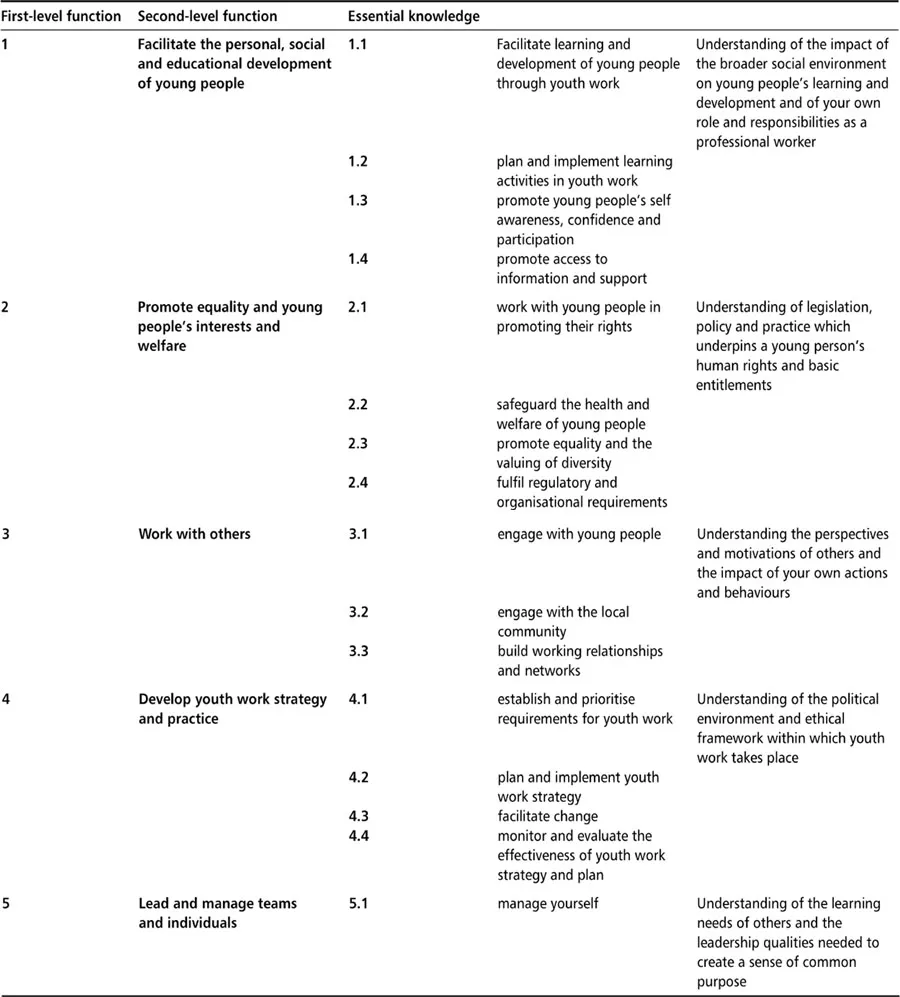
The occupational standards are represented in Table 1.1. You may already be familiar with them presented diagrammatically as the Summary Functional Map for Youth Work (National Occupational Standards, 2008).
Included within the table are the knowledge requirements. You will note that knowledge of legislation is explicitly listed under Section 2 which deals with the welfare and rights of young people, but it is essential in assisting you in promoting access to information and support (Section 1.4) and in understanding how youth work operates within a political and ethical environment (Section 4).
Throughout the book we will refer to key competencies to illustrate how your interpretation and application of legal principles aligns to your own professional development.
This book, therefore, considers the interrelationship between the law and professional youth work competencies. It asks you to consider which of the competencies are common to all those who engage with young people and which are those that help to distinguish youth work from other professional disciplines. It remains, therefore, quite focused on the unique perspective of the youth worker, but should help the worker to develop a better understanding of the public and professional duties of their colleagues. This, in turn, helps to equip the youth worker to provide more effective support to young people, particularly during times when intervention by other professionals becomes necessary. It may additionally help to reduce conflict between the worker and other agencies whose intervention, at least from the young person’s perspective, is involuntary. It should help you to understand the rules that regulate other professions and help you to operate alongside others to get the best outcome for the young person.
There is no intention here to replace any proper legal advice or advocacy to which a young person is entitled, nor is this book a potted guide to all aspects of the law that impact on a young person. Instead it aims to combine a straightforward approach to the law as it relates to youth work with some practical exercises for the professional worker to work through independently or with colleagues.
You are encouraged to reflect on your approach to your work and consider the values that underpin your practice as well as those that underpin the development of human rights law, because it is within the framework of human rights that we will consider the impact of the law on young people. You will discover that what we value is important in determining how effective we become and is therefore a significant feature of your professional youth work development. Values also underpin the principles of human rights development and the development of laws affecting children and young people. This will be discussed more fully in Chapter 2, Human rights.
Table 1.1 National Occupational Standards – Framework
The core themes are set out in chapter format with an outline of what you can expect from each chapter, some exercises for you to complete and questions for you to consider. Each chapter concludes with a chapter review. There is, in addition, some suggested further reading and a list of useful websites. You are encouraged to seek out a wide range of information from different sources. Online searches can help you get started but are no substitute for reading widely to develop a good understanding of your subject through books, journals and newspapers. You should read conflicting views to enable you to critically review the literature and develop your own understanding of the impact of changes in legislation and policy in relation to young people.
In Chapter 2, the background to the development of human rights law is examined. You will be taken through different theoretical perspectives on young people’s rights, from those that emphasise young people’s right to self-determination to those that highlight young people’s vulnerability and their right to protection and provision for their needs. You will be able to distinguish the United Nations Convention on the Rights of the Child from the European Convention on Human Rights and consider the impact of the Human Rights Act 1998 on the development of a young person’s rights.
Chapter 3 looks at the legal definition of capacity and considers the extent to which young people can consent to and refuse medical treatment or interference with their bodily integrity. It examines the current position, provides the background to key judicial decisions and invites the practitioner to question the extent to which the interpretation of the law has developed insofar as it promotes young people’s autonomy.
Chapter 4 is about safeguarding young people’s health and wellbeing. Recent well-publicised public inquiries into child deaths have consistently highlighted the importance of effective communication between different professionals, and reinforced the notion of professional accountability, even where the professional had no direct knowledge of the facts. In this chapter we will look at some examples of cases that pose particular challenges for youth workers, and examine briefly the roles and responsibilities of other professionals. The chapter deals with the balance between confidentiality and disclosure as well as the duties and powers provided for by the Children Acts of 1989 and 2004.
In Chapter 5, there is an opportunity to take a more in-depth look at the impact of emotional distress and mental ill health on a young person’s capacity to exercise their fundamental rights. It considers what protective measures the law adopts and whether there is more that could be done to intervene earlier to promote mental wellbeing.
Chapter 6 deals with crime and disorder. This is, for many youth workers, one of the most challenging to navigate as youth workers are often faced with young people who feel demonised by both the law and the wider adult communities within which they live. In this chapter we will consider current government policy and the relationship between the youth service and the youth justice agenda. We will examine the law and its relationship with the National Occupational Standards for youth workers. We will explore whether and how youth workers contribute to the development of public policy. We will ask whether there is a need to reassess youth work values in order to give effect to national policy on crime and disorder. Does the requirement in the Youth Crime Action Plan for detached youth workers and former gang members to work alongside the police to combat the ‘negative effect of delinquent peer groups’ equip the worker to become a more effective multi-agency worker, or does it represent a fundamental departure from core youth work values of impartiality and youth empowerment?
This leads us on to Chapter 7 in which we consider the inclusion and participation of young people in decision making and critically examine whether society’s relatively recent promulgation of participation helps young people to enforce their rights or merely provides the tools for them to articulate their dissatisfaction. We look more critically at what factors the worker may need to address about their own inclusion in order to effectively promote that of young people. We will explore notions of fairness, responsibilities and arbitration.
Chapter 8 concludes with a review of the youth worker’s role and takes an in-depth look at the needs of young peop...
Table of contents
- Cover
- Title
- Copyright
- Contents
- Foreword from the Series Editors
- 1 Introduction
- 2 Human rights
- 3 Autonomy, consent and competence
- 4 Child protection
- 5 Mental health
- 6 Crime and disorder
- 7 Participation and freedom of expression
- 8 Developing inclusive practice
- Appendix 1 Summary of the purpose of the Human Rights Act 1998
- Appendix 2 Convention for the Protection of Human Rights and Fundamental Freedoms
- Appendix 3 Table of cases
- Index
Trusted by 375,005 students
Access to over 1.5 million titles for a fair monthly price.
Study more efficiently using our study tools.
Frequently asked questions
Yes, you can cancel anytime from the Subscription tab in your account settings on the Perlego website. Your subscription will stay active until the end of your current billing period. Learn how to cancel your subscription
No, books cannot be downloaded as external files, such as PDFs, for use outside of Perlego. However, you can download books within the Perlego app for offline reading on mobile or tablet. Learn how to download books offline
Perlego offers two plans: Essential and Complete
- Essential is ideal for learners and professionals who enjoy exploring a wide range of subjects. Access the Essential Library with 800,000+ trusted titles and best-sellers across business, personal growth, and the humanities. Includes unlimited reading time and Standard Read Aloud voice.
- Complete: Perfect for advanced learners and researchers needing full, unrestricted access. Unlock 1.5M+ books across hundreds of subjects, including academic and specialized titles. The Complete Plan also includes advanced features like Premium Read Aloud and Research Assistant.
We are an online textbook subscription service, where you can get access to an entire online library for less than the price of a single book per month. With over 1.5 million books across 990+ topics, we’ve got you covered! Learn about our mission
Look out for the read-aloud symbol on your next book to see if you can listen to it. The read-aloud tool reads text aloud for you, highlighting the text as it is being read. You can pause it, speed it up and slow it down. Learn more about Read Aloud
Yes! You can use the Perlego app on both iOS and Android devices to read anytime, anywhere — even offline. Perfect for commutes or when you’re on the go.
Please note we cannot support devices running on iOS 13 and Android 7 or earlier. Learn more about using the app
Please note we cannot support devices running on iOS 13 and Android 7 or earlier. Learn more about using the app
Yes, you can access Law and Youth Work by Mary Maguire in PDF and/or ePUB format, as well as other popular books in Social Sciences & Social Work. We have over 1.5 million books available in our catalogue for you to explore.