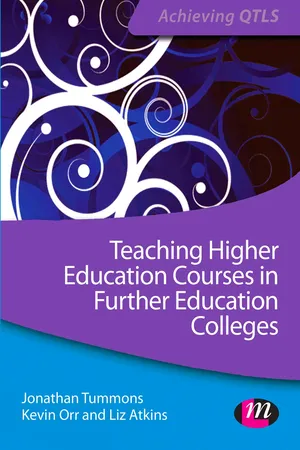
As the number of higher education (HE) courses offered in further education (FE) settings increases, so does the need for teachers and trainee teachers to develop their teaching skills. This text is written for all teachers and trainee teachers in FE. It considers what it means to teach HE in FE and how an HE environment can be created in an FE setting.
The text covers day-to-day aspects of teaching including planning and assessment, giving guidance on the unique needs of HE students. Chapters on research and quality assurance support the reader in developing some advanced teaching skills. This is a practical guide for FE teachers and trainee teachers as the sector adapts to the needs of education today.
eBook - ePub
Teaching Higher Education Courses in Further Education Colleges
- 128 pages
- English
- ePUB (mobile friendly)
- Available on iOS & Android
eBook - ePub
Teaching Higher Education Courses in Further Education Colleges
About this book
Information
1
College-based higher education and widening participation
By the end of this chapter you will be able to:
• contextualise widening participation in HE in terms of the political agenda;
• understand the academic and organisational implications of offering college-based higher education;
• discuss the new types of HE provision offered in FE;
• describe a broad range of curricula offered under the college-based higher education banner.
Introduction
The term ‘widening participation’ refers to a broad range of initiatives and activities which have taken place, over time, across both the HE and FE sectors. In terms of college-based higher education, however, it is used to:
...denote activities to recruit students from the groups that HEIs have identified as under-represented, and then to ensure their success. These groups may include disabled people, people from a particular cultural or socio-economic background, or even a particular gender.
(HEA, 2012, online)
Widening participation has been a major theme in government education policy for over a decade. This chapter explores the origins of the widening participation agenda, and considers it in the context of academic concepts of social justice. It explores the political and educational context surrounding widening participation, as well as the debates for and against what has become, for many, a contentious issue. A key aspect of the concerns around widening participation focus on the fact that HE is, like wider society, highly stratified. This means that students studying at higher status institutions (who tend to be more socially and economically advantaged) gain credentials that have greater exchange value than those that other students (who tend to be more disadvantaged) gain from lower status institutions. This is an important point, and one that we shall return to.
While this chapter is focused on widening participation, it is worth pointing out that many of the discourses, or discussions, surrounding widening participation resonate with those surrounding inclusion, which is itself a contested and sometimes controversial subject. Both are concerned with addressing issues of social and educational exclusion. Many of the students who benefit from inclusion policies and practices, or who form part of the widening participation agenda, may be seen to exhibit a range of characteristics associated with social exclusion (such as gender, a lack of credentials, ethnicity, disability, poverty and class), which locates them at the bottom of a highly stratified society. It is important, however, to be aware that within these hierarchies there are layers of inclusion and exclusion and not just a simple distinction between inclusion and exclusion (Bathmaker, 2005).
RESEARCH FOCUS
Hoelscher et al. (2008, page 149) have identified three goals of widening participation. They argue that two of these (fair access and widening participation to include under-represented groups) are deeply rooted in notions of social justice. The term social justice is widely used in education, and most people working in education would argue that they are committed to social justice. So, indeed, would politicians of all persuasions and this is often explicitly reflected in policies which claim to be, for example, an engine for social justice and equality of opportunity (DfES, 2006, page 1e). That so many people, often with extremely polarised views, claim a belief in social justice reflects the fact that it is a confused and debated notion, which has no clear definition but is open to many different interpretations and meanings.
Among some of the key authors on this subject, Minogue (1998, page 234) has described it as a family of ideas and an abstract universal, while MacIntyre (1981, page 234) refers to an older moral tradition but also refers to rival traditions (page 235), illustrating the conflicting views of the meaning of social justice. Here we explore some of the origins, interpretations and definitions of social justice prior to considering them in the context of equality and inequality in education. The notion of justice, as we understand it in a Western tradition, is ancient and is rooted in both the morality of the early Greek philosophers and ancient Judaeo-Christian texts. Plato and Aristotle, the ancient Greek philosophers, were among the first to debate the notion of justice. They regarded it as a form of morality: in Plato’s writings one definition refers to telling the truth and paying one’s debts (Lee, 1955, page 3). Similarly, early Biblical references to the notion of justice are also related to morality as well as to the concept of righteousness (e.g. Amos 5:24). Later, the idea of reciprocity was introduced, as in New Testament teaching that If any would not work, neither should he eat (2 Thessalonians 3:10). This notion later appears in work by the leading enlightenment philosopher David Hume (1740: III ii 2, page 318) and, more recently, in work by Minogue (1998, page 258). These notions eventually led to the concepts of deserving and undeserving poor, which originated in Victorian times and which continue to be debated today. Since ancient times, therefore, people have debated exactly what it means to act in a moral way, and what is just or fair and it is from these debates that contemporary ideas around social justice in both education and wider society have developed. Because it is a debated concept, many writers, from Socrates (born 469BC) to more contemporary authors such as Griffiths (2003) advocate a dialogic approach to the development of social justice. By this, they mean debating and agreeing ways forward to create a more just and equitable society.
The notion of social justice has particular resonance in education, where there is evidence of significant inequality in terms of the opportunity to access more elite forms of education, which result in greater opportunities well beyond formal education in terms of potential employability and level of income. For this reason, many academics writing about education draw on concepts of social justice. Notable among these is Pierre Bourdieu (see Chapter 3). In addition to academics and those working in education, politicians of all parties have drawn on concepts of social justice as a means of justifying particular policies, particularly those in relation to health and welfare as well as education, since these are the three key areas where there are particular concerns around in/equalities. In England and Wales, for example, more elite forms of education such as public and grammar schools as well as universities, have traditionally been available only to the more affluent or middle class in society and this has led to a situation where whole groups (such as those from lower socio-economic groups or from particular ethnic minorities) have been under-represented in higher education. The widening participation agenda initiated by New Labour sought to address this by including traditionally under-represented groups. However, the agenda has been criticised. In summary, many of the arguments both for and against widening participation use social justice as a form of justification, arguing that certain policies or strategies will either promote social justice or should be abandoned because they are contrary to social justice.
What follows is a summary of some of these debates: it is up to you to decide which arguments are most compelling, and which seem supported with the clearest evidence.
Widening participation: debates for and against
This section begins with a reflective task, designed to help you to consider the merits and weaknesses of each of the debates explored here.

Is it possible to claim that a policy or strategy is socially just if social justice is such a debated concept? Think about your answer and make notes on it. You could also discuss it with a peer or a mentor. Come back to them when you have finished reading the chapter and see whether your ideas have changed.
First, there is the economic argument that the benefits of HE have been exaggerated and that the outcomes for individuals, in terms of potential earnings and job security, are not as significant as politicians suggest. Related to this is the economic argument that ‘upward mobility’ among large numbers of the population requires an increase in ‘middle-class jobs’. While this has happened historically (notably during reconstruction following the Second World War), this is not the case during the current economic crisis. Related to this is the argument – sometimes called elitist – which suggests that to become more competitive the country does not need large numbers of graduates, but rather large numbers of people with highly developed craft and technical skills, such as plumbers or electricians.
Another debate around widening participation has related to those students who access HE through a vocational education route, rather than by taking the more traditional A levels. Some researchers have suggested that students who progress to HE from vocational programmes as a part of the widening participation initiatives tend to experience more academic difficulties in HE. For example, Lawson (2000) in his study of new engineering undergraduates found that A level students, irrespective of grades, had better basic mathematical skills that those holding vocational qualifications, and other research (e.g. see Hoelscher et al., 2008, page 139 and Hoelscher and Hayward, 2008, page 20) has suggested that students with combinations of vocational and academic qualifications are more likely to access HE successfully than those holding only vocational qualifications. Clearly, this research has implications for college-based higher education, which is primarily vocational, in terms of ensuring that appropriate academic support mechanisms are in place to enable students to develop the skills and understandings necessary for success in HE. Since this is expensive, there is a financial implication for colleges, in terms of the provision of intensive academic support as well as the related organisational and academic challenges for both teaching and support staff.
Other arguments have suggested that while HE can provide many advantages to those who access it, the widening participation agenda itself is essentially flawed. For example, research conducted as part of the major Teaching and Learning Research Project (TLRP) suggested that confining policy initiatives to HE would not improve participation because:
...much of the debate on access to higher education is based on inaccurate assumptions. Centuries of preferential male access to university have now eroded, and most students are female. Many, too, are from ethnic minorities, while young white men from poorer families are among the least likely to experience higher education. This research has proved that if we allow for the different performance at school of people from varying social backgrounds, they are equally likely to go to university. The policy implication is clear. Improving primary and secondary schools for all is the route to improved participation in higher education.
(TLRP, 2008, page 2)
Other arguments which make the case for a flawed process include the contention that higher education institutions (HEIs) are pressured into taking increasing numbers of widening participation students, because they are judged on their commitment to widening participation via the university league tables. The league tables ascribe a ‘grade’ to institutions based on the numbers of students they do, or do not admit, who fall into the widening participation cohort. This argument goes on to suggest that if HEIs are required to prioritise students perceived to be from certain social groups, this will disadvantage students from social groups which are not prioritised, as there will be fewer places for them to access both generally and at specific institutions.
Finally, there are ongoing arguments about the extent to which the widening participation agenda has been successful in achieving a more meritocratic education system. Some of these arguments suggest that participation has been increased but not widened, because what has actually happened is that more middle-class young people have been encouraged to apply to universities as a consequence of the agenda, while applications from traditionally under-represented groups have remained relatively unchanged. However, the data on this is open to interpretation and it is equally possible to make a case saying thing that the agenda has been successful in attracting increasing numbers of students from traditionally under-represented backgrounds into HE.
One of the arguments around widening participation is that the agenda can prioritise certain groups who are seen to be more disadvantaged and that this can, in turn, lead to reverse forms of discrimination against young people from more advantaged backgrounds who become unable to access a place in HE not because they do not hold the necessary credentials, but because they do not fit the widening participation criteria. Those who make this argument support it by saying that the criteria used to determine whether a young person falls into the widening participation cohort are arbitrary and unfair. In order to explore these arguments further, read the following scenario and then, with a colleague or fellow student, discuss your responses to the questions that follow.
Paige
Paige was the only child of a father who worked as a care assistant and a mother who was a shop worker. The family lived in social housing on a large post-war development in a city in the English midlands. Paige was four when her mother died of an aggressive form of cancer. Following this, she went to live with her grandmother, who lived nearby, in order to enable her father to continue working. Paige did well at her primary school. This was a feeder school to an 11–16 comprehensive, which had significant problems and had been labelled as ‘failing’ by both Ofsted and the local authority.
Scenario 1
Paige progressed to the comprehensive, moving from there to the local FE college where she gained a level 3 BTEC Certificate. She subsequently progressed to a foundation degree at the same college. In this scenario, Paige falls into the widening participation cohort.
Scenario 2
Unwilling to allow Paige to attend the comprehensive, Paige’s father approached a local independent girls’ school. After an entry test, they offered Paige a place with a 90 per cent bursary. Her father committed himself to paying school fees, which, despite the very low rate, represented a huge financial burden to a man earning the minimum wage. Paige achieved thr...
Table of contents
- Cover Page
- halftitle
- Title
- Copyright
- Contents
- About the authors
- Acknowledgements
- Introduction
- 1 College-based higher education and widening participation
- 2 The HE ethos – creating a university within a college
- 3 College-based higher education: the students
- 4 Planning and preparing for teaching HE in FE
- 5 The practice of teaching college-based higher education
- 6 Assessing learning in HE in FE
- 7 Research and scholarship in HE in FE
- 8 Managing HE in FE
- 9 Quality assurance in college-based higher education
- Index
Trusted by 375,005 students
Access to over 1.5 million titles for a fair monthly price.
Study more efficiently using our study tools.
Frequently asked questions
Yes, you can cancel anytime from the Subscription tab in your account settings on the Perlego website. Your subscription will stay active until the end of your current billing period. Learn how to cancel your subscription
No, books cannot be downloaded as external files, such as PDFs, for use outside of Perlego. However, you can download books within the Perlego app for offline reading on mobile or tablet. Learn how to download books offline
Perlego offers two plans: Essential and Complete
- Essential is ideal for learners and professionals who enjoy exploring a wide range of subjects. Access the Essential Library with 800,000+ trusted titles and best-sellers across business, personal growth, and the humanities. Includes unlimited reading time and Standard Read Aloud voice.
- Complete: Perfect for advanced learners and researchers needing full, unrestricted access. Unlock 1.5M+ books across hundreds of subjects, including academic and specialized titles. The Complete Plan also includes advanced features like Premium Read Aloud and Research Assistant.
We are an online textbook subscription service, where you can get access to an entire online library for less than the price of a single book per month. With over 1.5 million books across 990+ topics, we’ve got you covered! Learn about our mission
Look out for the read-aloud symbol on your next book to see if you can listen to it. The read-aloud tool reads text aloud for you, highlighting the text as it is being read. You can pause it, speed it up and slow it down. Learn more about Read Aloud
Yes! You can use the Perlego app on both iOS and Android devices to read anytime, anywhere — even offline. Perfect for commutes or when you’re on the go.
Please note we cannot support devices running on iOS 13 and Android 7 or earlier. Learn more about using the app
Please note we cannot support devices running on iOS 13 and Android 7 or earlier. Learn more about using the app
Yes, you can access Teaching Higher Education Courses in Further Education Colleges by Jonathan Tummons,Kevin Orr,Liz Atkins,Author in PDF and/or ePUB format, as well as other popular books in Education & Adult Education. We have over 1.5 million books available in our catalogue for you to explore.