![]()
1
An Introduction to Commissioning and Procurement
The 2008 financial crisis precipitated the world’s deepest recession since the 1929 Wall Street Crash. Perhaps not surprisingly a consequence of the financial fallout was for governments to seek to reduce expenditure and maximise efficiency in their public services, while at the same time addressing the future additional demands presented by rises in demographics and service expectations. Many have turned to more effective commissioning and procurement to help them with this challenge. Yet what constitutes commissioning and procurement is often surrounded by mystery and half-truths; often the target of media criticism and widely misunderstood by the population. The aim of this book is to:
• de-mystify commissioning and procurement in health and social care;
• present methods and tools to carry out essential analytic activities for evidence-based intelligent commissioning decisions; and
• promote mature business practice in health and social care organisations, bringing together commissioners and service providers to offer choice and high quality outcomes for consumers.
This book is for new and established practitioners who commission and procure health, public health and social care services. It is a book that health and social practitioners can apply to business problems whatever their role in commissioning and procurement. It comprises a collection of separate papers which cover different aspects of the commissioning cycle so that some themes and ideas overlap. It is a practical guide and aid to practice rather than a theoretical discussion of the relative merits of commissioning, the market or private sector provision of public care services. Each chapter contains definitions, case-studies, exercises and ‘stop and reflect’ sections designed to provide knowledge and opportunities for the reader to engage with their own commissioning problems.
Commissioning represents a series of activities which together constitute a systematic approach to planning and resourcing public services. As such, it is up to practitioners to determine how best they can organise and apply commissioning activities to help deliver better services and ultimately better outcomes for the people they serve. Delivering value for money and building social capital and investment will be key drivers in the communities they serve.
In de-mystifying commissioning and procurement of public services, none of the activities involved are new or exclusive to specialist commissioners. In many ways they are simply activities that anyone involved in good management and business practice should be doing. Commissioning, now more than ever, require a focus on the balance of services across a market, and because of this focus, an evidence-based and systematic approach.
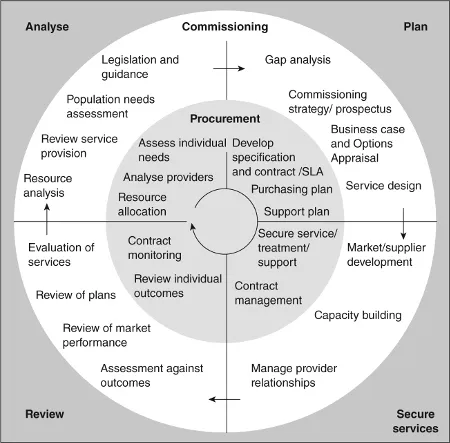
The Institute of Public Care (IPC) has reviewed many models of commissioning and procurement. This chapter presents the IPC model, which has developed over the last 10 years and forms the road map for the rest of this book. It is then split into four sections each containing three chapters of focused activities. Section 1 – Analyse – explores ‘Why, When and How to Commission’ in Chapter 2 and ‘Conducting Strategic Needs Assessments’ and ‘Mapping Resources’ in Chapters 3 and 4. Section 2 – Plan – covers ‘Strategic Analysis Tools for Commissioning’ and ‘Managing the Strategy and Communicating with Stakeholders’ in Chapters 5 and 6, followed by Chapter 7 that explores ‘Towards Effective Service Design’. Section 3 – Secure Services – starts with Chapter 8 that presents how to conduct ‘Market Facilitation’ which has become a key component of the commissioning and procurement role today. This is followed by ‘Procurement and the Contracting Process’ and ‘Contracting for Personalised Services’ in the twenty-first century in Chapters 9 and 10 respectively. Section 4 – Review – covers three key areas of current interest: ‘Managing Service Performance’, ‘Decommissioning’ and ‘Achieving Value for Money’ in Chapters 11, 12 and 13 respectively.
Defining commissioning
The British Government’s Modernising Commissioning Green Paper (Cabinet Office, 2011) defined commissioning as:
Developing this perspective further, the Commissioning Support Programme (2009) defined commissioning as:
Commissioning represents a broad concept with many definitions. Most definitions of commissioning paint a picture of a cycle of activities at a strategic level – concerned with populations – including:
• assessing the needs of a population;
• setting priorities and developing plans to meet those needs in line with local and national targets;
• securing services from providers to meet those needs and targets through building mature relationships;
• monitoring and evaluating outcomes; and
• the above combined with an explicit requirement to consult and involve service users in the process.
Commissioning is much more than just contracting and procurement; crucially it involves a whole range of services, not just the contracts or agreements, with external suppliers. This often involves the use of a wide range of resources across local partners, i.e. the whole local system of cooperation between partners, including local authority services, Clinical Commissioning Groups and other health bodies, schools and colleges, youth justice agencies and others. These need to be deployed in the best way possible to improve outcomes.
Commissioners then are not just those with ‘commissioning’ in their job title but everyone who contributes to the commissioning process.
Defining procurement
Procurement is not the same as commissioning, although it is often used interchangeably. Procurement, purchasing and contracting are activities that focus on a specific part of the wider commissioning process – the selection, negotiation and agreement with the provider of what service is to be supplied. To be more specific:
• Procurement or purchasing usually refers to the process of finding and deciding on a provider and buying a service.
• Contracting usually refers to the negotiation and letting of a contract and its subsequent monitoring: formalising the purchasing process, including writing down want is wanted (spec) and how you will be paid etc. (contract), working out the relationship with the provider and the monitoring of their performance.
Procurement uses the contracting process to achieve effective commissioning here, but it is not the only activity available to commissioners to enable them to secure service improvements. There are alternative tools as well, such as influencing external organisations to focus their resources on achieving the outcomes you would like to see delivered through constructive dialogue, revising business plans, or redesigning existing internal or external services.
Multi-level commissioning and procurement
Commissioning is practised on different scales or ‘levels’. There is not a single ‘ideal’ location for commissioning. The management task is to decide what is the most appropriate level to achieve the required outcomes, and hence the specific local com...