![]()
1
The Educational Context
This chapter covers:
- The role of the Learning Mentor in a school
- Learning Mentors as professionals
- Raising the profile of the Learning Mentor
Issues around teaching and learning are so well documented that there are a huge range of resources, journals, publications, theory and practice to help teachers to share good practice, garner advice and share ideas to draw upon in terms of making lessons engaging and interesting. Teachers are familiar with the need to keep lessons pacey and to offer opportunities for students to show what they can do. Peer assessment and evaluation are high on the agenda and independent learning is encouraged.
However, where does the Learning Mentor look for similar guidance? I think that we can in fact draw comparisons to the role of the NQT, the newly qualified teacher. There is a broad quality assured induction package programme with professional skills and knowledge that must be assessed. What induction package do we offer to Learning Mentors as professional practitioners? Can we be sure that the same levels of professional practice are adhered to, are explicit and that there is parity of standards? We know that OfSTED have critically evaluated the impact of Learning Mentor practice and their findings answer the question quite emphatically as follows:
Learning mentors are making a significant effect on the attendance, behaviour, self-esteem and progress of the pupils they support … the most successful and highly valued strand of the EiC [Excellence in Cities] programme … In 95% of the survey schools, inspectors judged that the mentoring programme made a positive contribution to the mainstream provision of the school as a whole, and had a beneficial effect on the behaviour of individual pupils and on their ability to learn and make progress. (OfSTED, 2003: 46)
Clearly evidence suggests that Learning Mentors are effective and having an impact. What we need to do is ensure consistent practice. The Learning Mentor’s role is now fully supported by a clear qualification structure, developed by the Department for Children, Schools and Families (DCSF). The role is categorised as one of the family of professionals who belong to the group known as ‘Learning Development and Support Services for Children, Young People and Those Who Care for Them’. The National Occupational Standards provide clear guidance about the functions of the Learning Mentor, the professional qualifications and the context in which the role is appropriate. The qualifications framework and standards makes explicit the context of the role and its relationship to other complementary and similar roles that involve the support of children and young people, for example personal advisors for Connexions. The qualifications framework provides a bundle of units that help to induct the Learning Mentor and clearly defines the knowledge, skills and qualities that are required for the developing practitioner.
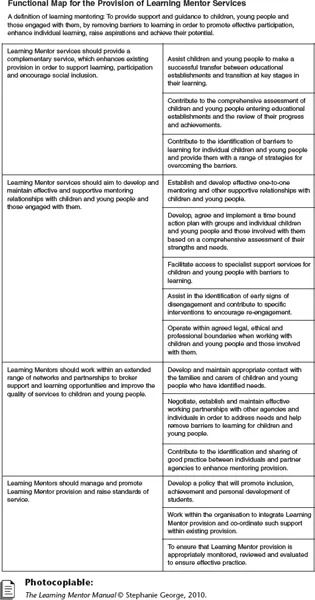
The units are mapped against a value base thus facilitating comparison and equivalence. Learning Mentors are also established as part of the new Children’s Workforce, and are supported through the new Children’s Workforce Development Council (CWDC). The CWDC describes the role of the Learning Mentor as being ‘To provide support and guidance to children, young people and those engaged with them, by removing barriers to learning in order to promote effective participation, enhance individual learning, raise aspirations and achieve their potential’ (www.cwdcouncil.org.uk/learning-mentors).
The functional map for the provision of Learning Mentor services is a very good place to start in terms of looking at the functions of the Learning Mentor and the skills that will be required for the Learning Mentor to provide successful intervention within the school setting.
What does all this mean for you in your school and how can you be sure that you are meeting the requirements and functions of a Learning Mentor by working holistically within the framework of the school to support children and young people? A good place to start is to look at what you currently do in your school. What interventions and activities are Learning Mentors involved in at your school? A useful task is to map those interventions and activities against the functional map.
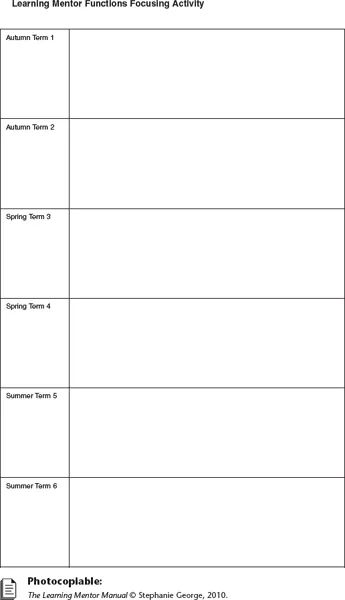
Using the ‘Learning Mentor Functions Focusing Activity’ Sheet, make a list of all of the activities that the Learning Mentor(s) is (are) involved in.
Think carefully about when you run these activities, for example the time of day, day of the week, week of the term and term in the year. Think also about seasonal things, for example religious festivals, annual events, celebrations and seasonal aspects of the school year.
You should end up with an overview of the Learning Mentor input across the school year. You might discover a particular strength, or there may be areas to develop. You might discover that resources need to be redirected, or that in fact there is a good balance of activities and interventions across the year, or that you might want to deepen or embed the intervention or the range of activities in one particular part of the school.
Functional Skills Mapping
In order to develop the functions of the learning mentor the next step would be to look at the activities and tasks and map them against the functional map. I have provided some thinking prompts to help you with the categorisation of the tasks and mapping these against the functional skills.
| 1. | Functional skill number 1 is to provide a complementary service which enhances existing provision, in order to support learning, participation and encourage social inclusion. |
Thinking Prompt:
- How do you provide this complementary service as described in functional skill number 1 – do you have a Breakfast Club, what extra curricular activities does the school offer?
- How accessible are your activities?
- How do you link in with other departments in the school?
- Are other departments aware of what you do in the school?
- How do you publicise the activities?
- Are you doing more of the same or are you offering something that is different to other departments?