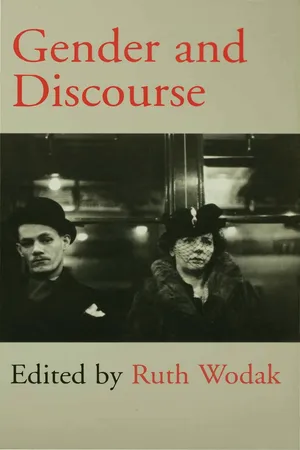
Gender and Discourse brings together European, American and Australian traditions of research. Through an analysis of a range of `real? data, the contributors demonstrate the relevance of these theoretical and methodological insights for gender research in particular and social practice in general.
- 320 pages
- English
- ePUB (mobile friendly)
- Available on iOS & Android
eBook - ePub
Gender and Discourse
About this book
The contributors to this collection offer an essential introduction to the ways in which feminist linguistics and critical discourse analysis have contributed to our understanding of gender and sex. By examining how these perspectives have been applied to these concepts, the contributors provide both a review of the literature, as well as an opportunity to follow the most recent debates in this area.
Information
Publisher
SAGE Publications LtdYear
1997Print ISBN
9780761950998
9780761950981
Edition
1eBook ISBN
9781446240403
1
THEORETICAL DEBATES IN FEMINIST LINGUISTICS: QUESTIONS OF SEX AND GENDER
Deborah Cameron
The theoretical debates which I will examine are debates about sex/ gender, its relationship to language and language use, and the implications of that relationship. All these are matters on which feminist scholars disagree – an important point to make, because outsiders often see feminist scholarship as a homogeneous category, defined by assumptions which all feminists must share. In fact, feminist scholarship encompasses diverse views, and not infrequently conflicting ones.
For the purposes of this discussion, ‘feminist linguistics’ will be taken to mean something different from the study of language and gender per se. In practice the two overlap significantly – most contemporary language and gender research is also feminist in orientation – but in principle the subject-matter can be treated without reference to feminism, either as a political movement or as a body of theory. Indeed, it can be treated from an overtly anti-feminist perspective. What distinguishes a feminist approach is not merely concern with the behaviour of women and men (or of women alone): it is distinguished, rather, by having a critical view of the arrangement between the sexes. It should also be said here that this ‘arrangement between the sexes’ cannot be reduced to ‘the differences between women and men’. From a feminist standpoint, male-female differences are of interest only as part of a larger picture, and they need to be theorized rather than simply catalogued.
This chapter deals with theoretical debates, and will not therefore have much to say about debates on methodology. ‘Feminist linguistics’ has never in fact been confined to departments of linguistics, but is a multidisciplinary enterprise to which anthropologists, sociologists, psychologists, cultural/semiotic theorists and philosophers have all contributed along with linguists (mainly sociolinguists and discourse analysts). Not surprisingly, there has been debate on the differing methodologies associated with these different (sub)disciplines: experimental work as practised in psychology versus the naturalistic approach of conversation analysis, not to mention introspection as practised by philosophers and (some) linguists; quantitative methods as used in psychology, some sociology and some sociolinguistics versus the qualitative or ‘holistic’ methods preferred in anthropology and discourse analysis. In many disciplines, too, orthodox methodologies have been subject to feminist critique from within. The issues raised are not irrelevant theoretically, since the methods a researcher uses embody theoretical assumptions (a point discussed at greater length in Cameron et al., 1992). But issues of method lie for the most part beyond my scope here.
Sex and gender: ‘Are there women, really?’
Modern feminist thinking has distinguished between ‘sex’, the biological phenomenon, and ‘gender’, the social one. The starting point is Simone de Beauvoir’s observation, made in 1949, that you may be born female, but you become the kind of social being your society defines as ‘a woman’ (the same is of course true of males/men). De Beauvoir’s point is by now familiar, but it is less often appreciated that the sex/ gender distinction is conceived by feminists in varying ways, and that some of them have questioned its usefulness.
It was also Simone de Beauvoir who asked, on the very first page of her introduction to The Second Sex, ‘Are there women, really?’ (1972: 13). Does the category ‘women’ have, in the terms used by today’s decon- structionists, any ‘ontological status’? Half a century on, the subject of most feminist theory is no longer simply ‘women’ but the gender relations which produce both women and men. Implicitly, however, and sometimes explicitly, these relations may be conceptualized in a number of ways, with a particular point of dispute being how far gender relations should be taken to have a basis in irreducible sexual difference.
Nicole-Claude Mathieu (1989), an anthropologist who is identified with the same theoretical current in feminism that Simone de Beauvoir represented, has suggested that there are three main paradigms for conceptualizing the sex/gender relationship. She does not mean that every society, or every social scientist, explicitly proclaims allegiance to one or other of these paradigms. On the contrary, in most cases they operate as implicit background assumptions. The aim of Mathieu’s paper is to foreground these assumptions so that conflicts about sex and gender (within feminism as well as outside it) may be clarified.
The first paradigm is what Mathieu calls ‘homology’: gender is seen as a socially mediated expression of the biological given, sex. Individuals learn ‘feminine’ or ‘masculine’ behaviour depending on their prior categorization as biologically ‘male’ or ‘female’, with the social elaborating on the biological. This is not the same as saying that all aspects of our behaviour are directly determined by biology, but it does suggest that sex is the foundation on which gender-related behaviour is built (for example, the greater degree of aggression displayed by boys compared with girls may be socially learnt, but it elaborates on a pre-existing biological tendency for males to be more aggressive than females). Gender in this paradigm ‘translates’ sex into the social behaviours we call gender.
The second paradigm is ‘analogy’: gender symbolizes sex. Gender identity in this paradigm is based on the collective social experience of living as a member of the group ‘women’ or ‘men’ – taking on particular ‘gender roles’ in order to conform to cultural expectations. These roles and expectations may differ significantly in different societies and periods of history even though male and female biology per se shows no such variation. Because of this variability, the ‘analogy’ approach rejects the first paradigm’s assumption that there is a direct and straightforward relation between sex and gender, emphasizing that gender is a symbolic marking of sexual difference rather than an elaboration on biological characteristics. In support of this it is also pointed out that people can live successfully as members of a gender that does not match their anatomical sex. Historically, women have ‘passed’ for men; currently, individuals of both sexes may seek surgery to bring their bodies into conformity with the social role with which they have identified. Mathieu notes that this privileging of social roles over biological traits has been the standard approach of the social sciences. In some versions (such as structural functionalism) the roles are treated as complementary; in feminist versions they are more often treated as hierarchical, involving male dominance and female subordination, and some degree of conflict between the two groups.
Mathieu’s third paradigm is ‘heterogeneity’: sex and gender are different in kind. The idea that their relationship is either homologous or analogous, or in other words that sex is in some sense the foundation for gender, is regarded within this approach as an ideological fiction. We should not take for granted that the world is ‘naturally’ divided into two groups, ‘women’ and ‘men’, but should see this division as something produced historically for the purpose of securing one group’s domination over the other. In this paradigm, gender constructs sex, not vice versa.
This argument may become easier to understand if we make an analogy with social class. Only an extremist fringe regards pre-given (genetic) traits as determining whether someone belongs to the ranks of the exploiters or the exploited. Wealth and poverty may be inherited, certainly, but this is a cultural matter. Class divisions arise in the first place from acts of exploitation: one group enslaves another, or manages to accumulate a larger share of the available resources (land, property, money) so that people left without these resources are forced to go to work for the more privileged on disadvantageous terms (for example as serfs for a feudal master or wage-labourers for a capitalist). A similar analysis may be applied to what looks at first glance like a more plausible instance of biological division, namely ‘race’. Although the physical markers of race, such as skin colour, are genetically transmitted, racial categories have consistently been found not to map on to biologically distinct populations. They map much more readily on to divisions created by the historical exploitation of some groups by others through enslavement, colonization, and indentured and migrant labour.
Some feminists, including both French materialists in the tradition of de Beauvoir like Mathieu, Monique Wittig and Christine Delphy and, from a rather different perspective, postmodernist theorists like the US philosopher Judith Butler, suggest that if it were not for our gendered social arrangements, ‘sex’ as we know it – a strict bipartite classification of people on the basis, usually, of their genitals – would not have its present significance. That is not to deny human sexual dimorphism; the point is rather (as it also is with race) that human biological variations assume importance for us when for social, economic and political reasons they become a basis for classifying people and ordering them into hierarchies. No society is ordered on the basis of variations in blood group, and therefore we do not regard ‘people with group O blood’ as a natural kind – though in purely biological terms it would be easier to identify this ‘kind’ than it is to identify classes or races. Sex may be more straightforward to identify, but arguably the significance we attach to the identification follows from the significance of gender divisions in the organization of our societies.
For materialist feminists gender, like race and class, is constituted by exploitation (of women’s domestic and other work, their sexuality and their reproductive capacities). For such feminists, the ultimate political goal is therefore not to make women and men ‘more equal’ but to eliminate gender divisions. As Susanne Kappeler (1995) observes, equality between groups which are constituted by the dominance of one over the other is by definition impossible. You cannot, for instance, tackle class inequality by proposing to make everyone a capitalist, for without workers’ labour to extract surplus value from, there are no capitalists. Other feminists would however disagree with the materialists’ analysis: some would see sexual difference as finally irreducible, while many would dispute that difference has to mean hierarchy, and would propose that it could and should be positively valued.
The answer to de Beauvoir’s question ‘Are there women, really?’ is not, then, as straightforward as it might seem. If the question means, ‘Do women exist as a natural kind?’, then feminists disagree. Some would say ‘Yes, and they should get a better deal’, others ‘Yes, but we could change what it means to be a woman’, and still others ‘No, and the sooner we get rid of “women” the better!’ What, though, does any of this have to do with language and linguistics? The answer I would give is that all the most important theoretical debates within feminist linguistics have their roots in disagreements about gender, and the relationship of language to it.
Language and gender: is there a ‘women’s language?
Feminist linguists have posed a question analogous to Simone de Beauvoir’s ‘Are there women, really?’: to wit, ‘Is there a women’s language?’ The terms in which this question is formulated have changed over the past twenty years, but there remains a basic concern with the question of what, if anything, characterizes the use of language by women, and how particular characteristics of ‘women’s language’ may be linked to the gender relations of a given society.
At a literal level, the term ‘women’s language’ is obviously problematic. As Sally McConnell-Ginet (1988) notes, no one would answer the question ‘What language do you speak?’ by saying ‘women’s language’, or for that matter ‘women’s English’. Even the less radical term ‘genderlect’, coined on the analogy with ‘dialect’, ‘sociolect’ and ‘idiolect’, is problematic because women and men do not in most cases form distinct speech communities. Some degree of segregation and exclusion on the basis of gender is found in many or most societies, but typically men and women will nevertheless participate in at least some of the same key social institutions (such as the family or household, the workplace, the village) while being differently positioned within them. As the sociolinguist Penelope Eckert has noted, gender works in a different way from race, ethnicity or class:
Gender and gender roles are normatively reciprocal, and though men and women are expected to be different … this difference is expected to be a source of attraction. Whereas the power relations between men and women are similar to those between dominated and subordinated classes and ethnic groups, the day to day context in which these power relations are played out is quite different. It is not a cultural norm for each working-class individual to be paired up for life with a member of the middle class or for every black person to be so paired up with a white person. However, our traditional gender ideology dictates just this kind of relationship between men and women. (1989: 253–4)
The question of what ‘women’s language’ is thus becomes a question about how the norm of gender ‘reciprocity’ operates to differentiate ‘women’ linguistically from ‘men’ in one speech community.
In considering the answers which have been given to that question, Mathieu’s paradigms of sex and gender are once again relevant. Early pre-feminist discussions (for example, Jespersen, 1922) vacillated between the view that gendered language ‘translates’ innate biological dispositions and the view that it ‘symbolizes’ gender roles which are fundamentally social. Feminist linguists, in common with most social scientists, have preferred the ‘social roles’ approach. Talking like a woman – or a man, though women have more often been the focus for research on gender – is treated as one part of a social gender role.
This assumption led pioneering feminist linguists like Robin Lakoff (1975) to suggest that ‘women’s language’ was a product of early childhood socialization. Parents and other authority figures encourage little girls to adopt a gender-specific way of speaking which displays their femininity linguistically in the same way that wearing frilly dresses, playing with dolls, ‘throwing like a girl’ and avoiding ‘rough’ play displays lone culture’s norm of) femininity physically. And this femininity is not just an arbitrary collection of traits whose function is to mark off girls as different from boys, it is a symbolic enactment of powerlessness: about taking up less space, making fewer demands, appearing weaker and less aggressive than boys. ‘Women’s language’, as Lakoff conceived it, is distinguished in particular by the use of mitigating devices which reduce the force of utterances, and by the avoidance of strong or aggressive language.
One question much asked in relation to Lakoff is how far her generalizations about ‘women’s language’ (WL) will hold empirically. Her evidence is anecdotal, and she has often been criticized for implicitly taking some women – white, relatively privileged anglophone US suburbanites – as the norm for all. Even within the same society, the USA, there are many women – working class or of non-Anglo ethnicity – who have been unable to identify with Lakoff’s description of WL. There have also been many studies which have failed to confirm the accuracy of the description.
While this is not the place to review all the empirical evidence and counter-evidence, it bears pointing out that in assessing Lakoff’s argument theoretically we need not fixate on issues of substance (what features WL might or might not consist of) to the exclusion of the more abstract point being made. This, I take it, is that women’s ways of speaking in any community, or for that matter the ways of speaking that are folk-linguistically associated with women, whether accurately or not, constitute a symbolic display of that community’s concepts of the norms for femininity. The actual substance of the latter can vary considerably: the ethnographic literature shows, for example, that whereas some communities (like Lakoff’s) regard indirectness as typically a feminine speech trait, others (like the Malagasy speakers described by Ochs, 1974) associate women with direct styles and men with indirectness. But the overarching claim would be that if a community identifies a particular speech style or genre as typical of women, it will also tend to see that style as indexical of ‘what women are (naturally) like’. The evidence for this more general proposition seems to me much stronger than the evidence for Lakoff’s substantive hypotheses about WL (for a survey that underlines the point, see Sherzer, 1987). And the proposi- tion itself can be interpreted in line with a more radical conception of the sex-gender relationship, as will be discussed below.
The model which has emerged, especially among anglophone scholars, as the main alternative to a Lakoff-style view of WL as symbolic powerlessness is the so-called ‘difference’ or ‘subcultural’ model whose best-known proponent is Deborah Tannen (1990; 1993; 1994). In this model, gender differences are treated as similar to the cultural differences that complicate and may frustrate intercultural or interethnic communication (cf. Gumperz, 1982). They are viewed as stemming in the first place from the pervasive segregation or separation of boys and girls in the peer groups of childhood and adolescence. Since these groups are organized differently, participate in different activities and orient to different values, immersion in them gives rise to differing repertoires of communicative practices – or perhaps more accurately, preferred communicative practices (see Goodwin, 1992, who shows that girls are able to adopt the ‘masculine’ practice when it is necessary for confronting boys in a dispute). Susan Gal (1991) has remarked o...
Table of contents
- Cover Page
- Studies
- Title
- Copyright
- Contents
- Contributors
- Introduction
- 1 THEORETICAL DEBATES IN FEMINIST LINGUISTICS: QUESTIONS OF SEX AND GENDER
- 2 GENDER, POWER AND PRACTICE: OR, PUTTING YOUR MONEY (AND YOUR RESEARCH) WHERE YOUR MOUTH IS
- 3 GENDER AND RACISM IN DISCOURSE
- 4 GENDER AND LANGUAGE IN THE WORKPLACE
- 5 IDEOLOGIES OF PUBLIC AND PRIVATE LANGUAGE IN SOCIOLINGUISTICS
- 6 GENDER, DISCOURSE AND SENIOR EDUCATION: LIGATURES FOR GIRLS, OPTIONS FOR BOYS?
- 7 DIFFERENCE WITHOUT DIVERSITY: SEMANTIC ORIENTATION AND IDEOLOGY IN COMPETING WOMEN’S MAGAZINES
- 8 ‘IT’S A GAME!’: THE CONSTRUCTION OF GENDERED SUBJECTIVITY
- 9 TALKING POWER: GIRLS, GENDER ENCULTURATION AND DISCOURSE
- 10 WOMEN’S FRIENDSHIPS, WOMEN’S TALK
- 11 STORY-TELLING IN NEW ZEALAND WOMEN’S AND MEN’S TALK
- Index
Trusted by 375,005 students
Access to over 1.5 million titles for a fair monthly price.
Study more efficiently using our study tools.
Frequently asked questions
Yes, you can cancel anytime from the Subscription tab in your account settings on the Perlego website. Your subscription will stay active until the end of your current billing period. Learn how to cancel your subscription
No, books cannot be downloaded as external files, such as PDFs, for use outside of Perlego. However, you can download books within the Perlego app for offline reading on mobile or tablet. Learn how to download books offline
Perlego offers two plans: Essential and Complete
- Essential is ideal for learners and professionals who enjoy exploring a wide range of subjects. Access the Essential Library with 800,000+ trusted titles and best-sellers across business, personal growth, and the humanities. Includes unlimited reading time and Standard Read Aloud voice.
- Complete: Perfect for advanced learners and researchers needing full, unrestricted access. Unlock 1.5M+ books across hundreds of subjects, including academic and specialized titles. The Complete Plan also includes advanced features like Premium Read Aloud and Research Assistant.
We are an online textbook subscription service, where you can get access to an entire online library for less than the price of a single book per month. With over 1.5 million books across 990+ topics, we’ve got you covered! Learn about our mission
Look out for the read-aloud symbol on your next book to see if you can listen to it. The read-aloud tool reads text aloud for you, highlighting the text as it is being read. You can pause it, speed it up and slow it down. Learn more about Read Aloud
Yes! You can use the Perlego app on both iOS and Android devices to read anytime, anywhere — even offline. Perfect for commutes or when you’re on the go.
Please note we cannot support devices running on iOS 13 and Android 7 or earlier. Learn more about using the app
Please note we cannot support devices running on iOS 13 and Android 7 or earlier. Learn more about using the app
Yes, you can access Gender and Discourse by Ruth Wodak in PDF and/or ePUB format, as well as other popular books in Languages & Linguistics & Communication Studies. We have over 1.5 million books available in our catalogue for you to explore.