![]()
Chapter 1 Introduction
Lyn Ashmore
Denise Robinson
Learning Outcomes
After reading this chapter, the reader should be able to:
- Understand how work-based learning (WBL) and adult and community learning have changed.
- Understand how the current trends in learning and development have shaped our practice.
- Appreciate ways in which the ‘what's in it for me?’ factor impacts on progress.
- Understand the themes and arguments covered in each chapter.
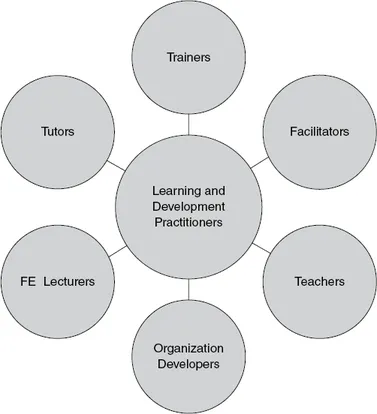
In this book we tend to use the word practitioner, which includes teacher, trainer, tutor, facilitator, lecturer and organizational developer. Whatever your role within learning and development you will be involved in providing a valuable service to your learners, the organization in which you work and the organizations in which your learners work. We will use the term further education and skills to incorporate providers in the public and private sector (further education colleges, WBL providers, adult and community learning) as well as organizational learning. The terms used to describe this sector have varied over the years. The term further education was regarded as too limited and was replaced by lifelong learning to ensure that it reflected other elements of the sector: vocational, work-based learning and adult education and training. Since the election of the coalition government the term further education and skills has been used to reflect the growing emphasis on the education and training of skills, as well as other aspects of the lifelong learning sector. This may apply to private and public sector organizations. We will also use the term learning and development to equate to the array of approaches and institutions in the sector.
Figure 1.1 Practitioners in Further Education, Skills and Organizational Learning
1.1 Introduction
This book is uniquely structured, drawing on evolving knowledge and grounded in a problem-based focus, challenging you to find solutions to real problems in your teaching and training practice. In recent years interest in the application of teaching, training, learning and development has seen unprecedented growth, separately emphasizing theory and practice. For experienced and developing practitioners, this then requires a combination of different models of delivery to enable the development of theory alongside the development of practice. With this in mind, this book is designed to provide the underpinning theory alongside its application to practice. Chapters 2 to 10 will include practical examples, such as case studies and discussion questions, to help stimulate the essential link between theory and practice with ‘signposts’ or ‘scaffolding’ to additional references that you can use to explore elements of the work elsewhere. We aim to provide a basis for improving understanding as well as providing employers with the assurance that their staff (as learners) will be striving towards a balance between practice and its underpinning theory.
Methods of organizational learning are continually changing, as organizations continue to look for and employ practitioners who are knowledgeable and inspiring in their approach to developing people. Hence staff development is seen as an essential component to real business as well as professional growth. With this in mind practitioners need to be able to introduce new approaches to support employees as learners and in turn benefit employers as well as the learners themselves. All aspects of this book are important to consider when examining your role as a learning and development practitioner and the organization's role; the concept of learning and development cannot be considered in isolation from other aspects of the practitioner's or learner's role, and requires an all-inclusive and collaborative approach.
It is without doubt that learning and development functions in organizations are fundamental to achieving success, because these functions are central to developing organizational needs and for practitioners to do their jobs well. Evidence shows that true learning organizations rely heavily on their learning and development practitioners to support business strategy and this means practitioners need to develop new ways of designing, delivering and evaluating learning (Harrison, 2009; Noe, 2010). This may be clear in training and educational organizations but is also true in business organizations. Practitioners need to ensure that the learning and development functions are efficient and effective in doing their job well, in addition to making learning delivery lively and energetic; in other words a dynamic and enthusiastic approach is required in order to encourage and engage self-motivated learners with the aim of achieving organizational as well as their own personal or professional goals.
Given its incorporation of organizational teaching and training approaches, this book will be useful in relation to a wide range of development activities. For instance, it will satisfy those involved in WBL and adult and community learning who often complain that courses and their resources are focused too much on staff in further education (FE) colleges, rather than the learning and skills sector as a whole, and will also satisfy those operating in the training industry and commerce, both in the private and public sectors. As a consequence this book aims to keep a distinctive feature of providing a focus and stimulus for action alongside theoretical coverage.
Although this book seeks to demonstrate the importance of a structured approach to learning and development as well as the key elements for delivery and professionalism, it also seeks to highlight the various concepts of learning and development as widely diversified terms used within the sector covering teaching, training and facilitating. Throughout, the various chapters explore what you as a learner practitioner can do to create an environment where you can improve upon what you already know as well as what you can do to increase and enhance learning and practice. Each chapter guides you through the actions you will need to take to develop and enhance your skills. Teacher or trainer practitioners, and anyone presenting or facilitating a training session, for classroom or group activity, can keep up to date by pro-actively learning, understanding and applying theory to a practical situation. Furthermore, you will be able to put to use a range of simple but effective techniques to create a productive and conducive learning environment for all. Chapters incorporate recent interest in the possibilities of learning and development as well as pitfalls in delivering learning and development sessions. We have included a range of suggested activities and case studies for readers to carry out and use, in teaching and training. The intention is to involve readers actively at all stages throughout the book.
Finally, the book is intended to be practical and dynamic and is not intended to be read in the same way as a theoretical textbook from cover to cover, but rather it should be used as a resource that can be tapped into at varying times and at various points in your teaching or training.
1.2 Equality and Diversity
Although equality and diversity principles and practicalities are often regarded as challenging, and can be interpreted in different and sometimes contradictory ways according to your understanding or even sensitivity (Ashmore et al., 2009), nonetheless they have long been important dimensions in teaching, training and development for practitioners, the organization and especially so for learners. Meeting the needs of a diverse group of learners is about ensuring equality of access and learning opportunities for all and, for example, promotional materials should represent a diverse focus. Equally importantly, active equality and diversity practices enable you, the practitioner, to appreciate what effective implementation really looks like, as well as enabling you to provide a rich environment that is conducive to all learners. That is a favourable atmosphere that successfully provides a positive learning experience for all. Even so, one of the most challenging features is promoting a culture of tolerance and understanding and making sure that no learners are prejudicially excluded because of their difference. Although equality and diversity are not included as a separate chapter in this book, they are embedded throughout all chapters through the examples; one of the overarching aims of the book is to ensure that learning develops the best for all individuals (see for example Chapter 7, section 7.5).
1.3 The Intended Audience for this Book
While it continues the coverage of learning and development delivery, this book will be suited to practitioners across a range of organizations and learners on various courses; for instance, Certificate in Education, Training the Trainers and other contexts in the learning and development sector. It will play an important role in further defining the field of learning, teaching, training and development as well as good practice in delivering sessions. Although the book does not have as its primary focus the learning and training cycle, the issues considered in the chapters are relevant and, significantly, the order of the chapters is akin to the aspects of a practitioner's development. Thus the book maintains the practitioner focus, while reflecting a critical coverage so as to appeal to both learners (especially those undertaking courses or modules and learning, teaching, training and development practitioners in FE, WBL, adult and community and training organizations) as well as contin...