![]()
PART ONE
UNDERLYING THEMES
![]()
1
Underpinning Concepts of Services Marketing Management
CHAPTER CONTENTS
- Scope of services marketing management
- Origins and background to services marketing management
- Services marketing is different
- Unique service features and resulting marketing management issues
- Conceptualizing the service marketing mix
- Services marketing dimensions
- Conceptual models or frameworks for services marketing
- Summary
Services are all around us – as consumers we use services every day. The growth in the service economy is widely recognized and increasingly contributes to the economic development of many regions. Although the service sector accounts for most of the new job growth in developed countries, the dominance of the service sector is not limited to highly developed nations. Many services such as those in the tourism sector contribute very heavily to developing economies also. By their very nature, services are diverse and therefore have often been difficult to define. However there have been many attempts to describe services and there is an overall recognition of what they are and how they contribute to marketing offerings and the economy.
This chapter considers the underpinning concepts of service management. It briefly outlines the history and origins of services marketing and management and provides some background discussion explaining the debates that have led to the identification of the now widely accepted characteristics of services. Also, the differences between goods and services will be discussed and lead to a description of how the characteristics of services impact on the different elements of the service offering. Then a description of dimensions that form the component parts of conceptual frameworks and models for services marketing is presented. Finally, the most frequently used conceptual frameworks are discussed in some depth, encapsulating the chief characteristics of services in order to provide the underpinnings for the focus of this text on service management issues in the context of service organizations and different sectors.
SCOPE OF SERVICES MARKETING MANAGEMENT
Most frequently, a service has been described as an act, a process and a performance. For example, activities such as accountancy, banking and hairdressing can be recognized as being predominantly service based. Also services can be more widely described as economic activities that create ‘added value’ and provide benefits for customers (consumers or organizations). Today most products include some element of service.
However, a service ‘product’ or a service company can be differentiated from customer service that is provided by all types of companies such as manufacturers and IT companies as well as service companies. Customer service usually entails answering questions, handling complaints, dealing with queries, taking orders, the provision of maintenance and repairs and other after sales services. Although customer service is inherent in services marketing it is carried out as an additional function by many industries. There are many products that depend upon service-based activities to give them a competitive advantage. For example, someone buying a new computer may be attracted to the store where s/he will also receive useful information and guidance from a helpful staff member at the store, a hotline service for installing programmes, and other services, in addition to their preferred computer. Recognizing the value of this to potential customers, computer store service managers will aim to offer many additional useful services for customers. This illustrates the value and relevance of understanding and recognizing the importance that service issues have on today’s society.
A service business is one where the perceived value of the offering to the buyer is determined more by the service rendered than the product offered. In this way the nature and scope of services pose different challenges for managers in service businesses. Such businesses include those that provide an almost entirely intangible offering, such as legal services, healthcare, and cleaning services and businesses that offer both services and products such as restaurants and retail outlets.
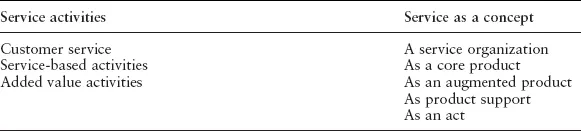
The definition and scope of the service concept is wide and can mean any or all of the following:
Table 1.1 Scope of services
- Service as an organization, that is the entire business or not-for-profit structure that resides within the service sector. For example, a restaurant, an insurance company, a charity.
- Service as core product, that is, the commercial outputs of a service organization such as a bank account, an insurance policy or a holiday.
- Service as product augmentation, that is any peripheral activity designed to enhance the delivery of a core product. For example, provision of a courtesy car, complimentary coffee at the hairdressers.
- Service as product support, that is, any product- or customer-oriented activity that takes place after the point of delivery. For example monitoring activities, a repair service, up-dating facilities.
- Service as an act, that is service as a mode of behaviour such as helping out, giving advice.
The scope and concept of services are summarized in Table 1.1.
However from a market or consumer point of view the relative importance of different components of the service offering can range vastly from one customer to another. So a service must be considered from the point of view of many types of customers. For example, two people may pay the same amount for a service but may be paying for different aspects of the service. A business person may dine regularly in an expensive, up-market restaurant because of the convenience to their place of work and the perceived ‘status’ of entertaining guests there. Other customers of the same restaurant may eat there regularly because of the excellent food, the modern décor and menu choice.
The service sector includes a wide range of industries such as the hospitality industry, the tourism industry, financial services, charities, the arts and public utilities, as shown in Table 1.2. Some service sectors such as charities and the arts operate in non-profit-making operations, other services such as the hospitality and financial services operate in competitive, profit-making environments. Many service industries such as tourism include large international companies and small independently and locally operated companies. Some examples of larger international service companies include airlines, hotel chains, banking and telecommunications. Smaller operators in the service sector include independent restaurants, business-to-business services, taxis and local tourism services. Therefore we can conclude that the service sector is a very diverse one with many companies operating within the context of very different agendas and sense of purpose.
Table 1.2 Service industries
| Hospitality Tourism |
| Financial services |
| Charities |
| Arts |
| Public utility services |
| Health services |
| Education services |
| Professional services |
ORIGINS AND BACKGROUND TO SERVICES MARKETING MANAGEMENT
Services marketing is founded upon the fundamental concepts of marketing. The development of service marketing concepts over the years has evolved in accordance with the philosophy of customer orientation. A marketing orientation puts the customer at the core of an organization’s purpose and activity. In many organizations the philosophy is manifested in terms such as ‘the customer is king’ and ‘everything the organization does is with the customer in mind’. For example, British Airways used the slogan ‘putting people first’ in the 1980s, United Airlines used ‘you are the boss’ and Burger King invited customers to ‘have it your way’. However a more rational and business-oriented approach to service marketing encompasses the philosophy of marketing orientation by concentrating on looking after customers and maximizing their satisfaction in the context of competitive offerings while remaining profitable as an organization.
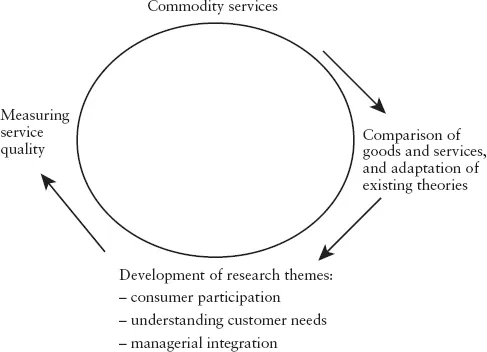
The philosophy of reaching the customer more precisely has dictated marketing activity throughout its history. In the early part of the twentieth century, trading in ‘commodity services’ was one form of services marketing. Indeed, this notion is recognized by Regan (1963) as the origin of services marketing when debating the ‘service revolution’ at that time. In reinforcing that a revolution was taking place in the early 1960s, Regan and others (Judd, 1964; Rathmell, 1966, 1974) set about trying to define services in this new domain. This debate recognized and anticipated the emergence of more formal and autonomous services marketing in areas such as transportation, communication, education and retailing. Attempts were made at this time to redefine services and divisions of service activities in a way that would allow descriptions of services in a wider context. This created the base for future research and discussion. The early development of services literature and research is illustrated in Figure 1.1.
FIGURE 1.1 Early development of services research
The early service literature focused on defining and refining the specific characteristics of services, the different classifications of the service product and the scope and complexity of services. These definitions and refinements were important in the quest for how services should be marketed and managed. Much of this earlier work emphasized the comparison of services with goods or physical products and how existing marketing theories could be adapted for services. Identifying and clarifying definitions and classifications of services dominated research in services for a considerable time during the 1960s and early 1970s.
By the end of the 1970s research in the services domain had grown and become a body of work in its own right. An international study, commissioned by the Marketing Science Institute of Cambridge, Massachusetts and authored by Languard et al. (1981) represented the most comprehensive analysis and description of services marketing at that time. The study focused on marketing issues that were considered to be central to the management of consumer service business. The findings, based on evidence from several large service companies and surveys of both consumers and managers, linked three separate themes: consumer participation in service production and delivery, management’s ability to understand customers’ needs and the relationship between operations, marketing and personnel functions in a service organization. These issues became recurrent topics for service researchers over the following decades.
While the services marketing literature has answered many of the issues raised as important research areas in the early 1980s, it has evolved and progressed into new and more integrated services marketing approaches and concepts. However, during the 1980s some of the most referenced and comprehensive empirical confirmation of the main concepts and frameworks occurred. In many instances empirical studies helped to both reinforce concepts and to create new concepts and theories designed to contribute to more effective and efficient services marketing, for example, the work of Parasuraman et al. (1985, 1988) in developing the SERVQUAL measurement technique (discussed in Chapter 2). The research underpinning the SERVQUAL instrument was widely accepted and disseminated in the 1980s. By the mid-1990s, however, the wide and sometimes indiscriminate use of the SERVQUAL mechanism for many contexts was so strong that some service researchers began to argue that many other aspects of services marketing and management had been neglected in its wake. Indeed research in services marketing in the late 1980s and early 1990s was dominated by the adaptation of the SERVQUAL model to almost every service application possible. Eventually studies became more focused on developing more appropriate models for different service situations and management priorities. Many of these conceptual developments are discussed later in the chapter.
SERVICES MARKETING IS DIFFERENT
Central to the debate about marketing tools for services are the characteristics of services, how these characteristics can be refined for different contexts (for example retailing services or not-for-profit services), the tangible and intangible aspects of the service offering and whether there is a difference between services and goods marketing.
In 1963 Regan highlighted that a large and growing market for commodities existed in the development of service systems. In his early work he considered some definitions of services and their characteristics. He recognized that the potential development of the service revolution depended upon the recognition of markets for business expansion, the development of service technologies, consideration...