- 200 pages
- English
- ePUB (mobile friendly)
- Available on iOS & Android
eBook - ePub
Study Skills for Policing Students
About this book
This text provides an accessible and up to date guide to study skills for all those undertaking degrees and foundation degrees in policing. It will also be relevant to degree courses in criminology and criminal justice. Efficient study skills pave the way to successful learning. This book helps policing students with all aspects of their studies including identifying how they learn best, effective note-taking, how to be critical and analytical in their reading, writing and thinking, how to carry out research and writing a final dissertation.
Information
1 Getting started
| CHAPTER OBJECTIVES |
| By the end of this chapter you will be able to:
|
| LINKS TO STANDARDS |
| This chapter provides opportunities for links with the following Skills for Justice, National Occupational Standards (NOS) for Policing and Law Enforcement 2008. AB1.1 Communicate effectively with people. AE1.1 Maintain and develop your own knowledge, skills and competence. HA1 Manage your own resources. HA2 Manage your own resources and professional development. Links to NOS will be provided at the start of each chapter; however, it should be noted that the NOS are subject to review and it is recommended that you visit the Skills for Justice website to check the currency of all the NOS provided: www.skillsforjustice-nosfinder.com. |
Introduction
This chapter offers guidance as you prepare for study. For some, study may be something that you have been doing for years and you are reading this book to glean any suggestions that may benefit future learning. Others may be returning to study following years of no study whatsoever and are reading this book to find out what study skills are all about. Whatever your reasons for reading this book, the fact that you are interested in improving your study skills means that your attitude towards your own study skills is commendable, and that you are exhibiting a healthy attitude towards your learning and, therefore, your future.
One lesson you may have found to be missing when you were at school was called ‘How to Study’. It was just assumed that people knew how to study and were, therefore, given things to learn. Nothing could be further from the truth. People think they know how to study, but sometimes the strategies they employ can be very long-winded and consequently a waste of time. For example, have you ever tried to learn something by writing it out a hundred times? Did you actually learn the information, or did you just regurgitate it verbatim? Rather than write it out time and again, you could have spoken out loud, which is far quicker. Alternatively, you could have discussed your understanding of the topic with another person and then answered any questions they may have had. This is just one example of the many alternative ways there are to study. Remember – if you always do what you always did, you will always get what you always got.
Studying is a skill and all skills benefit from analysis and practice. Analysis means that we will be breaking the component parts of study down into manageable chunks, giving you the opportunity to consider each part critically. Having identified the various parts that constitute study, you can then begin to practise them. To assist you with this task, a short questionnaire has been designed (see the first ‘Practical task’ below), enabling you to identify which elements of study skills you should practise and their location within this book.
The aspects of study this chapter considers include the themes, ‘Getting started’ and ‘Motivation’, as for some these are easier said than done. Next, ‘Time management’ is examined and ‘Activity scheduling’ is described and demonstrated. ‘Concentration’ is considered and guidance is offered in relation to those occasions when you find your mind wandering. ‘Chunking’ study into manageable tasks is discussed and ‘Attitude to study’ is considered in terms of the advantages of displaying a positive attitude towards your study. The concept of ‘Personal filters’ is noted, giving you the opportunity to identify some of your unique characteristics. Your learning journey involves what are referred to as ‘Steps of competence’, and these are discussed to assist your understanding of your own progress. Lastly, the benefit of ‘Reflective practice’ is highlighted as a tool to assist your learning by questioning your assumptions and researching solutions. As with any book, you can read it from cover to cover or, if you are keen to manage your time effectively, concentrate on those topics that will benefit you the most.
Getting started
Sometimes the first step in any journey can be the most difficult. If you are inclined to procrastinate, you may find that there is always something else to do that is more enjoyable than the task you know you have to do. You may find yourself in a position where you have bought new pens, paper, folders and books, but still have not got around to actually doing any study. The reason for not starting a task differs from person to person but frequently the reasons can include:
- a lack of confidence;
- low self-esteem;
- stress;
- anxiety;
- fear of the unknown;
- not wanting to take responsibility;
- lack of self-belief;
- being too busy with other things.
People are motivated by many influences, but to generalise, they can be anywhere between two points:

Or more succinctly:

The task remains the same whether it is done now or later and, generally, it does not go away or become any easier the longer you choose to do something else. If you are the type of person who is full of good intentions that never quite come to fruition, now may be a good time to re-evaluate your past habits and change your behaviour. One reason why people do not get around to the task in hand is because it is seen to be too large and therefore too onerous.
Tracy (2004) considers the issue of procrastination and uses the analogy of the frog to describe that of starting a task. The rule is that the frog must be consumed at some stage during the day. Obviously, the concept of eating a frog is naturally unpleasant for most and he asks whether people would:
- eat it first thing to get it out of the way;
- procrastinate and eat it last thing; or
- eat it over the course of a day, little by little.
The concept of the frog is useful when you think about your own behaviour. For most, breaking a task down into manageable chunks is the preferred option. But how do you break down your tasks into manageable chunks? Take, for example, the task of improving your study skills. If you want to improve, it may be useful to analyse your ability and your behaviour. The following questions are designed to help you to do this.
PRACTICAL TASK
Indicate with a tick in the boxes below which best describes you.
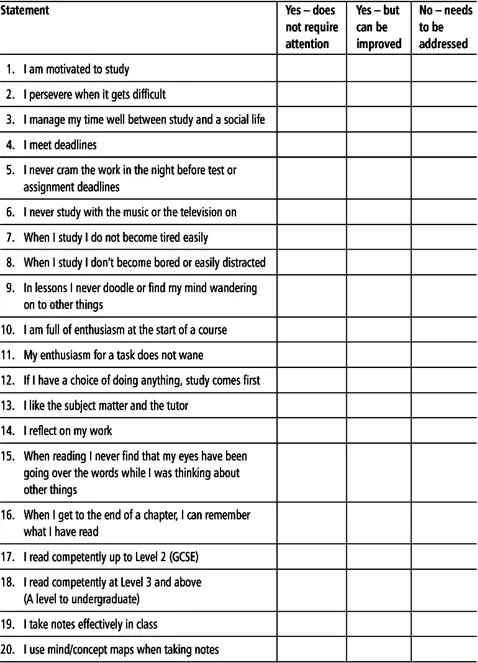
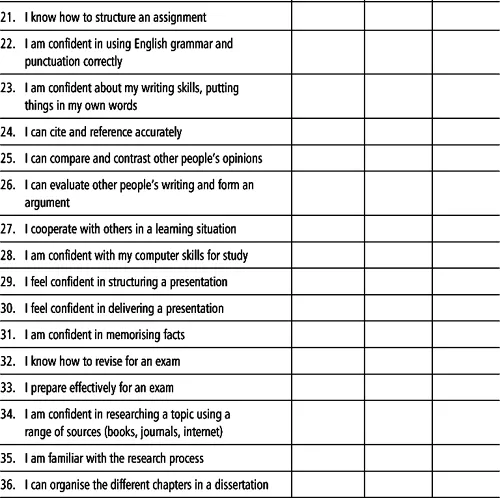
There is no chart to complete for the results of this task to tell you what type of person you are, as that is immaterial. You have simply identified the areas upon which you must concentrate. Table 1.1 indicates where in this book you can locate advice on your weaker areas.
Table 1.1 Where to find the topics you need
Statements | Topic | Addressed in chapter |
1–2 | Motivation | 1 |
3–5 | Time management | 1 |
6–9 | Concentration | 1 |
10–13 | Attitude | 1 |
14 | Reflective practice | 1 |
15–18 | Reading | 2 |
19–20 | Note-taking | 2 |
21–24 | Writing skills | 3 |
25–26 | Critical and analytical thinking skills | 4 |
27 | Collaborative learning | 5 |
28 | The use of ICT | 6 |
29–30 | Presentations | 7 |
31–33 | Exams | 8 |
34–35 | Research | 9 |
36 | Writing your dissertation | 10 |
The choice is yours; you can either read this book from cover to cover, or read only the parts that you have identified as being relevant to your individual needs. Hopefully you can turn your frog into something more appetising.
REFLECTIVE TASK
Think about and list the behaviours that you feel are indicative of a negative attitude to study. Next do the same for a positive attitude to study. When you compare them what are the underlying characteristics?
It is likely that your lists in the above task will be underpinned by considerations of perceived ability and motivation. We like to do what we can do well, and that which we find difficult we are less inclined to engage in. If you have struggled with study, it is likely that you will not enjoy it. This book will guide you through the process of improving your study skills so that you can not o...
Table of contents
- Cover
- Title
- Copyright
- Contents
- 1 Getting started
- 2 Reading and making notes
- 3 Writing skills
- 4 Critical and analytical thinking skills
- 5 Collaborative learning
- 6 The use of information and communication technology
- 7 Presentations
- 8 Examinations
- 9 The research project
- 10 Writing your dissertation
- Appendix: keyboard shortcuts
- Index
Trusted by 375,005 students
Access to over 1.5 million titles for a fair monthly price.
Study more efficiently using our study tools.
Frequently asked questions
Yes, you can cancel anytime from the Subscription tab in your account settings on the Perlego website. Your subscription will stay active until the end of your current billing period. Learn how to cancel your subscription
No, books cannot be downloaded as external files, such as PDFs, for use outside of Perlego. However, you can download books within the Perlego app for offline reading on mobile or tablet. Learn how to download books offline
Perlego offers two plans: Essential and Complete
- Essential is ideal for learners and professionals who enjoy exploring a wide range of subjects. Access the Essential Library with 800,000+ trusted titles and best-sellers across business, personal growth, and the humanities. Includes unlimited reading time and Standard Read Aloud voice.
- Complete: Perfect for advanced learners and researchers needing full, unrestricted access. Unlock 1.5M+ books across hundreds of subjects, including academic and specialized titles. The Complete Plan also includes advanced features like Premium Read Aloud and Research Assistant.
We are an online textbook subscription service, where you can get access to an entire online library for less than the price of a single book per month. With over 1.5 million books across 990+ topics, we’ve got you covered! Learn about our mission
Look out for the read-aloud symbol on your next book to see if you can listen to it. The read-aloud tool reads text aloud for you, highlighting the text as it is being read. You can pause it, speed it up and slow it down. Learn more about Read Aloud
Yes! You can use the Perlego app on both iOS and Android devices to read anytime, anywhere — even offline. Perfect for commutes or when you’re on the go.
Please note we cannot support devices running on iOS 13 and Android 7 or earlier. Learn more about using the app
Please note we cannot support devices running on iOS 13 and Android 7 or earlier. Learn more about using the app
Yes, you can access Study Skills for Policing Students by Richard Malthouse,Jodi Roffey-Barentsen in PDF and/or ePUB format, as well as other popular books in Social Sciences & Criminology. We have over 1.5 million books available in our catalogue for you to explore.