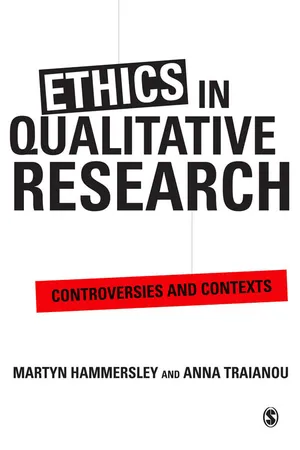
Ethics in Qualitative Research
eBook - ePub

Ethics in Qualitative Research

Controversies and Contexts

  1. 184 pages
  2. English
  3. ePUB (mobile friendly)
  4. Available on iOS & Android
eBook - ePub

Ethics in Qualitative Research

Controversies and Contexts

About this book

All social researchers need to think about ethical issues. Their salience has recently been increased by the pressures of ethical regulation, particularly in the case of qualitative research. But what are ethical issues? And how should they be approached? These are not matters about which there is agreement. Ethics in Qualitative Research explores conflicting philosophical assumptions, the diverse social contexts in which ethical problems arise, and the complexities of handling them in practice.

The authors argue that the starting point for any discussion of research ethics must be the values intrinsic to research, above all the commitment to knowledge-production. However, the pursuit of inquiry is rightly constrained by external values, and the book focuses on three of these: minimising harm, respecting autonomy, and protecting privacy. These external values are shown to be far from unequivocal in character, often in conflict with one another (or with the commitments of research), and always subject to situational interpretation and practical judgment. Nevertheless, it is contended that in the present challenging times it is essential that qualitative researchers uphold research values.

Martyn Hammersley is Professor of Educational and Social Research at The Open University.

Anna Traianou is Senior Lecturer in the Department of Educational Studies, Goldsmiths, University of London.

Frequently asked questions

Yes, you can cancel anytime from the Subscription tab in your account settings on the Perlego website. Your subscription will stay active until the end of your current billing period. Learn how to cancel your subscription.
At the moment all of our mobile-responsive ePub books are available to download via the app. Most of our PDFs are also available to download and we're working on making the final remaining ones downloadable now. Learn more here.
Perlego offers two plans: Essential and Complete
  • Essential is ideal for learners and professionals who enjoy exploring a wide range of subjects. Access the Essential Library with 800,000+ trusted titles and best-sellers across business, personal growth, and the humanities. Includes unlimited reading time and Standard Read Aloud voice.
  • Complete: Perfect for advanced learners and researchers needing full, unrestricted access. Unlock 1.4M+ books across hundreds of subjects, including academic and specialized titles. The Complete Plan also includes advanced features like Premium Read Aloud and Research Assistant.
Both plans are available with monthly, semester, or annual billing cycles.
We are an online textbook subscription service, where you can get access to an entire online library for less than the price of a single book per month. With over 1 million books across 1000+ topics, we’ve got you covered! Learn more here.
Look out for the read-aloud symbol on your next book to see if you can listen to it. The read-aloud tool reads text aloud for you, highlighting the text as it is being read. You can pause it, speed it up and slow it down. Learn more here.
Yes! You can use the Perlego app on both iOS or Android devices to read anytime, anywhere — even offline. Perfect for commutes or when you’re on the go.
Please note we cannot support devices running on iOS 13 and Android 7 or earlier. Learn more about using the app.
Yes, you can access Ethics in Qualitative Research by Martyn Hammersley,Anna Traianou in PDF and/or ePUB format. We have over one million books available in our catalogue for you to explore.

Information

Table of contents

  1. Cover Page
  2. Title Page
  3. Copyright Page
  4. Contents
  5. About the authors
  6. Introduction
  7. 1 What is ethics?
  8. 2 The research ethos
  9. 3 The risk of harm
  10. 4 Autonomy and informed consent
  11. 5 Privacy, confidentiality and anonymity
  12. Conclusion: challenging moralism
  13. References
  14. Index