![]()
1
What is a Literature Review?
• To understand what we mean by ‘the literature’ and evidence in social work
• To gain an awareness of what grey literature is, and why it is important
• To develop an awareness of the differing functions of literature reviews
• To gain an overview of narrative and systematic literature reviews
• To learn about the different methodologies employed in the literature review process
‘The Literature’ and Social Work Practice
What do we mean by ‘the literature’?
‘The literature’ is the body of academic research that has been published and disseminated through publications such as books, academic journals, practitioner journals, websites and other sources. It’s basically a shorthand way of referring to the sum of published knowledge about a particular subject. However, as you’ll discover in more detail in Chapter 4, the idea of there being a coherent body of literature around a particular subject such as social work is becoming more problematic, as more and more publications appear in a variety of formats and contexts.
The nature of knowledge and evidence in social care practice
When discussing ‘knowledge’ in relation to social work, it can be easy to overlook some of the trickier questions about how we establish, define and verify what comes to be understood as knowledge. We might ask whether it is even possible to achieve consensus about what constitutes useful knowledge (particularly in respect of the way social workers carry out their practice). In the current socio-political context, social workers are increasingly under pressure to be able to justify their decisions and account for their actions, yet at the same time it would appear that ideas about what constitutes effective social work practice are frequently contested, and often not well-documented in terms of available research evidence.
Pawson et al. (2003) carried out a substantial investigation into the issue of types of knowledge in social care. They propose that the questions that should be asked of any piece of knowledge can be encapsulated in the useful acronym ‘TAPUPAS’:
| Transparency | Is it open to scrutiny? |
| Accuracy | Is it well grounded? |
| Purposivity | Is it fit for purpose? |
| Utility | Is it fit for use? |
| Propriety | Is it legal and ethical? |
| Accessibility | Is it intelligible? |
| Specificity | Does it meet source-specific standards? |
ACTIVITY
Types and quality of knowledge in social care
For a flavour of some of the complex issues involved in considering the status and role of knowledge in social care practice, read the short ‘Summary’ section of Pawson et al.’s (2003) report, ‘Types and quality of knowledge in social care’, which is available at the following website address: www.scie.org.uk/publications/knowledgereviews/kr03.pdf
The use(s) of evidence
Increasingly, there is a demand for research in social work to establish evidence-based findings which can lead to replicable results in different settings. This ethos of evidence-based research comes from the domain of medicine and health care, and has gradually become more widespread in disciplines such as social care and education. Although there is recognition of the need for greater understanding of what is both effective and ineffective in social work practice, there is some disagreement as to whether evidence-based research can fulfil this role.
It should therefore be acknowledged that there are particular debates within the social work profession about the usefulness and appropriateness of evidence-based practice, with some claiming that it represents the best way of establishing better knowledge for practice, and others suggesting that it can minimise and overlook the importance of practitioners’ localised knowledge. This has lead some commentators to point to ‘evidence-informed’ approaches (Hodson and Cooke, 2004: 12), which acknowledge the importance of empirical data, but which also recognise the importance of other sources of knowledge, such as practitioner knowledge, user and carer knowledge, organisational knowledge, research knowledge and policy community knowledge (Pawson et al., 2003). We will return to these, and other important issues relating to evidence-based practice, in more detail in Chapter 10.
Using the grey matter!
Did you know? What is grey literature? ‘Grey literature’ has recently been defined as the various types of document produced by governments, academic institutions, businesses and industries
Basically, the term describes documents that may not have been published through conventional routes, and which may therefore be trickier to find and access. They can be thought to occupy a ‘grey area’ in comparison to traditional published material.
Examples of grey literature
Grey literature includes publications such as:
• newsletters
• policy documents
• some research reports
• minutes of meetings
• professional and regulatory body requirements
• leaflets
• internally printed reports
• unpublished undergraduate and postgraduate theses and dissertations
• unpublished conference papers
• blogs, tweets, bulletin board and other social media postings.
Why is grey literature useful or important?
Hartman (2006: 2) explains:
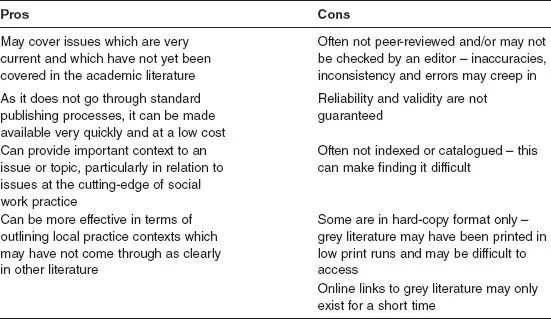
Grey literature can promote a greater level of democracy and plurality in terms of the range of voices and opinions that are heard. However, it can also introduce some questions around issues of ‘quality control’, and it’s important to be aware of both its strengths and limitations.
Grey literature – pros and cons
Table 1.1 Pros and cons of using grey literature
Did you know? ‘Reliability’ and ‘validity’ These words are often used in the context of assessing the strengths and weaknesses of research processes, and you are likely to come across some discussion of them (and related issues) when reading about research methodology.
In very broad terms:
• Reliability refers to the extent to which methods or findings are likely to yield similar results if the study, research, experiment or investigation were to be repeated in similar circumstances, using similar methods of investigation.
• Validity refers to the extent to which the research methods and instruments measure what they claim or set out to measure. An assessment of validity would also involve consideration of whether the results of a research process have been skewed or contaminated by additional (and sometimes unforeseen or unanticipated) factors in the research field and/or process.
ACTIVITY
Going grey
Time suggested: 20–30 minutes
Access the ‘Review of grey literature on drug prevention among young people – Review Summary’ at www.nice.org.uk/niceMedia/pdf/grey_lit_summary_v3FINAL.pdf (If the web link above is no longer active, use a search engine to find a current link to this document.)
Read the document (it is only five pages long so is quite quick to get through), and then answer the following questions:
1. What did this piece of work aim to do?
2. Why did they focus on grey literature?
3. How did they go about finding the grey literature?
4. Why was it important that the researchers applied critical appraisal criteria to the grey literature that they considered?
5. The ‘Concluding remarks’ section identifies several limitations of the grey literature that was reviewed. Can you identify three of these?
Introducing Literature Reviews
What is a literature review?
A literature review is a comprehensive summary of the ideas, issues, approaches and research findings that have been published on a particular subject area or topic. However, it is not a simple description of all that the reviewer has read on the topic. It is better understood as a critical synthesis (or bringing together) of:
• what can reasonably be asserted based on the extent of the literature findings
• what worked and didn’t work i...