- 192 pages
- English
- ePUB (mobile friendly)
- Available on iOS & Android
eBook - ePub
Using Counselling Skills in Social Work
About this book
This practical book enables students to develop key counselling skills that can help to enhance their practice and help to place the service-user at the centre of the decision making process. Relationship building will be a key area of the text and relevant counselling skills for achieving this in social work settings such as empathic responding will be illustrated in detail together with examples of dialogue and analysis of interventions. The role and importance of self-awareness will be discussed together with various exercises to develop the readers? own knowledge of themselves.
Information
Publisher
Learning MattersYear
2012Print ISBN
9780857256294
9780857258403
Edition
1eBook ISBN
9780857256300
Chapter 1 Counselling Skills and Social Work
Achieving a Social Work Degree
This chapter will help you to develop the following capabilities, to the appropriate level, from the Professional Capabilities Framework.
- Professionalism. Identify and behave as a professional social worker, committed to professional development.
- Values and ethics. Apply social work ethical principles and values to guide professional practice.
- Diversity. Recognise diversity and apply anti-discriminatory and anti-oppressive principles in practice.
See Appendix 1 for the Professional Capabilities Framework diagram.
The chapter will also introduce you to the following standards as set out in the 2008 social work subject benchmark statement.
- 5.1.4 Social work theory.
- 5.1.5 The nature of social work practice.
- 5.5.3 Analysis and synthesis.
- 5.5.4 Intervention and evaluation.
- 5.6 Communication skills.
- 5.7 Skills in working with others.
Introduction
In this chapter counselling skills are defined together with an examination of why they are important in social work practice. Research findings of the significance of empathic counselling skills in engaging service-users are discussed. Examining skills to place the service-user at the centre of the helping process is another key area of this chapter and there is a focus on the service-user as the expert on themselves. The chapter includes interviews with service-users discussing the skills they want from social workers. There is also a discussion of the compulsion social work students often feel to tell service-users what to do rather than assisting them in finding their own solutions. The Egan Skilled Helper model is a key feature of this chapter and it is discussed here together with my own research involving students from the University of Lincoln using this model during their placement.
What are Counselling Skills?
There is a difference between being a counsellor and using counselling skills. Counsellors undergo professional training to help people who are experiencing psychological difficulties in their lives (Nelson-Jones, 2008). Counsellors choose their training from one of the schools of counselling. The model they learn then becomes the underpinning theory by which they help clients (counsellors refer to service-users as clients). The various schools of counselling together with their individual theories can be categorised as shown in Table 1.1.
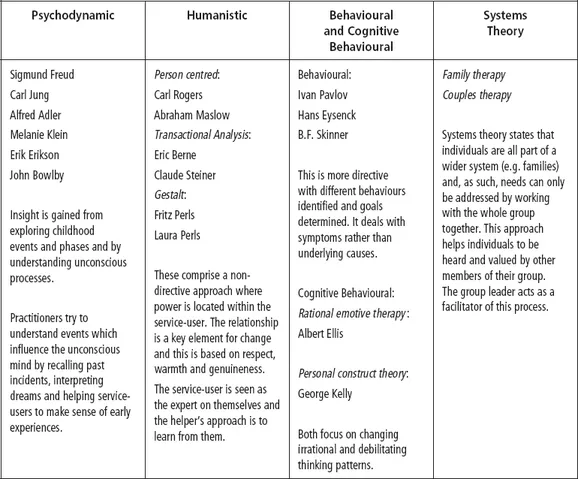
Each of the above schools and their associated theories involve particular skills and ways of working and counsellors would generally use the model with which they are familiar. Counsellors work in a specific way, for example holding strict boundaries by seeing a client for one hour per week and not engaging in contact at any other time. Counsellors do not act as advocates or take action for service-users. They do not engage other services (except in exceptional and serious situations), neither do they monitor people and write reports for other agencies such as courts and case conferences. The counselling relationship is a private, confidential arrangement (unless the client is threatening suicide or harm to someone else) whereas a social worker reports to their team manager and others, keeps records which may be shared with other professionals and takes an active role in doing things with and for the service-user.
Professionals from a wide range of helping professions, however, will use counselling skills. Egan (2010) refers to such people as ‘helpers’ and such professionals include doctors, nurses, youth workers, care officers, project workers, housing officers, voluntary workers and, of course, social workers. A competent social worker uses counselling skills whenever they engage with and listen to service-users; when they are establishing what the service-user needs or wants; when working with service-users who are vulnerable and in crisis; when establishing how to help or what is needed; when challenging in difficult circumstances such as in child protection and ultimately in helping service-users to change.
Social workers are not counsellors; however, a skilled social worker uses many of the skills which counsellors use in their practice (Lindsay, 2009). This book identifies these skills and explores how they are useful to engaging with service-users in social work.
Activity 1.1
Think of a time when you needed professional help for a problem you had, for example for a medical issue. What personal qualities did you want the person to demonstrate to you? What skills did you hope they would use with you?
Comment
If the experience you had with the professional was positive then it is likely that they listened fully to your concerns, engaged with you in a non-judgemental manner, showed you respect and involved you in any decision-making. This kind of approach would consist of using counselling skills. A negative experience with the professional, for example where they appeared disinterested, critical or unwilling to let you discuss your issue, is likely to have left you feeling unheard, unimportant and disempowered. Counselling skills, then, involve using active listening skills, asking relevant questions, reflecting back what the service-user has implied, gently prompting and probing for more information and summarising key points made. They also involve using skills to work with reluctant and resistant service-users, challenging, managing anger, raising concerns in a respectful manner and helping people to plan and sustain action. Each of these skills will be explored in detail later.
Why Counselling Skills are Important in Social Work
Counselling skills, as we have seen, constitute the building blocks of creating effective working relationships with service-users. In the review of the social work profession, The Social Work Task Force Report (2010, p21) recommends that social workers:
…work in a person centred manner, to support people to manage their own affairs where possible and to assist in finding solutions, which balance choice and control for the individual and their family and social networks.
Service-users themselves clearly specify the qualities they look for in their social workers. Barnes (2002) conducted research with service-users in her report on social work education and training. She found what matters most to service-users is that social workers understand what is really happening to them and that assumptions and judgements are not made about what the service-user really wants or needs. Barnes also found service-users particularly value a high-quality relationship with their social worker. The Shaping Our Lives National User Network (cited in Trevithick et al., 2004, p21) echoes this in describing the qualities service-users seek in social workers including warmth, respect, being non-judgemental, listening, treating people with equality, being trustworthy, open, honest and reliable and communicating well.
The above features are all counselling skills and it is apparent that there is a strong cross-over in skills employed in counselling and those necessary to effective social work practice. There will be a thorough exploration of how practitioners can develop these skills in later chapters.
Research Summary
Ethical Dilemmas in Learning Counselling Skills for Social Work
The reality of much social work practice in the contemporary environment is the pressure on practitioners to see ever increasing numbers of service-users in ever diminishing amounts of time. Richards et al. (2005) examine the dilemma this provokes in deciding which skills students should learn within communication skills training. Their findings are that although the pressures of practice can reduce social workers’ skills to filling in assessment forms as quickly as possible, nevertheless learning to engage empathically with service-users is an essential skill to learn. It is important to understand the unique needs of every individual service-user. Richards and her team comment that skills training should focus on listening, questioning and explaining in addition to developing the use of self. Use of self means understanding our own motives and reactions in communicating with others and how these may impact on the person with whom we are engaging.
Richards and her team comment that students experience the dilemma of learning empathic counselling skills on their programmes of study only to find there is little time to practise these skills on placement. However, they comment that even though it can be challenging to make the space to use these skills, failing to use communication (counselling) skills leaves the service-user not wanting to engage at all and feeling unsupported by their social worker.
It is important, therefore, that practitioners learn, practise and use counselling skills and think about how they can incorporate these ways of working into their everyday engagement with service-users. In the course of researching students’ use of counselling skills during their first practice placement, I interviewed Susan, a Practice Assessor. Susan talks about how students feel under pressure to complete assessments correctly and quickly and how, often, they simply ask one question after another. She comments:
I watch them with their heads down, intently filling in the forms, rarely looking up and with no eye contact. They are in complete control and you can see the service-user gradually sinking lower into their chair as opportunities for deeper engagement are lost. What I say to my students is, ‘get to know the person, find out how they are feeling and what is happening to them. Use your counselling skills and be aware of your and their non-verbal communication. You will get all the information you need for your form by doing this. Then fill it in afterwards – in your car’.
What this experienced practitioner and practice educator is saying is yes, it is important to complete the assessment form but there is more than one way of achieving this well. As a practitioner you could read out the questions from the form one after the other and record the answers without any engagement with the service-user or you could use your counselling skills to get to know the person and their real needs and then complete your paperwork. Either way, a completed form is produced but the second method enables a much better relationship to be fostered.
In the next section, service-users and carers themselves talk about what constitutes good counselling skills.
Interview with a Service-User Group
I interviewed a service-user group that advises on university teaching, practice and procedures to find out which counselling skills they particularly value in their social workers.
Dominic: It's nice when someone gives you a friendly smile, feeling the person is going to be friendly. It's also about giving feedback to demonstrate they have taken note of what you have been saying. It's very encouraging and it feels good to know that you have been listened to and not that the listener is assuming anything or guessing what you might be trying to say.
William: The first person I had, had warmth and was friendly. She was intuitive and had insight and what she did was to try to look at the positives of my life, rather than the negatives and I think that is a good thing. It puts into perspective that you have a lot of good things going for you and what you are good at. Another social worker I had was warm and kind, she listened to me well, she seemed to like the job she was doing which is a big thing. If you get the sense someone is enjoying the job they are doing, it puts you at your ease, and she put me at my ease. She was a very good listener. She seemed as though she really looked at my problem and she saw it from her side – how...
Table of contents
- Cover
- Half Title
- Title Page
- Copyright Page
- Contents
- Series Editors' Preface
- About the Author
- Acknowledgements
- Introduction
- Chapter 1 Counselling Skills and Social Work
- Chapter 2 Building Relationships
- Chapter 3 Empathic Responding
- Chapter 4 Overcoming Barriers
- Chapter 5 Using Challenging Skills to Raise Concerns
- Chapter 6 Service-users Managing their Own Lives
- Chapter 7 Working with Loss and Grief
- Chapter 8 Working with Conflict
- Chapter 9 Counselling Skills in Groupwork
- Chapter 10 Counselling Skills in Different Settings
- Conclusion
- Appendix 1: Professional Capabilities Framework
- Appendix 2: Subject Benchmark for Social Work
- Glossary
- References
- Index
Trusted by 375,005 students
Access to over 1.5 million titles for a fair monthly price.
Study more efficiently using our study tools.
Frequently asked questions
Yes, you can cancel anytime from the Subscription tab in your account settings on the Perlego website. Your subscription will stay active until the end of your current billing period. Learn how to cancel your subscription
No, books cannot be downloaded as external files, such as PDFs, for use outside of Perlego. However, you can download books within the Perlego app for offline reading on mobile or tablet. Learn how to download books offline
Perlego offers two plans: Essential and Complete
- Essential is ideal for learners and professionals who enjoy exploring a wide range of subjects. Access the Essential Library with 800,000+ trusted titles and best-sellers across business, personal growth, and the humanities. Includes unlimited reading time and Standard Read Aloud voice.
- Complete: Perfect for advanced learners and researchers needing full, unrestricted access. Unlock 1.5M+ books across hundreds of subjects, including academic and specialized titles. The Complete Plan also includes advanced features like Premium Read Aloud and Research Assistant.
We are an online textbook subscription service, where you can get access to an entire online library for less than the price of a single book per month. With over 1.5 million books across 990+ topics, we’ve got you covered! Learn about our mission
Look out for the read-aloud symbol on your next book to see if you can listen to it. The read-aloud tool reads text aloud for you, highlighting the text as it is being read. You can pause it, speed it up and slow it down. Learn more about Read Aloud
Yes! You can use the Perlego app on both iOS and Android devices to read anytime, anywhere — even offline. Perfect for commutes or when you’re on the go.
Please note we cannot support devices running on iOS 13 and Android 7 or earlier. Learn more about using the app
Please note we cannot support devices running on iOS 13 and Android 7 or earlier. Learn more about using the app
Yes, you can access Using Counselling Skills in Social Work by Sally Riggall in PDF and/or ePUB format, as well as other popular books in Social Sciences & Social Work. We have over 1.5 million books available in our catalogue for you to explore.