In a detailed reply to Habermas? Philosophical Discourse of Modernity, this volume explains the difference between Habermas? philosophical practice and Foucault?s between the analytics of truth and the politics of truth. Many of the most difficult arguments in the exchange are subject to a detailed critical analysis. This examination also includes discussion of the ethics of dialogue; the practice of criticism; the politics of recognition , and the function of civil society and democracy.
eBook - ePub
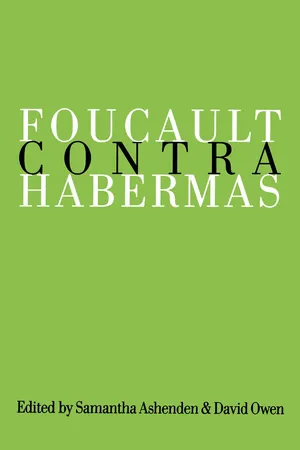
Foucault Contra Habermas
Recasting the Dialogue between Genealogy and Critical Theory
- 224 pages
- English
- ePUB (mobile friendly)
- Available on iOS & Android
eBook - ePub
Foucault Contra Habermas
Recasting the Dialogue between Genealogy and Critical Theory
About this book
Foucault contra Habermas is an incisive examination of, and a comprehensive introduction to, the debate between Foucault and Habermas over the meaning of enlightenment and modernity. It reprises the key issues in the argument between critical theory and genealogy and is organised around three complementary themes: defining the context of the debate; examining the theoretical and conceptual tools used; and discussing the implications for politics and criticism.
Information
Publisher
SAGE Publications LtdYear
1999Print ISBN
9780803977716
9780803977709
Edition
1eBook ISBN
9781446228340
1
ORIENTATION AND ENLIGHTENMENT
An Essay on Critique and Genealogy
David Owen
‘But being guided is surely a particular experience!’ The answer to this is: you are now thinking of a particular experience of being guided.
(Ludwig Wittgenstein)
This chapter addresses the dialogue between critique and genealogy by drawing attention to these practices of critical reflection as ways of orienting thinking. In taking this approach, the chapter has two purposes. The first is simply to try and clarify the terms of the debate by elucidating critique and genealogy as distinct practices of critical reflection. The second is to illustrate the stakes of the debate by showing that this encounter poses important questions concerning the ethics of dialogue.
The argument will be presented in four sections. The first and second sections focus on the grammars of critique and genealogy respectively by drawing out the distinct modes of orienting thinking exhibited by these practices of critical reflection. In the opening section, it is shown that critique legislates an orientation in thinking in which thinking is oriented to a transcendent ideal and that it articulates this orientation in terms of the project of striving to reconcile the real and the ideal through the lawful use of reason. The second section demonstrates that genealogy exemplifies an orientation in thinking in which thinking is oriented to an immanent ideal and that it articulates this orientation in terms of the process of becoming otherwise than we are through the agonic use of reason. The third section explores this encounter by focusing on an asymmetry which characterises Habermas’ and Foucault’s relations to each other’s practices. Here it is shown that whereas Foucault acknowledges but dissents from the claims of critique, Habermas fails to acknowledge the claims of genealogy and that this avoidance of genealogy is a necessary feature of Habermas’ own practice. The final section clarifies the stakes of this encounter by focusing on these practices in terms of the ethics of dialogue.
I
The central claim of this section is that the grammar of critique can be presented schematically as follows: critique legislates an orientation in thinking in which thinking is oriented to a transcendent ideal; it articulates this orientation in terms of the project of striving to reconcile the real and the ideal through the lawful use of reason. I will illustrate this claim by reference to Kant’s reflections on critique and enlightenment before showing that Habermas’ post-metaphysical reconstruction of Kantian critique demonstrates his commitment to the same mode of orientation in thinking. In both cases we will see that this way of orienting thinking produces a specific conception of enlightenment and, relatedly, a two-sided attitude of moral impatience and moral anxiety towards practices of critical reflection characterised by the ‘lawless’ use of reason.
From its inception, Kant’s philosophy links criticism to the unconstrained public use of reason. In the preface to the first edition of the Critique of Pure Reason (1983) [1781] Kant proclaims:
Our age is, in especial degree, the age of criticism, and to criticism everything must submit. Religion through its sanctity and law-giving through its majesty may seek to exempt themselves from it. But they then awaken just suspicion, and cannot claim the sincere respect which reason accords only to that which has been able to sustain the test of free and open discussion. (Kant, 1983: A, xii)
The relationship between reason and unconstrained public discussion invoked here under the title of criticism is elaborated in the revised second edition of the Critique of Pure Reason (1983) [1787]:
Reason depends on this freedom [of discussion] for its very existence. For reason has no dictatorial authority; its verdict is always simply the agreement of free citizens, of whom each one must be permitted to express, without let or hindrance, his objections or even his veto. (Kant, 1983: B 766f.)
This conceptualisation of reason’s critical judging of ‘everything’ in terms of ‘the test of free and open discussion’ means that reason’s critical judging of itself, that the law which reason imposes on itself, is specified by the transcendental presuppositions of ‘the test of free and open discussion’. Kant proposes the following maxims as transcendental hypotheses: ‘(1) to think for oneself [the maxim of unprejudiced thought/understanding]; (2) to think from the standpoint of everyone else [the maxim of enlarged thought/judgement]; (3) always to think consistently [the maxim of consistent thought/reason]’ (Kant, 1952: 1.2 s40; AA v, 294). From these maxims we can deduce the transcendental formula of moral law: ‘Act always according to that maxim which you can at the same time consistently will as universal law’ – and, concomitantly, the transcendental ideal to which Kant’s critical philosophy orients thinking, namely, the kingdom of ends. For Kant, it is by acting in conformity with the moral law that we direct and transform our present (the real) towards the kingdom of ends (the ideal).
The implications of this analysis for the concept of enlightenment are drawn out in the essays ‘An answer to the question: “what is enlightenment?” ’ (1784) and ‘What is orientation in thinking?’ (1786). In these essays, Kant argues that the free public use of reason is a necessary condition for the development of public enlightenment. Thus, in ‘An answer to the question: “what is enlightenment?”’, Kant defines enlightenment as ‘man’s emergence from his self-imposed immaturity’ (1991a: 54). He argues that this immaturity has been held in place by the ‘dogmas and formulas’ propagated by ‘the guardians of humanity’ but holds that public enlightenment is ‘almost inevitable’ if the public is granted ‘freedom to make public use of their reason in all matters’ (1991a: 54–5). Relatedly, in ‘What is orientation in thinking?’ Kant argues that two of the major threats to enlightenment are civic (i.e. legal) and moral (i.e. religious or ideological) constraints on freedom of communication (1991b: 247). However, while freedom to make public use of one’s reason in all matters is a necessary condition of the movement towards an enlightened public, it is not a sufficient condition. In ‘What is enlightenment?’, Kant points out that a further requirement is the existence of some enlightened individuals who ‘will disseminate the spirit of rational respect’ (1991a: 55); while in ‘What is orientation in thinking?’ Kant points to a third threat to enlightenment: the lawless use of reason (1991b: 247). These points are related but, for the purposes of this chapter, let us focus on the threat posed by the lawless use of reason.
Kant elaborates this threat in the following terms:
the inevitable result of self-confessed lawlessness in thinking (i.e., of emancipation from the restrictions of reason) is this: freedom of thought is thereby ultimately forfeited and, since the fault lies not with misfortune, for example, but with genuine presumption, this freedom is in the true sense of the word thrown away. (1991b: 248)
This result is inevitable because such lawlessness manifests itself as ‘rational unbelief’:
an undesirable state of mind which first deprives the moral laws of all their power to motivate the heart, and eventually even deprives them of all authority, so giving rise to the attitude known as libertinism (i.e., the principle of no longer acknowledging any duty). (1991b: 249)
Given widespread libertinism, Kant argues, the authorities will ‘intervene to ensure that civil affairs are not themselves plunged into complete disorder’ and impose arbitary legal and moral constraints on freedom of thought: ‘they may even abolish freedom of thought altogether’ (1991b: 249).
There are two initial points to note about this threat. First, the lawless use of reason is all too compatible with – indeed, seems to require – the freedom to make public use of one’s reason. Secondly, whether or not the lawless use of reason causes the authorities to reimpose constraints on freedom of communication, Kant identifies it as a threat to enlightenment simply by virtue of the fact that it undermines the authority of the moral law. Consequently, it should not surprise us that Kant exhibits a two-sided attitude towards philosophers who advocate the lawless use of reason: on the one hand, moral impatience with their failure to orient thinking appropriately (they abuse the freedom they have been granted) and, on the other hand, moral anxiety concerning the effects of their advocacy (they undermine enlightenment). What conclusions can we draw from Kant’s reflections on enlightenment and the lawless use of reason? The pertinent conclusion for my argument here is simply this: Kant’s remarks are only intelligible given an understanding of enlightenment as the project of striving to reconcile the real and the ideal through the lawful use of reason. In other words, it is only if we grasp Kant’s understanding of enlightenment in this way that we can see why he regards the lawless use of reason as posing such a significant threat. Consequently we can summarise Kant’s specific way of orienting thinking thus: critique orients thinking to the kingdom of ends (the transcendental ideal); it articulates this orientation in thinking in terms of enlightenment (the project of striving to reconcile the real and the ideal) in which the free public use of reason subjects itself to the regulative constraints of performative consistency that is, the maxims of reason (the lawful use of reason).
Let us turn to Habermas’ post-metaphysical reconstruction of Kantian critique in terms of universal pragmatics in which he ‘attempts to identify and reconstruct social-practical analogues of Kant’s ideas of reason’ (MacCarthy, 1994: 38). We should note initially that Habermas shares Kant’s emphasis on the relationship between criticism and communicative freedom, and, relatedly, Kant’s understanding of critique as the articulation of the transcendental presuppositions of the test of free and open discussion. But, in an attempt to avoid the aporias of Kant’s philosophy, Habermas shifts this understanding of critique from a metaphysical philosophy of the subject focused on the rational internal structure of individual consciousness to a fallibilistically conceived philosophy of intersubjectivity focused on the reconstruction of the rational internal structure of communication oriented to understanding/agreement (Verständigung). Consequently, Habermas reconstructs critique as engaged in a formal-pragmatic analysis which ‘aims at hypothetical reconstructions of that pre-theoretical knowledge that competent speakers bring to bear when they employ sentences in actions oriented to reaching understanding [Verständigung]’ (Habermas, 1984: 138, cf. Hutchings, 1996). To elucidate Habermas’ particular account of critique as a way of orienting thinking, let us attend briefly to this formal-pragmatic analysis.
Drawing on speech act theory, Habermas argues that ‘in communicative action one actor seeks rationally to motivate another by relying on the illocutionary binding/bonding effect [Bindungseffekt] of the offer contained in his speech act’ (Habermas, 1990: 58):
The fact that a speaker can rationally motivate a hearer to accept such an offer is not due to the validity of what he says but to the speaker’s guarantee that he will, if necessary, make efforts to redeem the claim that the hearer has accepted. (Habermas, 1990: 58)
He claims further that we, moderns, can distinguish analytically between three different types of validity claim raised in any communicative speech act. These are ‘the validity claims of propositional truth, normative rightness, and sincerity or authenticity’ which correspond to three world-relations (objective, social and subjective), three attitudes (objectivating, norm-governed and expressive) and three types of value-sphere (science, morality and law, aesthetics and ethics) (Habermas, 1984:137). Habermas specifies rationality in relation to these three types of validity claim:
In contexts of communicative action, we call someone rational not only if he is able to put forward an assertion and, when criticized, to provide grounds for it by pointing to the appropriate evidence, but also if he is following an established norm and is able, when criticized, to justify his action by explicating the situation in the light of legitimate expectations. We even call someone rational if he makes known a desire or an intention . . . etc., and is then able to reassure critics in regard to the revealed experience by drawing practical consequences from it and behaving consistently thereafter. (Habermas, 1984: 15)
Thus Habermas argues that ‘[in] the case of claims to truth or rightness, the speaker can redeem his guarantee discursively, that is, by adducing reasons; in the case of claims to truthfulness he does so through consistent behaviour’ (Habermas, 1990: 58–9).
Now, given that communicative action is oriented to ‘rationally motivated agreement’ based on ‘the intersubjective recognition of criticizable validity claims’ (Habermas, 1984: 137), Habermas claims that participants in argumentation concerning a validity claim to truth or rightness cannot avoid certain ‘idealizing presuppositions’ immanent in such action – presuppositions which can be reconstructed as universal rules of rational argumentation. These transcendental presuppositions ‘are identified by convincing a person who contests the hypothetical reconstructions offered that he is caught up in a performative contradiction’ (Habermas, 1990: 89), i.e. that he is committed to a constative speech act k(p) which rests on non-contingent presuppositions whose propositional content contradicts the asserted proposition p (Habermas, 1990: 80). We can elucidate this claim by reference to Habermas’ hypothetical reconstruction of the ‘idealizing presuppositions’ involved in redeeming validity claims concerning normative rightness. In this case, Habermas distinguishes three levels of presupposition: ‘those at the logical level of products, those at the dialectical level of procedures, and those at the rhetorical level of processes’ (Habermas, 1990: 87) – which correspond to three types of rule: logical-semantic rules of consistency, procedural rul...
Table of contents
- Cover Page
- Title Page
- Copyright Page
- Contents
- Preface and Acknowledgements
- Introduction: Foucault, Habermas and the Politics of Critique
- 1 Orientation and Enlightenment: An Essay on Critique and Genealogy
- 2 Critical Spirituality: On Ethics and Politics in the Later Foucault
- 3 Pas de deux: Habermas and Foucault in Genealogical Communication
- 4 To Think and Act Differently: Foucault’s Four Reciprocal Objections to Habermas’ Theory
- 5 Questions of Criticism: Habermas and Foucault on Civil Society and Resistance
- 6 Normalising Democracy: Foucault and Habermas on Democracy, Liberalism and Law
- 7 The Agony and the Ecstasy: Foucault, Habermas and the Problem of Recognition
- Index
Trusted by 375,005 students
Access to over 1.5 million titles for a fair monthly price.
Study more efficiently using our study tools.
Frequently asked questions
Yes, you can cancel anytime from the Subscription tab in your account settings on the Perlego website. Your subscription will stay active until the end of your current billing period. Learn how to cancel your subscription
No, books cannot be downloaded as external files, such as PDFs, for use outside of Perlego. However, you can download books within the Perlego app for offline reading on mobile or tablet. Learn how to download books offline
Perlego offers two plans: Essential and Complete
- Essential is ideal for learners and professionals who enjoy exploring a wide range of subjects. Access the Essential Library with 800,000+ trusted titles and best-sellers across business, personal growth, and the humanities. Includes unlimited reading time and Standard Read Aloud voice.
- Complete: Perfect for advanced learners and researchers needing full, unrestricted access. Unlock 1.5M+ books across hundreds of subjects, including academic and specialized titles. The Complete Plan also includes advanced features like Premium Read Aloud and Research Assistant.
We are an online textbook subscription service, where you can get access to an entire online library for less than the price of a single book per month. With over 1.5 million books across 990+ topics, we’ve got you covered! Learn about our mission
Look out for the read-aloud symbol on your next book to see if you can listen to it. The read-aloud tool reads text aloud for you, highlighting the text as it is being read. You can pause it, speed it up and slow it down. Learn more about Read Aloud
Yes! You can use the Perlego app on both iOS and Android devices to read anytime, anywhere — even offline. Perfect for commutes or when you’re on the go.
Please note we cannot support devices running on iOS 13 and Android 7 or earlier. Learn more about using the app
Please note we cannot support devices running on iOS 13 and Android 7 or earlier. Learn more about using the app
Yes, you can access Foucault Contra Habermas by Samantha Ashenden, David Owen, Samantha Ashenden,David Owen in PDF and/or ePUB format, as well as other popular books in Social Sciences & Sociology. We have over 1.5 million books available in our catalogue for you to explore.