Today, any kid can rattle off the names of dozens of dinosaurs. But it took centuries of scientific effort—and a lot of luck—to discover and establish the diversity of dinosaur species we now know. How did we learn that Triceratops had three horns? Why don't many paleontologists consider Brontosaurus a valid species? What convinced scientists that modern birds are relatives of ancient Velociraptor?
In The Story of the Dinosaurs in 25 Discoveries, Donald R. Prothero tells the fascinating stories behind the most important fossil finds and the intrepid researchers who unearthed them. In twenty-five vivid vignettes, he weaves together dramatic tales of dinosaur discoveries with what modern science now knows about the species to which they belong. Prothero takes us from eighteenth-century sightings of colossal bones taken for biblical giants through recent discoveries of enormous predators even larger than Tyrannosaurus. He recounts the escapades of the larger-than-life personalities who made modern paleontology, including scientific rivalries like the nineteenth-century "Bone Wars." Prothero also details how to draw the boundaries between species and explores debates such as whether dinosaurs had feathers, explaining the findings that settled them or keep them going. Throughout, he offers a clear and rigorous look at what paleontologists consider sound interpretation of evidence. An essential read for any dinosaur lover, this book teaches us to see an ancient world ruled by giant majestic creatures anew.
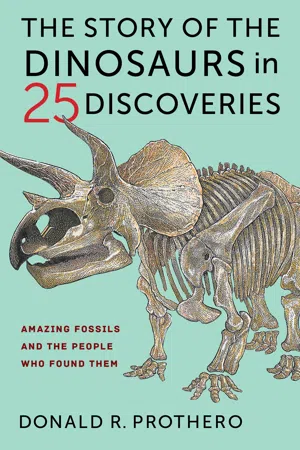
eBook - ePub
The Story of the Dinosaurs in 25 Discoveries
Amazing Fossils and the People Who Found Them
- English
- ePUB (mobile friendly)
- Available on iOS & Android
eBook - ePub
The Story of the Dinosaurs in 25 Discoveries
Amazing Fossils and the People Who Found Them
About this book
Information
Topic
Ciencias físicasSubtopic
EvoluciónPART I
IN THE BEGINNING
Behold now behemoth, which I made with thee; he eateth grass as an ox.
Lo now, his strength is in his loins, and his force is in the navel of his belly.
He moveth his tail like a cedar: the sinews of his stones are wrapped together.
His bones are as strong pieces of brass; his bones are like bars of iron.
He is the chief of the ways of God: he that made him can make his sword to approach unto him.
Surely the mountains bring him forth food, where all the beasts of the field play.
He lieth under the shady trees, in the covert of the reed, and fens.
The shady trees cover him with their shadow; the willows of the brook compass him about.
Behold, he drinketh up a river, and hasteth not: he trusteth that he can draw up Jordan into his mouth.
He taketh it with his eyes: his nose pierceth through snares.
—JOB 40:15–24
01 | THE “GREAT LIZARD,” THE “SCROTUM HUMANUM,” AND THE FIRST NAMED DINOSAUR |
MEGALOSAURUS | |
There were giants in the earth in those days.
—GENESIS 6:4
GIANTS IN THE EARTH
For centuries, people had picked up huge bones in the ground and puzzled over their origins. In some parts of the world, they were thought to be the remains of legendary dragons, sea monsters, or Cyclopes. On the Greek island of Samos, the numerous large bones were thought to be the remains of Amazon warrior women who had died in battle. (We now know they are the remains of elephants, giraffes, antelopes, cattle, hyenas, and other mammals that were abundantly fossilized there.) The red color of the rocks was thought to be bloodstains (the color actually comes from the rusty iron oxides in the rocks). Some people have argued that the striking fossils of Protoceratops found in the Gobi Desert of Mongolia were the source of the myth of griffins, which had a lion’s head and wings; the frill covering part of the neck reminded the ancients of wings (chapter 24). Large bones of dinosaurs, marine reptiles, and large mammals have been known since prehistoric times, and they have been explained by whatever mythology was prevalent among the peoples who found them.
In Europe, the myths about Earth found in the Bible strongly influenced what people saw in specimens. For example, in 1726 the Swiss scholar Johann Scheuchzer obtained and described a large fossil skeleton of a creature found in Switzerland. His biblical bias was so strong that he thought it was the skeleton of a man who had died in Noah’s flood. He even named it Homo diluvii testis, “man, a witness of the Flood” (figure 1.1). Many years later the famous anatomist and paleontologist Georges Cuvier showed it was not human at all but a giant salamander, which is a close relative of the living giant salamanders found in China and Japan. Today it seems laughable that Scheuchzer could mistake a salamander fossil for a human skeleton, but comparative anatomy was in its infancy in 1726, and everyone was preconditioned to see giant humans as described in the Bible.
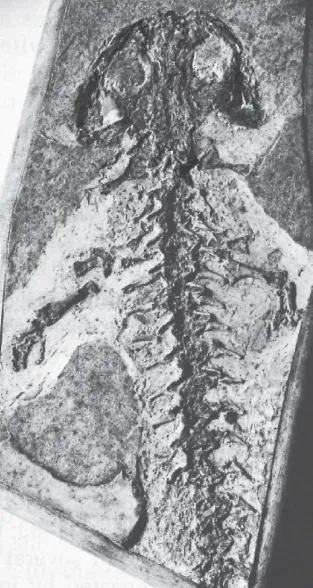
Figure 1.1
The giant extinct salamander interpreted as Homo diluvii testis, “Man, a witness of the Flood,” by Johann Scheuchzer in 1726. (Public domain)
Numerous accounts of giant bones are known in the literature before 1800, but most cannot be tracked down or identified because the fossils have been lost and adequate illustrations, measurements, or locality information are not available to determine what they were talking about. One of the first such fossils that might be identifiable was illustrated in Robert Plot’s 1677 book, Natural History of Oxfordshire (figure 1.2). Plot was the first professor of chemistry at the University of Oxford, and later he was curator of the Ashmolean Museum of Oxford, established in 1683. He was interested in all areas of natural history known at the time. His book described the living animals and plants of the Oxfordshire region as well as some of the rock and fossils. Among these was a strange piece of fossil bone that Plot correctly guessed was the end of a thighbone (femur) of a very large creature. This description was unusual for Plot because he did not believe that most fossils were the petrified remains of animals. Instead he imagined that they were formed by crystallization inside rocks.
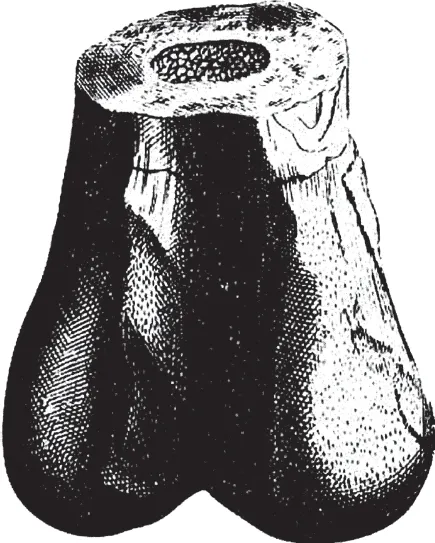
Figure 1.2
Robert Plot’s fossil of the knee end of a dinosaur thighbone that a later author, Richard Brookes, interpreted as a fossil of giant petrified testicles, “Scrotum humanum.” (Public domain)
The specimen had been found in quarries north of Oxford, from a formation we know now is the Middle Jurassic Taynton Limestone. It was much too large to match any animal currently found in England, so Plot guessed that it came from the skeleton of a war elephant used when the Romans conquered Britannia. Later he thought that it might be from a giant human, as mentioned in the Bible. In his words:
Come we next to such [stones] as concern the…Members of the Body: Amongst which, I have one dug out of a quarry in the Parish of Cornwell, and given me by the ingenious Sir Thomas Pennyston, that has exactly the Figure of the lowermost part of the Thigh-Bone of a Man or at least of some other Animal, with capita Femoris inferiora, between which are the anterior…and the large posterior Sinus…: and a little above the Sinus, where it seems to have been broken off, shewing the marrow within of a shining Spar-like Substance of its true Colour and Figure, in the hollow of the Bone…. In Compass near the capita Femoris, just two Foot, and at the top above the Sinus…about 15 inches: in weight, though representing so short a part of the Thigh-Bone, almost 20 pounds.
The fossil has since been lost, but it is the first adequately illustrated dinosaur fossil known and is almost certainly from the dinosaur discussed in this chapter, Megalosaurus.
This first known dinosaur was almost given a truly inappropriate name. In 1763 Richard Brookes republished Plot’s illustration and called the fossil “Scrotum humanum” in a figure caption. Indeed, to someone who doesn’t know anatomy well and is conditioned to see every large fossil as a relict of biblical giants, it does look a bit like a pair of huge human scrota and the base of a penis. In addition, the form of Brookes’s name suggests the genus and species binomial naming system devised by Carl Linnaeus in 1758 and earlier, not only for animals and plants but also for natural curiosities found in rocks. In 1970, the eccentric British paleontologist Lambert Beverly Halstead (famous for trying to act out dinosaurs mating when giving presentations at scientific meetings) published an article suggesting that the first named dinosaur was properly called “Scrotum humanum.” Later paleontologists asked the International Commission on Zoological Nomenclature (the body that makes the rules about scientific names) to formally suppress the name “Scrotum humanum.” The commission ruled that this was unnecessary because the name was only published in a caption, without adequate description or diagnosis, the only specimen was lost, and it was not certain that it was the same as Megalosaurus.
Even though the original fossil was lost, specimens continued to be found in Stonesfield that ended up in the Oxford collections. Most were huge but fragmentary, so it was impossible to identify the animal to which they belonged. However, one lower jawbone with several teeth in various states of eruption found in 1797—bought for Oxford by anatomist and physician Sir Christopher Pegge for the then princely sum of 10 shillings 6 pence—was placed in the anatomy collections of Christ Church College in Oxford where Pegge taught. By 1815, there were quite a few bones, and they caught the attention of the legendary naturalist Sir William Buckland (figure 1.3).
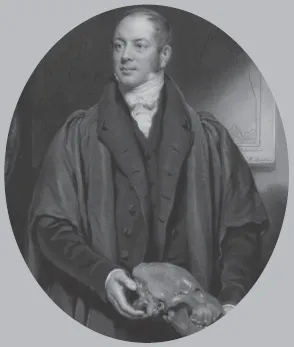
Figure 1.3
Portrait of William Buckland. (Courtesy of Wikimedia Commons)
THE ZOOPHAGE
Buckland was one of the most amazing and colorful figures in the history of science. Born in 1784 in Axminster in Devon in southwestern England, he accompanied his father (the local church rector) on fossil-collecting walks on the coastline at Lyme Regis (later famous for the marine reptiles found by Mary Anning) and developed an early interest in natural history. After attending several schools, he ended up studying mineralogy and chemistry at Corpus Christi College in Oxford, where he would spend most of the rest of his life. By 1813, he succeeded his mentor John Kidd as a reader in mineralogy at Oxford, and he soon became famous for his popular and engaging style of lecturing. Buckland was known for his dramatic delivery and gestures during lectures, sometimes acting out the behavior of the animals he was describing (figure 1.4). According to one story from The Life and Correspondence of William Buckland, D.D., F.R.S. (Gordon [1894]),
He paced like a Franciscan Preacher up and down behind a long show-case, up two steps, in a room in the old Clarendon. He had in his hand a huge hyena’s skull. He suddenly dashed down the steps—rushed, skull in hand, at the first undergraduate on the front bench—and shouted, “What rules the world?” The youth, terrified, threw himself against the next back seat, and answered not a word. He rushed then on me, pointing the hyena full in my face—“What rules the world?” “Haven’t an idea,” I said. “The stomach, sir,” he cried (again mounting his rostrum), “rules the world. The great ones eat the less, and the less the lesser still.”
He even gave lectures on horseback. He wore his heavy academic robes at every lecture and scrambled around outcrops on a field excursion in formal clothes.
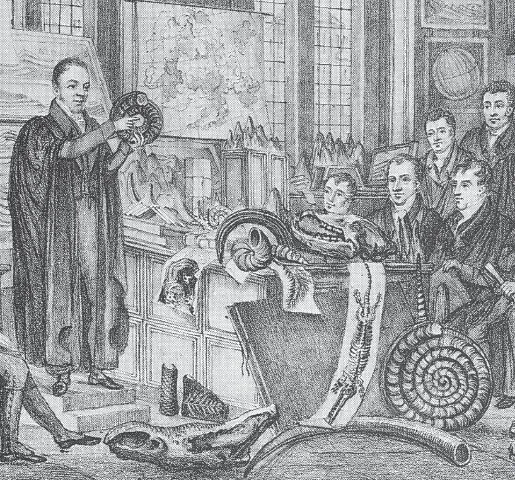
Figure 1.4
Woodcut showing Buckland lecturing to spellbound Oxford students, holding up fossils of an ammonite. (Courtesy of Wikimedia Commons)
His eccentricities extended to his household, which was loaded with specimens of fossils, minerals, and animals he had collected. He and his wife, Mary Morland (a talented naturalist and illustrator in her own right), would debate which species of fly was buzzing around the table, a common phenomenon in the early 1800s when both men and women were obsessed with natural history. The entire family (nine children, five of whom survived into adulthood) was recruited to collect natural history specimens. Buckland was so enthusiastic about experiencing animals directly that he claimed he had eaten his way through the animal kingdom. The Bucklands tried to make a meal from almost every animal they could obtain, a practice known as zoophagy. Mole and bluebottle fly were apparently the most disgusting, but his guests also record him eating panther, crocodile, and mouse. Another account has them eating (and offering to their guests) crisp mice in golden batter, panther chops, rhino pie, trunk of elephant, crocodile for breakfast, sliced porpoise head, horse's tongue, and kangaroo ham. According to Augustus Hare, in his autobiography The Story of My Life (1900), “talk of strange relics led to mention of the heart of a French king [possibly Louis XIV] preserved at Nuneham in a silver casket. Dr. Buckland, whilst looking at it, exclaimed, ‘I have eaten many strange things, but have never eaten the heart of a king before,’ and, before anyone could hinder him, he had gobbled it up, and the precious relic was lost for ever.”
Buckland had been looking at the huge bones in the Oxford collection from the Stonesfield Slate Quarry for some time. After the end of the Napoleonic Wars, in...
Table of contents
- Cover
- Title Page
- Copyright
- Dedication
- Contents
- Preface
- Acknowledgments
- Part I: In the Beginning
- Part II: The Long-Necked Giants: The Sauropods
- Part III: Red in Tooth and Claw: The Theropods
- Part IV: Horns and Spikes and Armor and Duck Beaks: The Ornithischians
- Index
Trusted by 375,005 students
Access to over 1.5 million titles for a fair monthly price.
Study more efficiently using our study tools.
Frequently asked questions
Yes, you can cancel anytime from the Subscription tab in your account settings on the Perlego website. Your subscription will stay active until the end of your current billing period. Learn how to cancel your subscription
No, books cannot be downloaded as external files, such as PDFs, for use outside of Perlego. However, you can download books within the Perlego app for offline reading on mobile or tablet. Learn how to download books offline
Perlego offers two plans: Essential and Complete
- Essential is ideal for learners and professionals who enjoy exploring a wide range of subjects. Access the Essential Library with 800,000+ trusted titles and best-sellers across business, personal growth, and the humanities. Includes unlimited reading time and Standard Read Aloud voice.
- Complete: Perfect for advanced learners and researchers needing full, unrestricted access. Unlock 1.5M+ books across hundreds of subjects, including academic and specialized titles. The Complete Plan also includes advanced features like Premium Read Aloud and Research Assistant.
We are an online textbook subscription service, where you can get access to an entire online library for less than the price of a single book per month. With over 1.5 million books across 990+ topics, we’ve got you covered! Learn about our mission
Look out for the read-aloud symbol on your next book to see if you can listen to it. The read-aloud tool reads text aloud for you, highlighting the text as it is being read. You can pause it, speed it up and slow it down. Learn more about Read Aloud
Yes! You can use the Perlego app on both iOS and Android devices to read anytime, anywhere — even offline. Perfect for commutes or when you’re on the go.
Please note we cannot support devices running on iOS 13 and Android 7 or earlier. Learn more about using the app
Please note we cannot support devices running on iOS 13 and Android 7 or earlier. Learn more about using the app
Yes, you can access The Story of the Dinosaurs in 25 Discoveries by Donald R. Prothero in PDF and/or ePUB format, as well as other popular books in Ciencias físicas & Evolución. We have over 1.5 million books available in our catalogue for you to explore.