??ntideva's eighth-century work, the Guide to Bodhisattva Practice (Bodhicary?vat?ra), is known for its eminently practical instructions and its psychologically vivid articulations of the Mah?y?na path. It is a powerful, succinct poem into which are woven diverse Buddhist traditions of moral transformation, meditative cultivation, and philosophical insight. Since its composition, it has seen continuous use as a ritual, contemplative, and philosophical manual, making it one of the crucial texts of the Buddhist ethical and philosophical tradition.
This book serves as a companion to this Indian Buddhist classic. The fifteen essays contained here illuminate the Guide's many philosophical, literary, ritual, and ethical dimensions. Distinguished scholars discuss the historical significance of the text as an innovative piece of Indian literature, illuminate the important roles it played in shaping Buddhism in Tibet, and bring to light its contemporary significance for philosophy and psychology. Whether experienced or first-time students of Buddhist literature, readers will find compelling new approaches to this resonant masterpiece.
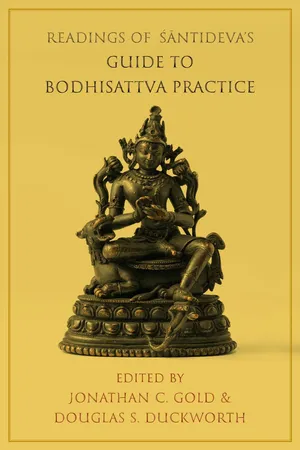
eBook - ePub
Readings of Śāntideva's Guide to Bodhisattva Practice
- English
- ePUB (mobile friendly)
- Available on iOS & Android
eBook - ePub
Readings of Śāntideva's Guide to Bodhisattva Practice
About this book
Information
Topic
Theology & ReligionSubtopic
Eastern Philosophy1
ŚĀNTIDEVA
THE AUTHOR AND HIS PROJECT
Paul Harrison
ON THE TRAIL OF THE DISAPPEARING AUTHOR: INTRODUCTORY REMARKS
The other chapters of this book address themselves primarily to the Bodhicaryāvatāra (the Guide) of Śāntideva, with only occasional reference to his second major work, the Śikṣāsamuccaya or Training Anthology (the Anthology).1 The two works are quite different in various ways. The Guide is a unified and extended verse composition, which is, as far as we can tell, entirely the creation of its author, and as poetry it is crafted with a fair degree of skill and art.2 The Anthology, by contrast, is a much longer composite work, in which Śāntideva’s own words, in both prose and verse, are combined with extensive citations from a wide variety of scriptural texts, over 110 in number. Written in an equally wide variety of registers, the passages cited also consist sometimes of prose, sometimes of verse, which is to be expected given the standard prosimetric style of the Mahāyāna sūtras to which Śāntideva gives pride of place; he quotes Mainstream Buddhist or Śrāvakayāna texts much less frequently, and even then not at great length.
The general style of the Anthology is consequently quite uneven, more prosaic and expository than artistic and evocative, although occasionally the verses that Śāntideva inserts, whether his own or taken from his canonical sources, rise to the heights of expressiveness achieved in the Guide. The Guide and the Anthology are thus very different in form and style, but what about their purpose? In this chapter we will make an attempt to understand who Śāntideva was and what he was about, asking whether each of these two works has its own agenda or somehow contributes to one coherent and comprehensive project clearly initiated by a single person.3 We will see in the end that the Guide and the Anthology do serve a common agenda, and that neither work can be fully understood independently of the other.
We arrive at this conclusion on the basis of internal evidence. That evidence is not always easy to interpret, but we have no alternative but to rely on it. The traditional biographies, such as they are, hardly help us to get a grip on Śāntideva’s purposes, and with them we face a problem endemic to the study of the authors of Buddhist treatises and commentarial works, of having to deal with a tissue of legends of uncertain and unverifiable historical validity. In the case of Śāntideva, who also seems to have gone by the name Akṣayamati (“Inexhaustible intelligence”), the core of the story is quite simple: a monk at the great monastic university of Nālandā,4 he appeared not to be applying himself to his studies and acquired a reputation for being lazy and unmotivated, so much so that his fellow monks grew used to treating him with contempt, bestowing on him the highly derogatory nickname Bhusuku, a composite of three verbal roots that we might translate as Mr. Eat-sleep-shit. One day the monks hatched a plan to compound the embarrassment and shame of this good-for-nothing slacker and invited him to preach the Dharma to them. To begin with, they made the preacher’s throne extremely high, but somehow he managed to seat himself upon it, after which he asked the assembled company whether they wanted to hear something old or something new. Choosing what they thought would be the more challenging option, they asked for something new, and to their great astonishment Śāntideva began to recite the Guide. Furthermore, as if the polished elegance and deep erudition of the work were not impressive enough, when Śāntideva got to verse 34 in chapter 9, he rose into the sky and vanished from sight, although his voice could still be heard reciting the rest of the poem. He never returned to Nālandā, and when his shamefaced tormenters searched his cell later for clues as to what had happened to him and why they had got him so terribly wrong, they found the manuscript of the Anthology.
Of course we cannot help but pay some attention to such legends, even if it is but a sideways glance, and in the case of Śāntideva in particular there is an almost irresistible temptation to try to salvage something from his hagiography on which to peg our understanding of his authorial impulses. After all, do we not know such characters in the world of academia, the colleague who seems to be doing nothing, who is looked at askance for letting the side down and not justifying his or her tenure, but eventually turns out to have been all along incubating a masterpiece, that one big prize-winning book, indeed the only one produced by the faculty of the department to be hailed as a field changer? Or in Śāntideva’s case, two books—the double whammy, an even better payoff! This is a tale of undeniable appeal, of the dunce who turns out to have been a genius in disguise putting the learned to shame, the plodder who is at last revealed as a superstar, leaving everyone dumbstruck with amazement. As emotionally satisfying as the story is, however, we can hardly rely on it as a record of w...
Table of contents
- Cover
- Series Statement
- Title Page
- Copyright
- Dedication
- Contents
- A Note to the Reader
- Acknowledgments
- Introduction. Participatory Authorship and Communal Interpretation: The Bodhicaryāvatāra as a “World Classic”
- 1. Śāntideva: The Author and His Project
- 2. Reason and Knowledge on the Path: A Protreptic Reading of the Guide
- 3. On Learning to Overhear the “Vanishing Poet”
- 4. An Intoxication of Mouse Venom: Reading the Guide, Chapter 9
- 5. Seeing from All Sides
- 6. Bodies and Embodiment in the Bodhicaryāvatāra
- 7. Ritual Structure and Material Culture in the Guide to Bodhisattva Practice
- 8. Bodhicaryāvatāra and Tibetan Mind Training (Lojong)
- 9. Taming Śāntideva: Tsongkhapa’s Use of the Bodhicaryāvatāra
- 10. The Middle Way of the Bodhisattva
- 11. Seeing Sentient Beings: Śāntideva’s Moral Phenomenology
- 12. Śāntideva’s Ethics of Impartial Compassion
- 13. Śāntideva and the Moral Psychology of Fear
- 14. Innate Human Connectivity and Śāntideva’s Cultivation of Compassion
- Appendix 1: A Guide to Guide Translations: Advice for Students and Instructors
- Appendix 2: Index of Guide Verses Cited
- Bibliography
- Contributors
- Index
- Illustrations
Trusted by 375,005 students
Access to over 1.5 million titles for a fair monthly price.
Study more efficiently using our study tools.
Frequently asked questions
Yes, you can cancel anytime from the Subscription tab in your account settings on the Perlego website. Your subscription will stay active until the end of your current billing period. Learn how to cancel your subscription
No, books cannot be downloaded as external files, such as PDFs, for use outside of Perlego. However, you can download books within the Perlego app for offline reading on mobile or tablet. Learn how to download books offline
Perlego offers two plans: Essential and Complete
- Essential is ideal for learners and professionals who enjoy exploring a wide range of subjects. Access the Essential Library with 800,000+ trusted titles and best-sellers across business, personal growth, and the humanities. Includes unlimited reading time and Standard Read Aloud voice.
- Complete: Perfect for advanced learners and researchers needing full, unrestricted access. Unlock 1.5M+ books across hundreds of subjects, including academic and specialized titles. The Complete Plan also includes advanced features like Premium Read Aloud and Research Assistant.
We are an online textbook subscription service, where you can get access to an entire online library for less than the price of a single book per month. With over 1.5 million books across 990+ topics, we’ve got you covered! Learn about our mission
Look out for the read-aloud symbol on your next book to see if you can listen to it. The read-aloud tool reads text aloud for you, highlighting the text as it is being read. You can pause it, speed it up and slow it down. Learn more about Read Aloud
Yes! You can use the Perlego app on both iOS and Android devices to read anytime, anywhere — even offline. Perfect for commutes or when you’re on the go.
Please note we cannot support devices running on iOS 13 and Android 7 or earlier. Learn more about using the app
Please note we cannot support devices running on iOS 13 and Android 7 or earlier. Learn more about using the app
Yes, you can access Readings of Śāntideva's Guide to Bodhisattva Practice by Jonathan C. Gold,Douglas S. Duckworth, Jonathan C. Gold, Douglas S. Duckworth in PDF and/or ePUB format, as well as other popular books in Theology & Religion & Eastern Philosophy. We have over 1.5 million books available in our catalogue for you to explore.