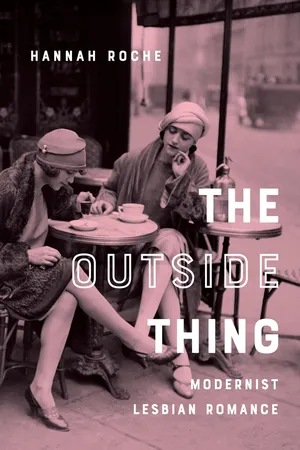
In a lecture delivered before the University of Oxford's Anglo-French Society in 1936, Gertrude Stein described romance as "the outside thing, that . . . is always a thing to be felt inside." Hannah Roche takes Stein's definition as a principle for the reinterpretation of three major modernist lesbian writers, showing how literary and affective romance played a crucial yet overlooked role in the works of Stein, Radclyffe Hall, and Djuna Barnes. The Outside Thing offers original readings of both canonical and peripheral texts, including Stein's first novel Q.E.D. (Things As They Are), Hall's Adam's Breed and The Well of Loneliness, and Barnes's early writing alongside Nightwood.
Is there an inside space for lesbian writing, or must it always seek refuge elsewhere? Crossing established lines of demarcation between the in and the out, the real and the romantic, and the Victorian and the modernist, The Outside Thing presents romance as a heterosexual plot upon which lesbian writers willfully set up camp. These writers boldly adopted and adapted the romance genre, Roche argues, as a means of staking a queer claim on a heteronormative institution. Refusing to submit or surrender to the "straight" traditions of the romance plot, they turned the rules to their advantage. Drawing upon extensive archival research, The Outside Thing is a significant rethinking of the interconnections between queer writing, lesbian living, and literary modernism.
- English
- ePUB (mobile friendly)
- Available on iOS & Android
eBook - ePub
About this book
Information
Subtopic
English Literary CriticismIndex
LiteratureNOTES
INTRODUCTION: LOCATING THE LESBIAN WRITER, OR “WE INSIDE US DO NOT CHANGE”
1. Gertrude Stein, “Portraits and Repetition,” in Lectures in America [1935] (Boston: Beacon Press, 1957), 167–68.
2. Jodie Medd, “Lesbian Literature: An Introduction,” in The Cambridge Companion to Lesbian Literature, ed. Jodie Medd (Cambridge: Cambridge University Press, 2015), 1.
3. Ann Cvetkovich, An Archive of Feelings: Trauma, Sexuality, and Lesbian Public Cultures (Durham, N.C.: Duke University Press, 2003), 11; Jodie Medd, Lesbian Scandal and the Culture of Modernism (New York: Cambridge University Press, 2012), 9; Susan Lanser, The Sexuality of History: Modernity and the Sapphic, 1565–1830 (Chicago: University of Chicago Press, 2014), 15.
4. Lanser, Sexuality of History, 15.
5. Valerie Traub, Thinking Sex with the Early Moderns (Philadelphia: University of Pennsylvania Press, 2016), 274, 267.
6. Medd, “Lesbian Literature,” 2.
7. Terry Castle, The Apparitional Lesbian: Female Homosexuality and Modern Culture (New York: Columbia University Press, 1993); Adrienne Rich, “Compulsory Heterosexuality and Lesbian Existence” [1980], in Blood, Bread, and Poetry: Selected Prose 1979–1985 (London: Virago Press, 1987), 23–75; Esther Newton, “The Mythic Mannish Lesbian: Radclyffe Hall and the New Woman” [1984], in Hidden from History: Reclaiming the Gay and Lesbian Past, ed. Martin Bauml Duberman, Martha Vicinus, and George Chauncey, Jr. (London: Penguin, 1991), 281–93.
8. Queer Modernism(s) II: Intersectional Identities, University of Oxford, April 12 and 13, 2018; 90 Years Since “The Well of Loneliness”: A Radclyffe Hall Symposium, Birkbeck, University of London, July 27, 2018.
9. Valerie Traub, “The New Unhistoricism in Queer Studies,” PMLA 128, no. 1 (2013), 21.
10. Sharon Marcus, “Queer Theory for Everyone: A Review Essay,” Signs 31, no. 1 (Autumn 2005), 196.
11. Laura Doan and Jane Garrity, “Introduction,” in Sapphic Modernities: Sexuality, Women, and National Culture, ed. Laura Doan and Jane Garrity (New York: Palgrave Macmillan, 2006), 3.
12. “ ‘Sapphic’ as I use it is also meant to encompass ‘lesbian-like’ discourses and representations like those sometimes signaled by ‘romantic friendship’ that are plausibly if not provably sexual.” Lanser, Sexuality of History, 16.
13. Castle quotes from “Identity Crisis: Queer Politics in the Age of Possibilities,” Village Voice, June 30, 1992, 27.
14. Gloria Anzaldúa, “To[o] Queer the Writer—Loca, Escritora y Chicana” [1990], in The Gloria Anzaldúa Reader, ed. AnaLouise Keating (Durham, N.C.: Duke University Press, 2009), 163–64.
15. Madhavi Menon, Indifference to Difference: On Queer Universalism (Minneapolis: University of Minnesota Press, 2015), 4, 127.
16. Heather Love, Feeling Backward: Loss and the Politics of Queer History (Cambridge, Mass.: Harvard University Press, 2007), 21.
17. Laura Doan, Disturbing Practices: History, Sexuality, and Women’s Experience of Modern War (Chicago: University of Chicago Press, 2013), xi. Doan is referring to her first book, Fashioning Sapphism: The Origins of a Modern English Lesbian Culture (New York: Columbia University Press, 2001).
18. Judith M. Bennett, “ ‘Lesbian-Like’ and the Social History of Lesbianisms,” Journal of the History of Sexuality 9, no. 1/2 (January–April 2000), 1–24; Traub, Thinking Sex, 85.
19. Stein, “Portraits and Repetition,” 195.
20. Leonard Woolf, “The World of Books: The Well of Loneliness,” Nation and Athenaeum, August 4, 1928.
21. See chapter 6. Quoted in Cheryl J. Plumb, “Introduction,” in Djuna Barnes, Nightwood: The Original Version and Related Drafts, ed. Cheryl J. Plumb (Normal, Ill.: Dalkey Archive Press, 1995), xviii.
22. Elizabeth Freeman, Time Binds: Queer Temporalities, Queer Histories (Durham, N.C.: Duke University Press, 2010), 95.
23. Carla Freccero, “The Queer Time of Lesbian Literature: History and Temporality,” in Medd, The Cambridge Companion to Lesbian Literature, 20.
24. Bennett, “Lesbian-Like,” 2.
25. See Barbara Will, Unlikely Collaboration: Gertrude Stein, Bernard Faÿ, and the Vichy Dilemma (New York: Columbia University Press, 2011); Tom Villis, British Catholics and Fascism: Religious Identity and Political Extremism Between the Wars (Basingstoke, U.K.: Palgrave Macmillan, 2013), 104; Erin G. Carlson, Thinking Fascism: Sapphic Modernism and Fascist Modernity (Stanford, Calif.: Stanford University Press, 1998).
26. Love, Feeling Backward, 21; Bennett, “Lesbian-Like,” 2.
27. Will, Unlikely Collaboration, 12; Stephen Best and Sharon Marcus, “Surface Reading: An Introduction,” Representations 108, no. 1 (Fall 2009), 2.
28. Radclyffe Hall to Evguenia Souline, August 19, 1934, Radclyffe Hall and Una Troubridge Papers, Harry Ransom Center, University of Texas at Austin (collection henceforth cited as HRC).
29. Richard von Krafft-Ebing, Psychopathia Sexualis: With Especial Reference to the Antipathic Sexual Instinct, A Medico-Forensic Study, trans. F. J. Rebman, 12th ed. (New York: Physicians and Surgeons Book Company, 1924), 398–99. The first edition of Psychopathia Sexualis was published in 1886; the twelfth edition was first translated into English in 1924.
30. Krafft-Ebing, Psychopathia Sexualis, 399.
31. The Northamptonshire Evening Telegraph described Adam’s Breed as “her clever novel” on April 13, 1927. Quotations are taken from clippings from Minirva, September 4, 1927, and Houston Chronicle, May 8, 1927, in Hall and Troubridge’s scrapbook “Re: Adam’s Breed and awards, 1927–28” (HRC). Further quotations from newspapers in this introduction are taken...
Table of contents
- Cover
- Series Statement
- Title Page
- Copyright
- Dedication
- Contents
- List of Illustrations
- Acknowledgments
- Introduction: Locating the Lesbian Writer, or “We Inside Us Do Not Change”
- I. Gertrude Stein
- II. Radclyffe Hall
- III. Djuna Barnes
- Coda: A Happy Ending?
- Notes
- Bibliography
- Index
- Series List
Trusted by 375,005 students
Access to over 1.5 million titles for a fair monthly price.
Study more efficiently using our study tools.
Frequently asked questions
Yes, you can cancel anytime from the Subscription tab in your account settings on the Perlego website. Your subscription will stay active until the end of your current billing period. Learn how to cancel your subscription
No, books cannot be downloaded as external files, such as PDFs, for use outside of Perlego. However, you can download books within the Perlego app for offline reading on mobile or tablet. Learn how to download books offline
We are an online textbook subscription service, where you can get access to an entire online library for less than the price of a single book per month. With over 1.5 million books across 990+ topics, we’ve got you covered! Learn about our mission
Look out for the read-aloud symbol on your next book to see if you can listen to it. The read-aloud tool reads text aloud for you, highlighting the text as it is being read. You can pause it, speed it up and slow it down. Learn more about Read Aloud
Yes! You can use the Perlego app on both iOS and Android devices to read anytime, anywhere — even offline. Perfect for commutes or when you’re on the go.
Please note we cannot support devices running on iOS 13 and Android 7 or earlier. Learn more about using the app
Please note we cannot support devices running on iOS 13 and Android 7 or earlier. Learn more about using the app
Yes, you can access The Outside Thing by Hannah Roche in PDF and/or ePUB format, as well as other popular books in Literature & English Literary Criticism. We have over 1.5 million books available in our catalogue for you to explore.