eBook - ePub
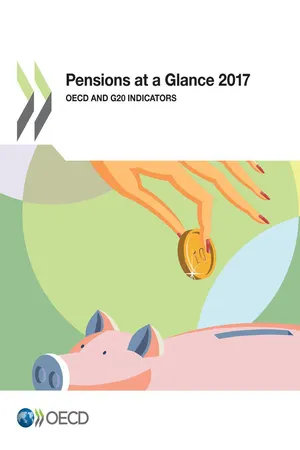
Pensions at a Glance 2017
OECD,
Information
Subtopic
SociologyIndex
Social SciencesChapter 1. Recent pension reforms1
This chapter looks at pension reforms in OECD countries over the past two years (between September 2015 and September 2017). Most OECD countries have enacted pension reforms since the last publication of Pension at a Glance. However, the reforms have been fewer and less widespread than in previous years with one-fifth of OECD countries taking no policy action. Among the most common reforms are changes in benefits and contributions. In addition, retirement ages are being adjusted in the majority of OECD countries. However, some of these adjustments are a reversal of previously legislated retirement age increases.
1.1. Introduction
In the last few years the pace of pension reforms across the OECD countries has slowed. After the financial crisis and the subsequent sovereign debt crisis in Europe, pension reforms were plenty and widespread, as documented in previous editions of Pensions at a Glance.2 However, even taking into account the progress that has been made, concerns about the financial sustainability and pension adequacy of the current state of pension systems in OECD countries remain.
Continued ageing of societies combined with the changing nature of work puts pressure on both the financial sustainability and the retirement income adequacy of pension systems; in addition, risks of increasing old-age inequality have been building up (OECD, 2017). At the same time, the momentum for far reaching pension reforms might be dwindling. After a decade of stress, improved government finances, potential pension reform fatigue as well as politically volatile times and rising populism are slowing the pace of reform.
Public expenditure on pensions as a percentage of GDP has increased and is expected to rise further in the near future in most OECD countries. For the OECD as a whole, public pension expenditure rose by about 2.5% of GDP since 1990. Currently, Greece and Italy already spend more than 15% of GDP on pensions. However, long-term prospects have improved and the projected pace of spending growth has slowed substantially (see indicators 7.3 and 7.5 in this publication; Fall and Bloch, 2014; European Commission, 2015).3 At the same time, recent reforms will lower replacement rates in many countries due to measures aimed at improving pension finances. This may jeopardise the adequacy of retirement income in some countries, especially for retiring low-skilled and low-paid workers. The long term need to reform is still present in many countries, especially given the ongoing improvements in longevity.
The challenges for financial sustainability and pension adequacy generally call for bold action by policy makers. To keep defined benefit systems financially sustainable a number of measures can be taken. Contributions can be raised, initial benefits can be cut and indexation of pensions in payment can be limited. These measures have been taken in many countries. In many European countries, for example, replacement rates are projected to decline while the financial balance of pension systems is projected to improve in coming decades (European Commission, 2015). Higher contributions might improve financial sustainability and/or pension adequacy but it raises non-wage costs, which in turn may affect net wages and employment depending on how the labour market adjusts over time. In countries where pension contribution rates are low, lower net wages might be acceptable to workers if this preserves or raises retirement income levels in the future.4 By contrast, cutting benefits and limiting indexation endangers pension adequacy, in particular in countries which are already facing low pension income prospects. Against this background, raising the retirement age can be a win-win proposition: it increases the labour force participation of older workers and helps maintain pension levels, at least for those who can actually work longer.
To maintain retirement income adequacy a number of measures can be taken. Apart from raising contributions resulting in higher entitlements, coverage of mandatory schemes can be increased. In most OECD countries, however, there are limits to this strategy since coverage levels among the employed population are already very high. Only countries with a relatively large informal economy can significantly increase pension coverage, but this will require policy packages which extend far beyond pension policies. However, coverage can also be extended to groups that are not systematically covered, such as the self-employed. Moreover, coverage of voluntary private pensions can still be improved in many countries. Adequacy concerns can also be addressed by raising the level of basic and minimum pensions, possibly in combination with relaxing eligibility criteria for such pensions, albeit at a cost and potential risks for financial sustainability.
The changing nature of work in the context of population ageing highlights the importance of continuing to improve pension systems. Most ...
Table of contents
- Title page
- Legal and rights
- Foreword
- Editorial: Flexibility or the comeback of early retirement?
- Executive summary
- Chapter 1. Recent pension reforms
- Chapter 2. Flexible retirement in OECD countries
- Chapter 3. Design of pension systems
- Chapter 4. Pension entitlements
- Chapter 5. Demographic and economic context
- Chapter 6. Incomes and poverty of older people
- Chapter 7. Finances of retirement-income systems
- Chapter 8. Private pensions and public pension reserve funds
- About the OECD
Trusted by 375,005 students
Access to over 1.5 million titles for a fair monthly price.
Study more efficiently using our study tools.
Frequently asked questions
Yes, you can cancel anytime from the Subscription tab in your account settings on the Perlego website. Your subscription will stay active until the end of your current billing period. Learn how to cancel your subscription
No, books cannot be downloaded as external files, such as PDFs, for use outside of Perlego. However, you can download books within the Perlego app for offline reading on mobile or tablet. Learn how to download books offline
Perlego offers two plans: Essential and Complete
- Essential is ideal for learners and professionals who enjoy exploring a wide range of subjects. Access the Essential Library with 800,000+ trusted titles and best-sellers across business, personal growth, and the humanities. Includes unlimited reading time and Standard Read Aloud voice.
- Complete: Perfect for advanced learners and researchers needing full, unrestricted access. Unlock 1.5M+ books across hundreds of subjects, including academic and specialized titles. The Complete Plan also includes advanced features like Premium Read Aloud and Research Assistant.
We are an online textbook subscription service, where you can get access to an entire online library for less than the price of a single book per month. With over 1.5 million books across 990+ topics, we’ve got you covered! Learn about our mission
Look out for the read-aloud symbol on your next book to see if you can listen to it. The read-aloud tool reads text aloud for you, highlighting the text as it is being read. You can pause it, speed it up and slow it down. Learn more about Read Aloud
Yes! You can use the Perlego app on both iOS and Android devices to read anytime, anywhere — even offline. Perfect for commutes or when you’re on the go.
Please note we cannot support devices running on iOS 13 and Android 7 or earlier. Learn more about using the app
Please note we cannot support devices running on iOS 13 and Android 7 or earlier. Learn more about using the app
Yes, you can access Pensions at a Glance 2017 by OECD in PDF and/or ePUB format, as well as other popular books in Social Sciences & Sociology. We have over 1.5 million books available in our catalogue for you to explore.