In an increasingly global and multilingual society, translators have transitioned from unobtrusive stagehands to key intercultural mediators-a development that is reflected in contemporary media. From Coppola's Lost in Translation to television's House M.D., and from live performance to social media, translation is rendered as not only utilitarian, but also performative and communicative.
In examining translation as a captivating theme in film, television, commercials, and online content, this multinational collection engages with the problems and limitations faced by translators, as well as the ethical and philosophical aspects of translation and Translation Studies. Contributors examine the role of the translator (as protagonist, agent, negotiator, and double-agent), translation in global communication, the presentation of visual texts, multilingualism in contemporary media, and the role of foreign languages in advertisements. Translation and translators are shown as inseparable parts of a contemporary life that is increasingly multilingual, multiethnic, multinational and socially diverse.
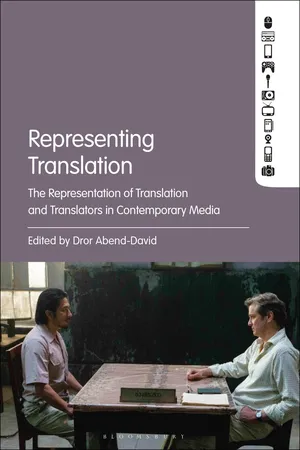
eBook - ePub
Representing Translation
The Representation of Translation and Translators in Contemporary Media
- 248 pages
- English
- ePUB (mobile friendly)
- Available on iOS & Android
eBook - ePub
Representing Translation
The Representation of Translation and Translators in Contemporary Media
About this book
Information
1
Imagining Translation and Translators
Editor’s Introductory Note
The first chapter in this collection introduces us to the manner in which translation is fictionalized in popular culture: the functions that it is imagined to have; the hopes that are attributed to translation as a mode of social and political communication; and the concerns that translation generates as a possible means of distortion and deception. In the context of science fiction in the English-speaking world during the 1960s and 1970s, the chapter examines two cult series that generated overwhelming viewership and critical reaction: Doctor Who and Star Trek. Beyond the anticipated realization that translation serves an important function in science fiction, the chapter highlights the extent to which popular culture precedes theorists of translation, much in the way that Jules Verne’s novels predicted various scientific discoveries and inventions. Both Doctor Who and Star Trek envision machine translation to an extent that we are only beginning to imagine today. More importantly, at a time that Translation Theory still imagined translation as the exchange of “equivalencies,” the two series already projected complex models of translation that involve cultural, political, social, and technical challenges. In addition, the two series envision gender as an important element, both in terms of the identity of the translator and of its role in determining a particular approach to translation. Overall, the chapter underscores the extent to which our future theoretical approach to translation can be found in our popular culture, and the ways in which fictional translation eventually influences translation in reality.
The Evolution of the “Universal Translator”: Technical Device and Human Factor in Doctor Who and Star Trek from the 1960s to the Present
Erga Heller
What you want is irrelevant; what you have chosen is at hand.
Captain Spock, Star Trek IV: The Undiscovered Country (1991)
1. Introduction
Communication with “Other” was a main theme of Science Fiction (SF) in the English-speaking world during the 1960s and 1970s. Nevertheless, many SF writers intentionally avoided the question of “real” translation (Mossop 1996: 1–2). They did not use fictional human translators or other sorts of translation agents in order to transform a message in a source language (SL) into a message in a target language (TL). Instead, the writers preferred to elucidate the interpretive aspect within their narratives by telepathy, assimilated pan-communication features, or other non-human communication capacities in which all possible languages of the universe were easily processed by natural/automatic cognitive process. Because telepathy enables the brain to receive, to decipher, and to re-construct any message, the brain, literally, constructs a semantic meaning by its own terms, without a noticeable translation process. This literary solution for communication with aliens is easy to use in either simple or complicated narratives. In SF plots, communicating with an alien through telepathy is just a simple narrative “bypass,” according to Brian Mossop (1996: 3). However, many SF heroes of the 1940s and the 1950s, such as Superman or other superheroes, have this ability (James and Mendlesohn 2003: 40).
In the 1950s, telepathy, as a potential way of communication, became a subject of an academic study, as in J.B. Rhine’s lab at Duke University (James and Mendlesohn 2003: 228). Such studies legitimized and revived the SF concepts of communications with the “Other” through telepathy. Those concepts are the starting point for Doctor Who’s and Star Trek’s communication ideal of a Universal Translator.
Although the major part of stories about alien communication are based on telepathy, some stories suggest a different ideal. They are based on technological solutions, such as machine translation. These literary tendencies imply a sort of a universal axiom. Based on Noam Chomsky’s theory of “Universal Grammar,” which was first suggested in the 1950s (Chomsky 2006: 24; Chomsky 2009: 118), the new concept of a wide-rooted communication scheme was transformed to an idea of a utopian pan-communication potent scheme valid throughout the entire universe. Although Chomsky and other MIT bio-linguistics who studied the potential of universal extra-terrestrial communication for half a century do not know whether or not “Universal Grammar” can be found in other domains or organisms (Chomsky 2005: 2), Chomsky’s theory has been adopted enthusiastically by many SF authors and screenwriters since the 1960s, and abandoned the former motif of pure telepathic communication. This new concept opens SF narratives to the question of translating extra-terrestrial languages into a terrestrial one (mostly English). In recent studies, as opposed to his extra-terrestrial aims that inspired many SF authors, Chomsky notes that language is “unique to humans” and “radically different from animal symbolic systems,” yet he continues to argue for a “universal grammar” and that language is based on “conceptual structures” (Chomsky 2017: 200–201), two essential criteria for the creation of a Universal Translator in fantasy as well as in developing digital language tools and applications.
But even though the concept of universal communication is popular in SF productions, the question of the way translation acts in SF was hardly discussed; this field of SF translation was as neglected as the linguistic aspect of the entire genre (Wozniak 2014). In addition to the fact that there are few recent studies on the topic of translation acts in SF, such studies are generally occupied with technological aspects (Lasbury 2017) or discuss cross-lingual capacities as literary devices (Chapman 2014; Gonzalez 2017; Sandapen 2014).
This chapter focuses on the evolution of a new concept of automatic translation (AT), referred to as a Universal Translator, in two innovative SF television series. It depicts its transformation from a technical device to a human interpreter or meditator through the last half a century in relation with actual technological developments during this time in AT and language engineering.
2. Understanding known and unknown languages in Doctor Who
Two innovative television series—Doctor Who (BBC1, 1963–1989, 1996, and 2005 to the present) and Star Trek (NBC and Paramount Pictures, 1966–1969, 1987–2005)—were aired for the first time during the 1960s, and suggested some of the newest notions about communication with “Others.” Both have been very successful, and include various franchises as the original television series, television sequels, animated series, special episodes, movies, graphic novels, literary adaptions, and more.
The two series are very different in nature. Doctor Who depicts a re-incarnated alien Time Lord, called “the Doctor,” and his companion. In the early 1960s, while BBC producers developed the concept of the series, they aimed to present British values and history via the program. They looked for a British style “handsome young man hero […] [and a] handsome well-dressed heroine aged about 30” (Chapman 2014: 46). In 1963, Doctor Who was designed as a shallow weekend program about a man lost in space and time, but swiftly shifted into a complicated SF narrative concerning known human history as well as imaginary monsters and aliens who often intend to invade Earth (Chapman 2014: 49).
A main characteristic of the Doctor is his ability to regenerate. From 1963 to 2017, for a dozen times, the Doctor was regenerated as a man, although not always as a young man. In July 2017, BBC1 announced that the next Doctor’s regeneration, in December 2017 Christmas special is a woman (actress Jodie Whittaker).1 This surprising announcement was followed by the actress’ statement, in which she asks Doctor Who’s fans to not be “scared” by her gender. This changing gender issue is not only a matter of fans’ worries or rejections, but an important cultural mirror for the changing attitudes toward a variety of feminine (and not only feminist) aspects. A female Doctor concerns lingual and communicational functioning and challenges concepts of male supremacy in language. She marks the edges of the inner gendered self. This feminine shift is very important to our discussion, as we can see later.
But from the very first episodes of Doctor Who, the clear need of communication with “Other”—as in the cases of a Stone Age child, Renaissance-Venetian Marco Polo, or a future alien “Dalek”—was essential to the plots. Consequently, Doctor Who’s first screenwriters, Anthony T. Coburn, Terry Nation, John Vincent Lucarotti, David Whitetaker, and others, had to find a permanent solution for this issue. They introduced two solutions:
1.The first concerns the Doctor only, and is based on Chomsky’s theory of language universals. As a Time Lord, the Doctor naturally knows all possible natural languages from all times and from all over the universe (yet almost always everything sounds like English, a plot device that favors the viewers).
2.The second solution is technical in nature. The screenwriters “invented” a “translation circuit.” This is a mechanical device for machine translation (MT) that has been assimilated into the Doctor’s feminine and super intelligent bio-spaceship, the “TARDIS.” It is able to translate from any language to any language, but due to the medium and in favor of the viewers’ understanding, translation is made from and to British English most of the time.
The translation circuit is taken for granted in most of the episodes. It is not referred to in detail and is not a part of the rising action of the narrative so long as it functions well. This device enables the Doctor’s companions to “hear” and “produce” ancient, foreign, or alien languages, much like the Doctor himself/herself. It automatically, and almost stimulatingly, deciphers either oral or written messages. In favor of the viewers, the translation is made into and from English (or German, French, Italian, and other languages in the dubbed versions). In addition, a major characteristic of the Doctor is his/her affection to contemporary and ancient English dialects. The Doctor’s dialogs in the early episodes include a “very British, very BBC [dialect]” in order to both educate and entertain. In fact, about a half of his dialogs serve as explanations, or rather inter-translations, in favor of the viewers (October 2014: 8–9). But, with time, the Doctor’s language changes. For instance, when the character of the Doctor is played by David Tennant, between 2005 and 2010, he speaks contemporary English, uses black English dialect, as well as American English, but fails to understand local lexis in Pagan English (H...
Table of contents
- Cover
- Half-Title Page
- Title Page
- Contents
- Editor’s Note Dror Abend-David
- 1 Imagining Translation and Translators:
- The Evolution of the “Universal Translator”: Technical Device and Human Factor in Doctor Who and Star Trek from the 1960s to the Present Erga Heller
- 2 The Translator as Protagonist:
- In Search of a Chinese Hamlet: Translation, Interpretation, and Personalities in Postwar Film-Cultural Exchange Ying Xiao
- 3 Translators as Social (Double) Agents:
- Mediating Violence: Three Film Portrayals of Interpreters’ Dilemmas as Participants in Conflict Kayoko Takeda
- 4 Translation and Translators in New Media:
- Reactions to Audiovisual Adaptation on Social Media: The Case of How To Get Away With Murder Chiara Bucaria
- 5 Translation and/as Global Communication:
- Cross-Languaging Romance on Screen Delia Chiaro
- 6 “They have eyes, but they [could see better]”:
- Audio Description for All? Enhancing the Experience of Sighted Viewers through Visual Media Access Services Iwona Mazur
- 7 Translating Translation:
- Translating Multilingual Films in a South African Context Zoë Pettit
- 8 Translation and Localization in Advertisement:
- Localization Strategies in English–Chinese Advertisement Translation Ying Cui and Yanli Zhao
- 9 The “Non-Translation”:
- Yiddish, Media and the Dramatic Function of Translation—or What Does It Take to Read Joel and Ethan Coen’s film, A Serious Man? Dror Abend-David
- Contributors
- Index
- Copyright
Trusted by 375,005 students
Access to over 1.5 million titles for a fair monthly price.
Study more efficiently using our study tools.
Frequently asked questions
Yes, you can cancel anytime from the Subscription tab in your account settings on the Perlego website. Your subscription will stay active until the end of your current billing period. Learn how to cancel your subscription
No, books cannot be downloaded as external files, such as PDFs, for use outside of Perlego. However, you can download books within the Perlego app for offline reading on mobile or tablet. Learn how to download books offline
Perlego offers two plans: Essential and Complete
- Essential is ideal for learners and professionals who enjoy exploring a wide range of subjects. Access the Essential Library with 800,000+ trusted titles and best-sellers across business, personal growth, and the humanities. Includes unlimited reading time and Standard Read Aloud voice.
- Complete: Perfect for advanced learners and researchers needing full, unrestricted access. Unlock 1.5M+ books across hundreds of subjects, including academic and specialized titles. The Complete Plan also includes advanced features like Premium Read Aloud and Research Assistant.
We are an online textbook subscription service, where you can get access to an entire online library for less than the price of a single book per month. With over 1.5 million books across 990+ topics, we’ve got you covered! Learn about our mission
Look out for the read-aloud symbol on your next book to see if you can listen to it. The read-aloud tool reads text aloud for you, highlighting the text as it is being read. You can pause it, speed it up and slow it down. Learn more about Read Aloud
Yes! You can use the Perlego app on both iOS and Android devices to read anytime, anywhere — even offline. Perfect for commutes or when you’re on the go.
Please note we cannot support devices running on iOS 13 and Android 7 or earlier. Learn more about using the app
Please note we cannot support devices running on iOS 13 and Android 7 or earlier. Learn more about using the app
Yes, you can access Representing Translation by Dror Abend-David in PDF and/or ePUB format, as well as other popular books in Social Sciences & Communication Studies. We have over 1.5 million books available in our catalogue for you to explore.