Hazardous Waste Management, Volume II
eBook - ePub

Hazardous Waste Management, Volume II

Characterization and Treatment Processes

  1. 122 pages
  2. English
  3. ePUB (mobile friendly)
  4. Available on iOS & Android
eBook - ePub

Hazardous Waste Management, Volume II

Characterization and Treatment Processes

About this book

This second volume focuses on treatment technologies that are commonly applied at hazardous waste sites and site characterization.

Environmental engineers are responsible for cradle-to-grave handling and management of a hazardous waste. To fulfil this responsibility, a practicing engineer needs to apply their knowledge of federal, state, and local regulations; environmental audits; toxicology; site characterization; and treatment processes to transform the hazardous waste site to a condition where it cannot cause adverse effect to human health and the environment.

Volume I of this series covered the regulatory landscape, basic environmental chemistry principles, fate and transport of contaminants, toxicology, and risk assessment. This second volume focuses on treatment technologies that are commonly applied at hazardous waste sites and site characterization. It covers physicochemical processes (air stripping, adsorption, ion exchange, and reverse osmosis), incineration, stabilization and solidification, biological treatment, and land disposal. Numerous solved examples provide a step-by-step approach to apply these technologies in real-life situations. The two volumes combined present a clear roadmap to the reader to integrate these topics in practice.

Frequently asked questions

Yes, you can cancel anytime from the Subscription tab in your account settings on the Perlego website. Your subscription will stay active until the end of your current billing period. Learn how to cancel your subscription.
At the moment all of our mobile-responsive ePub books are available to download via the app. Most of our PDFs are also available to download and we're working on making the final remaining ones downloadable now. Learn more here.
Perlego offers two plans: Essential and Complete
  • Essential is ideal for learners and professionals who enjoy exploring a wide range of subjects. Access the Essential Library with 800,000+ trusted titles and best-sellers across business, personal growth, and the humanities. Includes unlimited reading time and Standard Read Aloud voice.
  • Complete: Perfect for advanced learners and researchers needing full, unrestricted access. Unlock 1.4M+ books across hundreds of subjects, including academic and specialized titles. The Complete Plan also includes advanced features like Premium Read Aloud and Research Assistant.
Both plans are available with monthly, semester, or annual billing cycles.
We are an online textbook subscription service, where you can get access to an entire online library for less than the price of a single book per month. With over 1 million books across 1000+ topics, we’ve got you covered! Learn more here.
Look out for the read-aloud symbol on your next book to see if you can listen to it. The read-aloud tool reads text aloud for you, highlighting the text as it is being read. You can pause it, speed it up and slow it down. Learn more here.
Yes! You can use the Perlego app on both iOS or Android devices to read anytime, anywhere — even offline. Perfect for commutes or when you’re on the go.
Please note we cannot support devices running on iOS 13 and Android 7 or earlier. Learn more about using the app.
Yes, you can access Hazardous Waste Management, Volume II by Sukalyan Sengupta in PDF and/or ePUB format, as well as other popular books in Technology & Engineering & Ecology. We have over one million books available in our catalogue for you to explore.

CHAPTER 1

PHYSICOCHEMICAL TREATMENT PROCESSES

Hazardous waste sites may be contaminated with various toxic compounds, and therefore to remove these hazardous compounds, environmental engineers need to develop an arsenal of technologies and the maturity to adopt the most appropriate technology/technologies for a particular scenario. These technologies may be broadly classified as physical–chemical (also known as physicochemical), thermal, stabilization, and encapsulation of the waste (so the toxic components cannot migrate out of it), biological, and land disposal. This chapter discusses four common physicochemical technologies that are widely employed in hazardous waste decontamination.

1.1 AIR STRIPPING

Air stripping is a physicochemical process used to remove volatile compounds from a liquid phase (water) to a gas phase (air) by promoting vigorous contact between the two phases. It is routinely used to treat groundwater contaminated with volatile organic compounds (VOCs) at low concentrations.
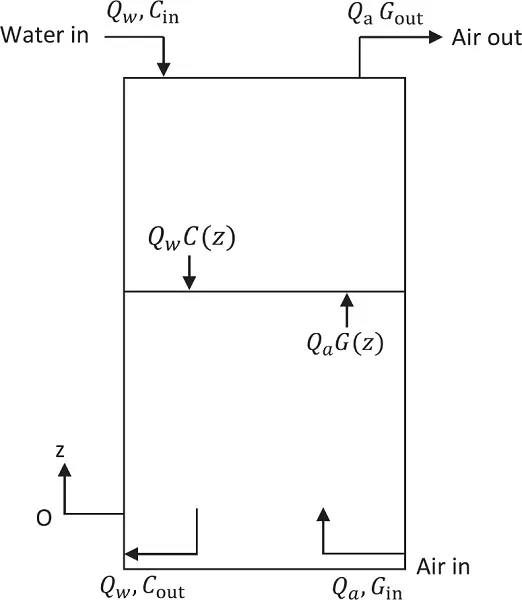
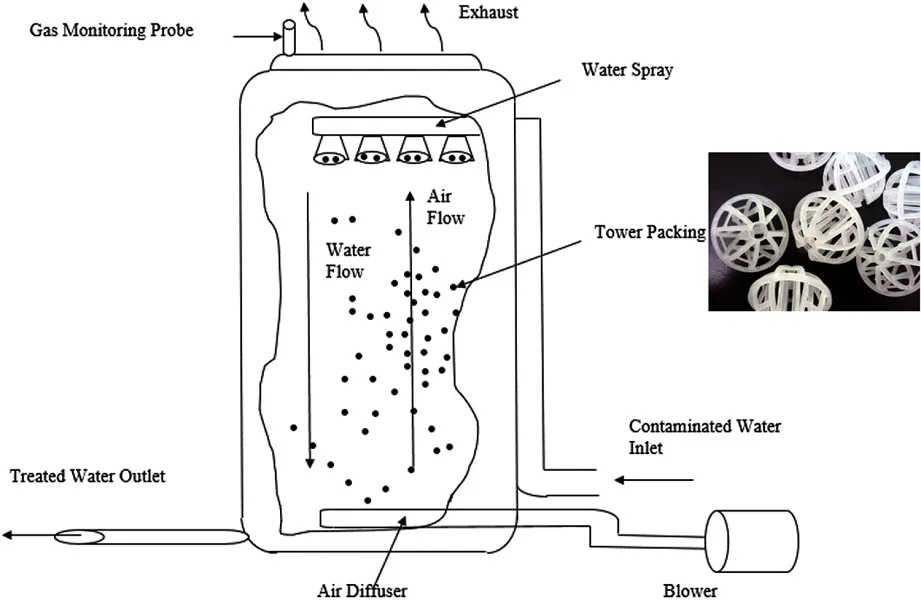
The most common method of contacting air with contaminated water is in a stripping tower, as shown in Figure 1.1. The tower is filled with a high surface-area-to-volume-ratio packing material and air flows in opposite direction to that of water, known as countercurrent flow. Mass exchange takes place between the aqueous and the vapor phase, and the air stream that leaves the tower at the top carries the contaminant with it, typically at a much lower concentration that meets air quality standards. The treated groundwater can then be discharged to a surface water-receiving body or pumped to effect groundwater recharge. If the concentration of the volatile organic contaminant is too high in the influent, its resulting concentration in the exhaust may be too high for air quality standards, and thus the off-gases may need to be treated.
Figure 1.1. Sketch of an air-stripping tower (packing material image courtesy: www.ceramic-honeycombs.com/plastic/Plastic_Tripack_Tower_Packing.htm)
The design of an air stripper entails expedited mass transfer of the volatile compound from the aqueous phase to the gas phase. The “Two-film” theory (Whitman 1923) (a full discussion of this topic is outside the purview of this book) states that the mass transfer of the volatile compound between water and gas is limited by diffusion through thin films at the water–gas interface. A mass balance for an air stripper is discussed in the next section.

1.1.1 MASS BALANCE FOR AIR STRIPPER

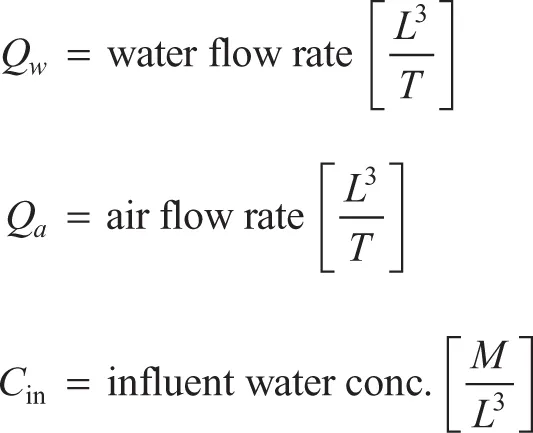
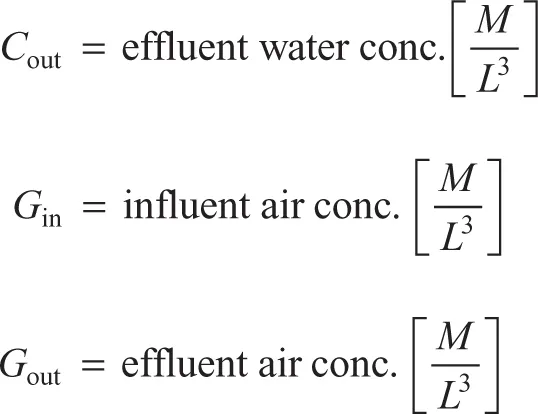
where
(set by environment regulations)
z = height above bottom of air stripper [L...

Table of contents

  1. Cover
  2. Title Page
  3. Copyright Page
  4. Contents
  5. Acknowledgments
  6. Chapter 1 Physicochemical Treatment Processes
  7. Chapter 2 Incineration
  8. Chapter 3 Stabilization and Solidification
  9. Chapter 4 Biological Treatment
  10. Chapter 5 Land Disposal
  11. Chapter 6 Site Characterization
  12. About the Author
  13. Index