eBook - ePub
Available until 23 Dec |Learn more
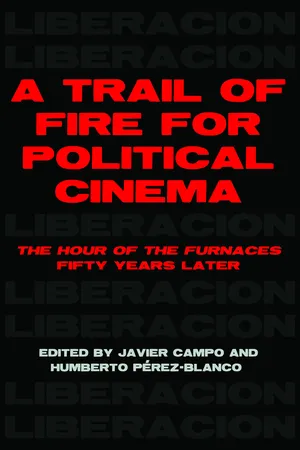
A Trail of Fire for Political Cinema
The Hour of the Furnaces Fifty Years Later
This book is available to read until 23rd December, 2025
- English
- ePUB (mobile friendly)
- Available on iOS & Android
eBook - ePub
Available until 23 Dec |Learn more
A Trail of Fire for Political Cinema
The Hour of the Furnaces Fifty Years Later
About this book
Marking the 50th anniversary of the premiere of La Hora de Los Hornos (The Hour of the Furnaces) (Getino and Solanas, 1968), A Trail of Fire for Political Cinema is an edited collection that closely analyses the film, looking to the context and the socio-political landscape of 1960s Argentina, as well as the film's legacy and contemporary relevance. Attention is paid to the corpus of political documentaries made between 1968 to 1976, including those that marked the last coup d'état in Argentina, to emphasize how formal and thematic trends relate to their Argentinian social context. In order to highlight The Hour of the Furnaces's contemporary relevance as a form of politically engaged activism, the book will also look at Fernando Solanas's documentary output in the twenty-first century.
Frequently asked questions
Yes, you can cancel anytime from the Subscription tab in your account settings on the Perlego website. Your subscription will stay active until the end of your current billing period. Learn how to cancel your subscription.
No, books cannot be downloaded as external files, such as PDFs, for use outside of Perlego. However, you can download books within the Perlego app for offline reading on mobile or tablet. Learn more here.
Perlego offers two plans: Essential and Complete
- Essential is ideal for learners and professionals who enjoy exploring a wide range of subjects. Access the Essential Library with 800,000+ trusted titles and best-sellers across business, personal growth, and the humanities. Includes unlimited reading time and Standard Read Aloud voice.
- Complete: Perfect for advanced learners and researchers needing full, unrestricted access. Unlock 1.4M+ books across hundreds of subjects, including academic and specialized titles. The Complete Plan also includes advanced features like Premium Read Aloud and Research Assistant.
We are an online textbook subscription service, where you can get access to an entire online library for less than the price of a single book per month. With over 1 million books across 1000+ topics, we’ve got you covered! Learn more here.
Look out for the read-aloud symbol on your next book to see if you can listen to it. The read-aloud tool reads text aloud for you, highlighting the text as it is being read. You can pause it, speed it up and slow it down. Learn more here.
Yes! You can use the Perlego app on both iOS or Android devices to read anytime, anywhere — even offline. Perfect for commutes or when you’re on the go.
Please note we cannot support devices running on iOS 13 and Android 7 or earlier. Learn more about using the app.
Please note we cannot support devices running on iOS 13 and Android 7 or earlier. Learn more about using the app.
Yes, you can access A Trail of Fire for Political Cinema by Javier Campo, Humberto Perez-Blanco, Javier Campo,Humberto Perez-Blanco in PDF and/or ePUB format, as well as other popular books in Politics & International Relations & Film & Video. We have over one million books available in our catalogue for you to explore.
Information
Chapter 1
To Invent Our Revolution: An Aesthetic-Political Analysis of The Hour of the Furnaces
To make a film in three parts and over four hours long is taking a risk. To make it in clandestine conditions is dangerous. To screen it as a palimpsest articulating diverse languages is foolish. But the experiment was a success. As Mariano Mestman argues (2008: 27)1 1968 in Latin America is signified by the premiere of a “beacon film,” The Hour of the Furnaces (Getino and Solanas, 1968). For Paulo Antonio Paranaguá “[the film] does not limit itself to agitate, to denunciate or to social testimony […] it sketches another genre, a sort of cinematic essay” (1996: 337). Made with disparate materials, the filmmakers “incorporated the perspective of historical revisionism and a look on the Peronist working class as fundamental subject of the revolutionary transformation in Argentina” (Mestman 2008: 28). The Grupo Cine Liberación (Liberation Cinema Group) was not defined at the time of The Hour of the Furnaces as Peronist. It shifted little by little toward the positions of national socialism (not the same as “National Socialism”/Nazi as some mistook it for during the European circulation of the film). According to Solanas himself, there was a process of maturing without shying from the leader of the movement:
We never concealed our political origins. Octavio Getino flew to Madrid from Cuba with presents for Perón: a bottle of Cuban rum and the complete works of Che Guevara. We were part of an intellectual middle class sector from the left in a process of nationalization that ended up by converting us, definitely, into Peronists.
(Mestman 2007: 53)
That is, it is possible to understand The Hour of the Furnaces by locating it at the beginning of a path that commences in the Marxist left (with sympathies for foquism) for whom Frantz Fanon and Ernesto Guevara were standard bearers,2 and ends in the ample Peronist movement in which the filmmakers lived together with other militants coming from different directions. Other Argentine films made during the period or years later confirmed the monumental character of the film by revealing themselves inspired aesthetically and thematically by The Hour, following some of its formal characteristics, repeating some of its messages, or taking actual shots from the film as archive footage.
This chapter will produce a formal analysis of Getino and Solanas’ film.3 Without leaving out the political-thematic variables, it will weave together the core ideas that link the aesthetic mechanisms and the formal structures that construct the film with the presentation and defense of ideas and calls for political action. The sequences will be grouped according to their recurrent functions and, therefore, without attending to their chronological position in the film.
The aim of this analysis is to confront what has not often been asked: how is this indispensable political documentary elaborated? In what ways does it present its political discourses and what is their content? Something as simple as well as complex, how to carry out an aesthetic-political analysis of The Hour of the Furnaces?
Latin America is a continent at war
Voice-over with an informative function
From its beginnings, the inclusion of an informative voice-over narration has been frequent in documentary cinema. With the function of informing or explaining and interpreting events, ideas, or concepts, a narrator intervenes in the soundtrack while the image track serves as illustration or proof. Many political documentaries from Latin America made between the late 1960s and the early 1970s use this technique. The second sequence of the first part of The Hour of the Furnaces presents a summary of the situation in Latin America in general, and of Argentina in particular. After the titles and initial quotations, the narrator comments over a black image track: “Latin America is a continent at war. For the dominant classes, a war of oppression. For the oppressed people; a war of freedom.” Following from this, paintings and engravings from the time of the Spanish colony are inserted. Over these images, the narration continues: “the war of independence was betrayed by exporting elites. While Bolivar lead it, Rivadavia signed loans with Baring Brothers “[…] for the first time here in Latin America a new form of domination begun to be applied. The exploitation of colonial trade through the local bourgeoisies. Neo-colonialism was born.” The images of men playing golf accompany the final part of the sequence. A presentation that not only informs about the themes of the film to follow, but also stresses the point of view taken by the coupled narration/sound-image.
The next sequence is the one that provides the most dense amount of information on the population and extension of Argentina, while a forward-tracking shot shows roads lined with trees and houses and inserts of faces shot with zoom-ins ending in close-up. This is followed by illustrative images (villages, rural workers, old people, buildings) while the narration accounts for the figures that show the low standards of living, land ownership, death rates from curable diseases, and the function of Buenos Aires (“neocolonial epicenter”). The search for “objectivity” is lost here when the narrator highlights that the city is the
cradle of the great middle class. A middling, meddling “mediocracry” […], eternal sniveler of a troubled world. For it change is necessary, yet, at the same time, impossible […] [Buenos Aires] seat of the religious curia,4 of the Commander-in-Chief of the army, the legislative power, the government, and of 80% of the country’s criminal gangs.5
This narration is spoken over images of significant buildings representing the powers and institutions mentioned. The oral discourse employs rhetoric strategies that are at odds with the objective tone of the narration, of the figures extracted from official documents and studies (as an intertitle at the beginning of the film tells the audience). Robert Stam (1998: 259) affirms that this last sequence is “dipped in acid. Rather than exalt the cosmopolitan charm of Buenos Aires, the commentary disengages its class structure” in a similar procedure to Luis Buñuel’s satire of Rome in L’Age d’Or (1930).
At the beginning of the segment “La Resistencia” (Resistance) in the second part of the film, Getino and Solanas discuss the scope of the data and information given to announce/justify the historical account of Peronism. Alternating diverse images such as forward-tracking shots through the city, militants speaking with the filmmakers off camera, and assorted shots discarded from other parts of the film, which acknowledge the film as a work-filmic artifice, the directors’ point out:
we knew that information had been misrepresented by the system, that it did not figure in official archives […] but we also discovered that the popular organizations, labour union and political organizations, did not have the necessary information either […] [urgency] makes it difficult for the people to recount their combats and experiences, that is why we directed our search towards that collective memory. We spoke to basic labourers, activists, rural leaders and students.
After this introduction, the formal account of Peronism starts. This is reflexivity on the part of the filmmakers manifested in first person, not a characteristic of classic historical documentaries (Nichols 1988: 48).
The owners of the country
Voice-over with an expository function
In Getino and Solanas’ film the function of presenting testimonies or characteristic voices is drawn up with the input from facts that, because of its selection and ordering, account for the position taken by the filmmakers. For example, a sequence announces: “Argentine Rural Society traditional center of our oligarchy, 50 Buenos Aires families who have appropriated forty million hectares, barely 5% of the working population but which annually makes off with 42% of the national income. The country’s owners”. The images that accompany the narration combine an auction of priced bulls with close-up of those attending. The soundtrack moves on to characteristic voices of that “oligarchy.” Steve Neale affirms in his study of the film that images function here “merely to legitimate what the commentary has to say,” that is, their value is imposed by the soundtrack (1984: 441). Irony is also included when we are introduced to the words of Manuel Mujica Lainez. The voice-over narration announces “[a]nd now we go, to the Pepsi-Cola salon. This is where Manuel Mujica Lainez presents his latest book, Royal Chronicles.” The narration continues enumerating the prizes he has won while the image track goes from a long shot of an illuminated building to a journey through a room full of people shot with a handheld camera.
Another type of exposition in Getino and Solanas’ film is the play with space off-screen and with the viewing spectators. Solanas indicates in the first sequence of the second part:
we hand over to our comrade, the narrator,6 who from the hall will bring up to date the present circumstances of this ceremony and I request you all, a warm tribute to the peoples and their armed vanguards that are today in violent combat against colonialism and imperialism.
What is the only option left to Latin Americans?
Voice-over with a persuasive function
The persuasive function is not only present in this film but also takes different forms. In the last sequence of the first part, images of a funeral procession in Juella, Jujuy (a province in the Northwest of Argentina) are edited together. The narration claims: “this is our war, a genocide that cost twice as many lives as the First World War.” It follows a fade to black while the narrator asks “what is the only option left to Latin Americans?” The image then moves to photographs of a dead Che and the words that close this first part (which will be analyzed below in the section on the use of archive material). The emphatic function of this question formulated without images demands special attention from the spectator. The first sequence of the second part functions in the same way. In it, Solanas makes clear, “this is not just the screening of a movie, neither is it a show. It is a ceremony for liberation,” while the blank image track lingers for several seconds.
The persuasive function in the film in conjunction with the editing of images shot by the filmmakers is crucial in The Hour of the Furnaces. While military parades are presented, the voice-over indicates that “neocolonialism provides the enemy with our language, without an army of colonial occupation, the identification of the enemy is not so easy. There are no neocolonial policies if there aren’t factors that facilitate it.” This speech ends with images of police repression in Parque de los Patricios (indicated by the caption in the image) on 17 October 1965 together with a narration presented as the logical conclusion:
in Latin America the peoples do not have the possibility of changing their destiny by bourgeois democratic means. For the past twelve years the Argentine people have been living politically proscribed […] the people of a dependent country will always be underdeveloped people. A “sub-man.”7
In this sequence of the first part of the film, the rhetoric path that will result in the different calls to popular armed violence repeated later on is already present. An example of this can be found in the second part of the film in which, over the image of a female worker (Rudi Taborda) in a continuous single shot, the narrator takes over the soundtrack and in a reflexive tone comments “the occupations were violent acts, non-alienated, they erase from the worker’s consciousness a history of myths and deceit. By taking possession of their work, they are taking possession of their humanity.” The combination of narration and image seems to indicate that the worker is already persuaded that workers are worth more than what they have been led to believe and that they are ready for something more.
The editing procedures in the film have been particularly examined by those studying the film abroad. On this, Robert Stam affirms that it is an open film for its frequent calls to debate among the spectators but not in the sense of polysemy, because “its messages are stridently unequivocal” (1998: 256). For his part, Vicente Sánchez-Biosca is categorical: “the conceptual montage used to narrate the history of Argentina cannot be but totalitarian inasmuch as it imposes meaning without any type of cracks” (2004: 246–47). It could be argued that the director’s call to debate from the soundtrack opens a possible channel for a different understanding, but for the Spanish scholar, that possibility is false since “the hypothesis for discussion, in spite of their name, are limiting and without any ambiguity […] Their condition as a report for collective reflection with flesh and bone spectators finds itself in open conflict with the univocal precision of its slogans” (Sánchez-Biosca 2004: 247). For his part, Louis Marcorelles divides the assessment of the first part of The Hour (where “the spectator is manipulated, provoked, more than stimulated to reflect”) from the second part in which “the tone changes radically. There is no impressive montage, big headlines but the omnipresence of the word” (1978: 103). For Marcorelles, the second part of the film falls clearly in the field of the essay. On the contrary, the first part “could serve equally for any cause: with some modifications and with a simplifying editing, you can prove everything or not to prove anything” (1978: 104).8
In the third part of the film (the “true call to action” for Marcorelles [1978: 104]) a sequence is included in which the images and sounds construct a tense atmosphere that calls for political violence. A succession of brief shots of police repression shot with a moving handheld camera fades to black accompanied by a repetitive percussion that gets increasingly louder, reaching the same level, then the voice of the narrator comments: “with the people absent from political power, the crimes of neo-colonialism enjoy the greatest impunity. They are legality. […] violence invades the streets, introduces itself into the houses.” The sequence, included after the tales from militants and the reading of their letters and after all the information given in the film’s previous four hours, wants to impact on the position to be taken by the spectator in relation to the whole film. Contrary to what happens in other parts of the film in which the images only work to illustrate the discourse, here images, sounds, and words pull together to configure a complex discourse. At the end of the last part of the film, this example is presented as a model for liberation: “for us, Argentines and Latin Americans, perhaps Cuba is the best ...
Table of contents
- Cover Page
- Title Page
- Copyright
- Contents
- Introduction: The Place of The Hour of the Furnaces in World Cinema (and in the Political World)
- Chapter 1: To Invent Our Revolution: An Aesthetic-Political Analysis of The Hour of the Furnaces
- Chapter 2: Fanon and The Hour of the Furnaces
- Chapter 3: A Look from Literature on Fernando Solanas and Octavio Getino’s The Hour of the Furnaces
- Chapter 4: Popular Music and Political Militancy in The Hour of the Furnaces
- Chapter 5: The Hour of the Furnaces’ Sexualized History
- Chapter 6: The Hour of the Furnaces, May 68, and the Pesaro International Film Festival
- Chapter 7: Tracing the Winding Road of The Hour of the Furnaces in the First World
- Chapter 8: Trails of Ink: An Approximation to the Historiography on The Hour of the Furnaces
- Chapter 9: The Dialogue between The Hour of the Furnaces and the Tradition of Argentine Documentary
- Chapter 10: Solanas’ Recent Documentaries
- Chapter 11: Experimenting with TV: The Hour of the Furnaces at the Crossroads of Cinematic Experimentalism and Video Art
- Chapter 12: The Hour of the Furnaces as an Essay Film
- Afterthoughts on The Hour of the Furnaces
- Contributors