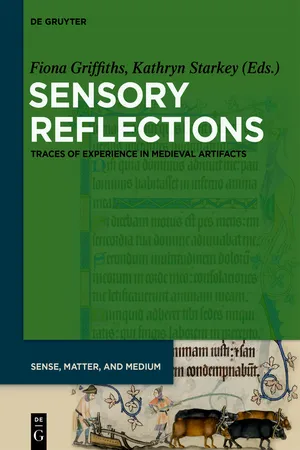
This volume draws on emerging scholarship at the intersection of two already vibrant fields: medieval material culture and medieval sensory experience. The rich potential of medieval matter (most obviously manuscripts and visual imagery, but also liturgical objects, coins, textiles, architecture, graves, etc.) to complement and even transcend purely textual sources is by now well established in medieval scholarship across the disciplines. So, too, attention to medieval sensory experiences—most prominently emotion—has transformed our understanding of medieval religious life and spirituality, violence, power, and authority, friendship, and constructions of both the self and the other. Our purpose in this volume is to draw the two approaches together, plumbing medieval material sources for traces of sensory experience - above all ephemeral and physical experiences that, unlike emotion, are rarely fully described or articulated in texts.
eBook - ePub
Sensory Reflections
Traces of Experience in Medieval Artifacts
- 281 pages
- English
- ePUB (mobile friendly)
- Available on iOS & Android
eBook - ePub
Sensory Reflections
Traces of Experience in Medieval Artifacts
About this book
Information
Jesse Rodin
1The Songbook as Sensory Artifact
Mirror in hand, a jester lovingly regards himself (Plate I). Encased in a pink-and-blue costume with dunce cap to match, he has wedged his way into the inner part of a large illuminated J. Behind the J’s back, a slightly less ridiculous pair of lovers in courtly dress (but the same color scheme) embraces, gazing into one another’s eyes. The man leans far forward.41
On the facing recto things are even sillier. At the top of the page, an errant rat runs along the roof of a large T. Beneath it we find three figures with mouths agape: on the left, a balding man and an angry fox singing (or yelling) into each other’s faces; on the right, a massive-lipped grotesque with equally massive teeth and blue glasses. Lower down on the page, a half-smiling male face hovers inside an illuminated C.
What might these grotesques have to tell us?42 What sort of gloss do they provide on the text and music they adorn? To approach these questions, we first need to get our bearings: these figures decorate Antoine Busnoys’s song Je m’esbaïs de vous mon cuer, preserved on folios 53v–54r of a book known to its friends as the Dijon Chansonnier.43 Dijon is the longest of six surviving small-format songbooks (it measures 6.9 by 5 inches) copied in the orbit of the French royal court during the 1460s and ’70s.44 Without these chansonniers our understanding of a central musical repertory would be radically impoverished: indeed, in the context of a very poor survival rate for musical sources in fifteenth-century France, the Dijon Chansonnier, copied circa 1470, preserves a full 161 songs, of which 61 (including this one) are unica.
As plate I makes clear, Je m’esbaïs de vous is composed for three voices: a high voice (the discantus) that carries the melody, and two lower voices that interweave with the discantus to form a coherent whole.45 Our J adorns the discantus, notated on the verso; the tenor (T) and contratenor (C) appear on the facing recto. This configuration of voices and voice types (high, medium, and medium-low) is absolutely standard in polyphonic songs of this period; Je m’esbaïs de vous is a paradigmatic example of the so-called Burgundian chanson, a repertory cultivated above all in the courts of France and Burgundy. At the top of the page we find the name of the composer, [Antoine] Busnoys, who, perhaps even more than Johannes Ockeghem, was the leading chanson composer of the mid-fifteenth century. Busnoys probably wrote this piece in France in the 1460s.46
Like more than half the songs in the repertory, Je m’esbaïs is a rondeau, a forme fixe poem with a textual and musical organization denoted somewhat confusingly by the pattern AB aA ab AB (Figure 1).47 In fact the form is fairly simple. Each poetic stanza is divided into two portions.48 The capital letters A and B indicate the two halves of the refrain (“Je m’esbaïs … erreur”); this refrain appears in full at the beginning and the end of the poem (AB … AB) and in partial form in the middle (A). Each lowercase letter indicates a unique non-refrain text. Thus in a complete performance one hears first a full refrain (AB); then a half stanza of new text followed by a half stanza of the refrain text (aA); then a full stanza with completely new text (ab); and, to conclude, the entire refrain (AB). The music is composed in just two sections but otherwise follows the same scheme, repeating according to the sequence AB AA AB AB. One consequence of this musical organization is that at the end of each A section one of two things happens: the performers either pause, returning to the beginning of the music, or move seamlessly forward into the B section.

The poem is classic unrequited love. The speaker – a man, as in more than nine out of ten rondeaux – is distressed at having lost the object of his affection.49 He does not, and perhaps cannot, speak directly to the woman who has spurned him; instead he addresses his heart, whose feebleness in persisting in her service causes him genuine astonishment. In the manuscript these elevated sentiments are matched by a handsome and careful textual and musical script (Plate I). By convention, the refrain text (AB) is copied underneath the notes of the discantus. Also by convention, at the bottom of the verso we find the non-refrain texts written out: one half-stanza (a) and one full stanza (ab). The scribe’s only slip, one that would probably not have confused anyone, was to have failed to copy the refrain incipit after each of these. Instead, the words “Je m’esbaïs de vous” float somewhat inanely below the last line of music.
Speaking of the music: it, too, is copied in a handsome hand, and features the diamond-shaped noteheads characteristic of fifteenth-century musical notation. The standard layout used here – one voice on the verso, two on the recto – dictated the graphic approach of the so-called Dijon Scribe. On the verso, notice how he has taken care to space both the words and the notes relatively evenly across the page, so as to fill exactly four staves.50 On the recto, where by convention the tenor and contratenor are texted only with incipits (“Je m'esbaïs” or “Je”), he was able to copy the notes more closely together, such that each voice fills less than three staves.51 This represents a significant compression, since, as opposed to 113 symbols (notes and rests) in the discantus, one finds 110 in the tenor and 101 in the contratenor. In other words, the scribe has squeezed an average of 37 musical symbols onto each line of the recto, as compared to only about 28 per line on the verso. One might surmise that this solution would produce considerable visual disjunction; and yet when one examines the entire manuscript opening, the recto hardly looks cramped. On the contrary, owing to an almost complete lack of text on the recto and an empty staff separating the two lower voices, the overall impression is one of remarkable visual balance.
This quasi-symmetrical layout is so compelling, in fact, as to offer up insights into a long-standing conundrum of performance practice.52 The absence of text in the lower voices of chansons has been taken as evidence of either instrumental or “vocalized” performance (the latter meaning that the singer would sing exclusively “ah,” “ooh,” or something of the sort). Both solutions are clearly possible, and were doubtless adopted for performances of polyphonic songs at various times during the fifteenth century.53 That having been said, there is a danger, with respect to books such as this, of taking the absence of evidence as evidence of absence.54 Consider first the discantus. It is surely owing to the practical constraints of page layout that scribes never crammed in all three texts sung to the A music (in this case, “Je m’esbaïs,” “Vray est,” and “Deportez vous”) among the musical notation, with one stanza underneath the next55; performers were clearly expected to memorize or partially memorize the words.56 The same logic applies to the lower voices: as should by now be clear, to underlay even the refrain text alone, as in the discantus, would all but preclude the horizontal compression of notes described above, which in turn would force the lower voices to be notated on four staves each, for a total of eight – or nine, if they were to be separated by a blank staff.57 It is therefore difficult to imagine how the scribe could have texted both lower voices on the seven staves provided here – indeed, how any scribe could have done so when copying a book in which the three voices are arrayed one and two across an opening.
There is more. By convention the contratenor occupies a wide melodic range, such that the distance between its lowest and highest notes is greater than it is for either of the other voices.58 Notice how, even in just the beginning of the contratenor’s first line of music, the notes rise up, then careen downward.59 The stems issuing northward from the highest notes penetrate the staff above to the point of precluding the notation of music there, let alone text60; the lowest notes, too, move well beyond the borders of the five-line staff, such that the scribe would have needed to employ some fancy footwork to fit words beneath them.61 All of this suggests that the lack of text (save incipits) in the tenor and contratenor owes to practical and aesthetic choices concerning mise-en-page, and carries no implication that the words are optional. On the contrary, there is every reason, at least with respect to most of the repertoire in chansonniers like this one, to take the incipits at face value. In both cases they mean: “Sing the text that begins with these words.”62
To sum up: we have here a perfectly conventional rondeau by the most famous song composer of the period, copied by a scribe who, impressively but unremarkably for books of this type, paid careful attention to page layout. The song is scored for three voices; the most likely performance scenario is three singers each singing all the words. Generous accompanying decorations appear, the work of someone who evidently possessed both imagination and humor.
Methodological Roadblocks
At this stage, a musicologist who has learned anything from the postmodern turn of (in our discipline) the 1980s and ’90s might ask: What can these visual elements tell us about the music, and vice versa? Can a multidisciplinary approach make legible the cultural context in which songs like Je m’esbaïs circulated? And what about that rat?
The impulse to ask these questions is reasonable. But it also betrays a bias toward what I’ll call “interpretive harmony” that too often beclouds our engagement with historical materials. We have been told that our arguments will be more interesting if, to stick with the example at hand, we can conne...
Table of contents
- Cover
- Title Page
- Copyright
- Contents
- Acknowledgments
- List of Abbreviations
- Contributor Biographies
- Sensing Through Objects
- 1 The Songbook as Sensory Artifact
- 2 Sensory Experiences of Low-Status Female Textile Workers in the Carolingian World
- 3 Appealing to the Senses: Experiencing Adornment in the Early Medieval Eastern Mediterranean
- 4 Sensing Iconography: Ornamentation, Material, and Sensuousness in Early Anglo-Saxon Metalwork
- 5 The Vessel as Garden: The “Alhambra Vases” and Sensory Perception in Nasrid Architecture
- 6 Theatricality, Materiality, Relics: Reliquary Forms and the Sensational in Mosan Art
- 7 The Wound’s Presence and Bodily Absence: Activating the Spiritual Senses in a Fourteenth-Century Manuscript
- 8 Birds in Hand: Micro-books and the Devotional Experience
- 9 Moved by Medicine: The Multisensory Experience of Handling Folding Almanacs
- 10 “putten to ploughe”: Touching the Peasant Sensory Community
- Reflections on Sensory Reflections: An Afterword
- Index
- Plates
Trusted by 375,005 students
Access to over 1.5 million titles for a fair monthly price.
Study more efficiently using our study tools.
Frequently asked questions
Yes, you can cancel anytime from the Subscription tab in your account settings on the Perlego website. Your subscription will stay active until the end of your current billing period. Learn how to cancel your subscription
No, books cannot be downloaded as external files, such as PDFs, for use outside of Perlego. However, you can download books within the Perlego app for offline reading on mobile or tablet. Learn how to download books offline
Perlego offers two plans: Essential and Complete
- Essential is ideal for learners and professionals who enjoy exploring a wide range of subjects. Access the Essential Library with 800,000+ trusted titles and best-sellers across business, personal growth, and the humanities. Includes unlimited reading time and Standard Read Aloud voice.
- Complete: Perfect for advanced learners and researchers needing full, unrestricted access. Unlock 1.5M+ books across hundreds of subjects, including academic and specialized titles. The Complete Plan also includes advanced features like Premium Read Aloud and Research Assistant.
We are an online textbook subscription service, where you can get access to an entire online library for less than the price of a single book per month. With over 1.5 million books across 990+ topics, we’ve got you covered! Learn about our mission
Look out for the read-aloud symbol on your next book to see if you can listen to it. The read-aloud tool reads text aloud for you, highlighting the text as it is being read. You can pause it, speed it up and slow it down. Learn more about Read Aloud
Yes! You can use the Perlego app on both iOS and Android devices to read anytime, anywhere — even offline. Perfect for commutes or when you’re on the go.
Please note we cannot support devices running on iOS 13 and Android 7 or earlier. Learn more about using the app
Please note we cannot support devices running on iOS 13 and Android 7 or earlier. Learn more about using the app
Yes, you can access Sensory Reflections by Fiona Griffiths, Kathryn Starkey, Fiona Griffiths,Kathryn Starkey in PDF and/or ePUB format, as well as other popular books in Literature & Literary Criticism. We have over 1.5 million books available in our catalogue for you to explore.