- 508 pages
- English
- PDF
- Available on iOS & Android
eBook - PDF
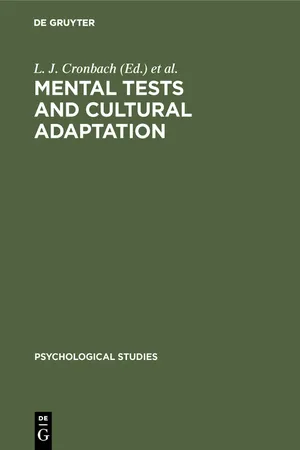
Mental tests and cultural adaptation
Information
Table of contents
- Foreword
- Contents
- Introduction
- Development of psychology and mental testing in Turkey
- PART I: Testing in its social framework
- 1. Laying the groundwork for test application in less-developed countries
- 2. Implications of testing for individual and society
- 3. Industrial application of tests developed for illiterate and semiliterate people
- 4. Adaptability: its measurement and determinants
- 5. Development, application and interpretation of tests for use in French-speaking black Africa and Madagascar
- PART II: Crosscultural research strategy
- 6. Radical cultural relativism and the concept of intelligence
- 7. A model for the analysis of cultural determinants of between-groups variation in measured intelligence
- 8. The necessity of a theory for applied crosscultural research
- PART III: Testing procedure
- 9. Some principles for adaptation of psychological tests
- 10. Test construction and standardization in different cultural settings
- 11. Why certain tasks from mental tests must be adapted whereas operational tasks need not
- 12. Procedure for group test administration in developing countries
- 13. Three handbooks on crosscultural testing
- 14. Attitude to multiple-choice tests in West Africa
- 15. Instructions as determinants of performance: the effect of information about the task
- 16. Effects of incentives on the test-taking behavior of Botswana primary-school children
- PART IV: Testing devices
- 17. Psychological studies of Kalahari Bushmen
- 18. Assessing cognitive capacities of nonliterate New Guinea adults and children
- 19. Tests of general cognitive ability for use with Maori and European children of New Zealand
- 20. Patterns of reasoning test responses in the South Pacific
- 21. Remarks on testing in the Pacific
- 22. A children's intelligence test for Greece
- 23. Application of the D 48 test in Turkey
- 24. Application of Progressive Matrices in Iraq
- 25. The Purdue motion-picture tests of visual perception
- 26. A search for tests of practical intelligence
- 27. A culture-assimilation measure and its relationship to intellectual performance
- 28. Self-perceived abilities and on-the-job performance of culturally disadvantaged workers
- PART V: Educational intervention and educational influence
- 29. Cognitive assessment of the socioculturally deprived child and adolescent
- 30. Consequences of attending elementary school in a second language
- 31. Continuities in observational field methods and mental testing
- 32. The abilities and problems of immigrants in learning to drive busses
- 33. Divergence among school beginners caused by different cultural influences
- 34. Adolescent changes in ability in relation to schooling
- PART VI: Correlates and determinants of test performance
- 35. Intergenerational mobility as a function of social origin and mental test results
- 36. Cognitive development of children from selected ethnic, educational and language backgrounds in Malaysia
- 37. Age, socioeconomic status and classificatory behavior among Turkish children
- 38. Genetic and environmental influences on language abilities
- 39. A comparison of African and European students in simple auditory and visual tasks
- 40. Social-class differences in the performance o
- 41. A normative study of the Goodenough-Harris Drawing test on a Turkish sample
- 42. Long-range prediction of educability and its determinants in East Africa
- PART VII: Factor-analytic studies
- 43. The factor structure of intelligence among teachers in the Congo
- 44. The organization of intellectual abilities of an African ethnic group in cultural transition
- 45. The influence of maturation and education on the development of mental abilities
- PART VIII: Technical issues and proposals
- 46. Judging how well a test measures
- 47. Logic, language and method in construct identification across cultures
- 48. Evaluating environmental influences on test scores
- 49. Applicability of the Rasch model in two cultures
- 50. Cultural influence on the development of Number and Flexibility-of-closure factors
- Summary and commentary
- Roster of Conference Participants
- Index
Trusted by 375,005 students
Access to over 1.5 million titles for a fair monthly price.
Study more efficiently using our study tools.
Frequently asked questions
Yes, you can cancel anytime from the Subscription tab in your account settings on the Perlego website. Your subscription will stay active until the end of your current billing period. Learn how to cancel your subscription
No, books cannot be downloaded as external files, such as PDFs, for use outside of Perlego. However, you can download books within the Perlego app for offline reading on mobile or tablet. Learn how to download books offline
Perlego offers two plans: Essential and Complete
- Essential is ideal for learners and professionals who enjoy exploring a wide range of subjects. Access the Essential Library with 800,000+ trusted titles and best-sellers across business, personal growth, and the humanities. Includes unlimited reading time and Standard Read Aloud voice.
- Complete: Perfect for advanced learners and researchers needing full, unrestricted access. Unlock 1.5M+ books across hundreds of subjects, including academic and specialized titles. The Complete Plan also includes advanced features like Premium Read Aloud and Research Assistant.
We are an online textbook subscription service, where you can get access to an entire online library for less than the price of a single book per month. With over 1.5 million books across 990+ topics, we’ve got you covered! Learn about our mission
Look out for the read-aloud symbol on your next book to see if you can listen to it. The read-aloud tool reads text aloud for you, highlighting the text as it is being read. You can pause it, speed it up and slow it down. Learn more about Read Aloud
Yes! You can use the Perlego app on both iOS and Android devices to read anytime, anywhere — even offline. Perfect for commutes or when you’re on the go.
Please note we cannot support devices running on iOS 13 and Android 7 or earlier. Learn more about using the app
Please note we cannot support devices running on iOS 13 and Android 7 or earlier. Learn more about using the app
Yes, you can access Mental tests and cultural adaptation by L. J. Cronbach, P. J. D. Drenth in PDF and/or ePUB format, as well as other popular books in Languages & Linguistics & Linguistics. We have over 1.5 million books available in our catalogue for you to explore.