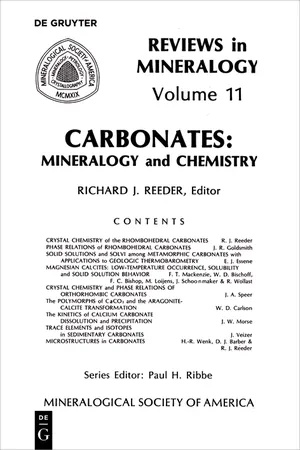
Volume 11 of Reviews in Mineralogy attempts to synthesize our present understanding of certain aspects of the mineralogy and chemistry of the rock-forming carbonates. This review follows, by ten years, a major assessment of (sedimentary) carbonate minerals by Lippmann (1973). There is only minor overlap of subject material, and I hope that this difference reflects fairly how this field has developed.
In this volume, some of the papers are general (i.e., those addressing crystal chemistry and phase relations), and they provide overviews of a fundamental nature and are of interest to many. Others are more specialized in coverage and generally reflect the different approaches used in carbonate geochemistry. The final chapter introduces transmission electron microscopy, a relatively new and powerful technique for mineralogical research that has great potential in carbonate research.
- 412 pages
- English
- PDF
- Available on iOS & Android
eBook - PDF
About this book
Information
Topic
Physical SciencesSubtopic
Geology & Earth SciencesTable of contents
- COPYRIGHT
- LIST OF PUBLICATIONS
- FOREWORD
- PREFACE and ACKNOWLEDGMENTS
- TABLE of CONTENTS
- Chapter 1. CRYSTAL CHEMISTRY of the RHOMBOHEDRAL CARBONATES
- Chapter 2. PHASE RELATIONS of RHOMBOHEDRAL CARBONATES
- Chapter 3. SOLID SOLUTIONS and SOLVI among METAMORPHIC CARBONATES with APPLICATIONS to GEOLOGIC THERMOBAROMETRY
- Chapter 4. MAGNESIAN CALCITES: LOW-TEMPERATURE OCCURRENCE, SOLUBILITY and SOLID-SOLUTION BEHAVIOR
- Chapter 5. CRYSTAL CHEMISTRY and PHASE RELATIONS of ORTHORHOMBIC CARBONATES
- Chapter 6. The POLYMORPHS of CaC0<sub>3 </sub>and the ARAGONITE—CALCITE TRANSFORMATION
- Chapter 7. The KINETICS of CALCIUM CARBONATE DISSOLUTION and PRECIPITATION
- Chapter 8. TRACE ELEMENTS and ISOTOPES in SEDIMENTARY CARBONATES
- Chapter 9. MICROSTRUCTURES in CARBONATES
- REFERENCES
- APPENDIX to Second Printing
Trusted by 375,005 students
Access to over 1.5 million titles for a fair monthly price.
Study more efficiently using our study tools.
Frequently asked questions
Yes, you can cancel anytime from the Subscription tab in your account settings on the Perlego website. Your subscription will stay active until the end of your current billing period. Learn how to cancel your subscription
No, books cannot be downloaded as external files, such as PDFs, for use outside of Perlego. However, you can download books within the Perlego app for offline reading on mobile or tablet. Learn how to download books offline
Perlego offers two plans: Essential and Complete
- Essential is ideal for learners and professionals who enjoy exploring a wide range of subjects. Access the Essential Library with 800,000+ trusted titles and best-sellers across business, personal growth, and the humanities. Includes unlimited reading time and Standard Read Aloud voice.
- Complete: Perfect for advanced learners and researchers needing full, unrestricted access. Unlock 1.5M+ books across hundreds of subjects, including academic and specialized titles. The Complete Plan also includes advanced features like Premium Read Aloud and Research Assistant.
We are an online textbook subscription service, where you can get access to an entire online library for less than the price of a single book per month. With over 1.5 million books across 990+ topics, we’ve got you covered! Learn about our mission
Look out for the read-aloud symbol on your next book to see if you can listen to it. The read-aloud tool reads text aloud for you, highlighting the text as it is being read. You can pause it, speed it up and slow it down. Learn more about Read Aloud
Yes! You can use the Perlego app on both iOS and Android devices to read anytime, anywhere — even offline. Perfect for commutes or when you’re on the go.
Please note we cannot support devices running on iOS 13 and Android 7 or earlier. Learn more about using the app
Please note we cannot support devices running on iOS 13 and Android 7 or earlier. Learn more about using the app
Yes, you can access Carbonates by Richard J. Reeder in PDF and/or ePUB format, as well as other popular books in Physical Sciences & Geology & Earth Sciences. We have over 1.5 million books available in our catalogue for you to explore.