- English
- ePUB (mobile friendly)
- Available on iOS & Android
eBook - ePub
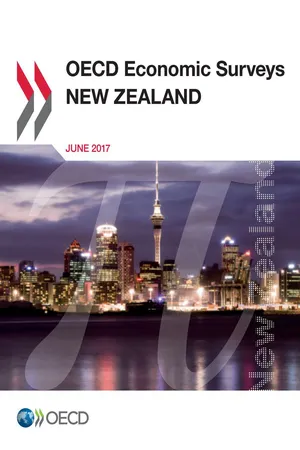
OECD Economic Surveys: New Zealand 2017
OECD,
Information
Subtopic
SociologyIndex
Social SciencesThematic chapters
Chapter 1. Improving productivity in New Zealand’s economy
New Zealand ranks highly on most indicators of well-being, but incomes are below the OECD average due to low labour productivity. Low labour productivity is only partly explained by the industry composition of the NZ economy and is primarily a consequence of sustained low multi-factor productivity growth within industries, as well as weak investment. Economic geography is an important factor in New Zealand’s poor productivity performance, as the small size and remoteness of the economy diminish its access to global markets, the scale and efficiency of domestic businesses, the level of competition, and the ability to benefit from innovation at the global frontier. Policy and institutions are generally supportive of productivity growth, but there are a number of areas where there is scope for reforms that would help offset the country’s geographical disadvantages and improve the welfare of New Zealanders over the coming decades. This includes promoting international connections, removing barriers to fixed capital investment (including taxation), accessing benefits from agglomeration by improving urban planning and infrastructure provision, enhancing competition and increasing investment in innovation and intangibles.
Productivity growth will be a central determinant of the welfare of New Zealanders over the coming decades. Globally, productivity is expected to be the main driver of incomes, in particular via investment in technology and knowledge-based capital. Economic growth from productivity improvements contributes to welfare through increasing the income that can be earned from each hour worked, providing individuals with the option to work less or consume more goods and services. It also allows societies to honour implicit commitments to the elderly in the form of pensions, to those on low incomes in terms of avoiding poverty and to youth by way of investments in high-quality education.
Productivity growth is particularly important for New Zealand, as this is one dimension where it compares unfavourably with leading OECD countries. As described elsewhere in this Survey, New Zealand has robust institutions, good governance, generally strong policy settings, a stable macroeconomy and a world-class education system that contributes to strong human capital and workforce skills. Rare exceptions to New Zealand’s success are household disposable incomes that are below the OECD average, and work/life balance, where an above-average share (14%) of New Zealanders works very long hours (OECD, 2016a), although on average employees in New Zealand work similar hours to their OECD counterparts. Despite high labour utilisation, reflecting high participation and low unemployment, GDP per capita is below the OECD average due to low productivity.
This chapter seeks to synthesise and build on the literature explaining New Zealand’s poor productivity performance – including the 2009 Survey – to develop a set of specific policy recommendations that could improve its future productivity growth. The focus of this chapter is on business-sector productivity, where market forces work to align production with consumer demands. Productivity is a key determinant of the efficiency with which consumer demands are met. Efficiency of services delivery in the non-market sector is also critical to New Zealand’s economic performance, but this is not covered herein. Synergies between boosting productivity and improving inclusiveness are highlighted, as there are opportunities to address inequality and weak productivity growth through win-win policies that deliver improved inclusiveness as well as productivity growth (OECD, 2016b).
New Zealand’s productivity performance in an international context
From the late 19th century until the mid-20th century, New Zealand was consistently among the three or four richest countries in the world by GDP per capita. This performance was underpinned by rents from the agricultural sector. Following the Great Depression, NZ governments adopted protectionist policies, including import tariffs, quotas and capital controls, while labour market flexibility was constrained by legislative requirements for centralised wage bargaining. These policies undermined the efficiency with which resources were allocated and made the economy less resilient in the face of shocks. New Zealand’s GDP per capita ranking fell from 3rd highest in 1960 to 9th highest in 1970 (Maddison, 2001). The country’s economic performance deteriorated further in the 1970s following the first oil shock and the loss of New Zealand’s major export market for agricultural products following the entry of the United Kingdom into the European Union, taking New Zealand’s GDP per capita ranking down to 17th. Moreover, government debt and foreign debt began rising rapidly. To e...
Table of contents
- Title page
- Legal and rights
- Introduction
- Abbreviations and acronyms
- Executive summary
- Assessment and recommendations
- Annex Progress in structural reform
- Thematic chapters
- About the OECD
Trusted by 375,005 students
Access to over 1.5 million titles for a fair monthly price.
Study more efficiently using our study tools.
Frequently asked questions
Yes, you can cancel anytime from the Subscription tab in your account settings on the Perlego website. Your subscription will stay active until the end of your current billing period. Learn how to cancel your subscription
No, books cannot be downloaded as external files, such as PDFs, for use outside of Perlego. However, you can download books within the Perlego app for offline reading on mobile or tablet. Learn how to download books offline
Perlego offers two plans: Essential and Complete
- Essential is ideal for learners and professionals who enjoy exploring a wide range of subjects. Access the Essential Library with 800,000+ trusted titles and best-sellers across business, personal growth, and the humanities. Includes unlimited reading time and Standard Read Aloud voice.
- Complete: Perfect for advanced learners and researchers needing full, unrestricted access. Unlock 1.5M+ books across hundreds of subjects, including academic and specialized titles. The Complete Plan also includes advanced features like Premium Read Aloud and Research Assistant.
We are an online textbook subscription service, where you can get access to an entire online library for less than the price of a single book per month. With over 1.5 million books across 990+ topics, we’ve got you covered! Learn about our mission
Look out for the read-aloud symbol on your next book to see if you can listen to it. The read-aloud tool reads text aloud for you, highlighting the text as it is being read. You can pause it, speed it up and slow it down. Learn more about Read Aloud
Yes! You can use the Perlego app on both iOS and Android devices to read anytime, anywhere — even offline. Perfect for commutes or when you’re on the go.
Please note we cannot support devices running on iOS 13 and Android 7 or earlier. Learn more about using the app
Please note we cannot support devices running on iOS 13 and Android 7 or earlier. Learn more about using the app
Yes, you can access OECD Economic Surveys: New Zealand 2017 by OECD in PDF and/or ePUB format, as well as other popular books in Social Sciences & Sociology. We have over 1.5 million books available in our catalogue for you to explore.