A Lullaby to Awaken the Heart
eBook - ePub

A Lullaby to Awaken the Heart

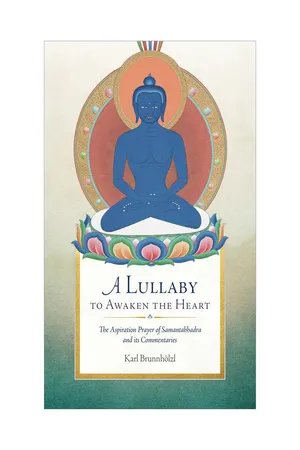
The Aspiration Prayer of Samantabhadra and Its Commentaries

  1. 504 pages
  2. English
  3. ePUB (mobile friendly)
  4. Available on iOS & Android
eBook - ePub

A Lullaby to Awaken the Heart

The Aspiration Prayer of Samantabhadra and Its Commentaries

About this book

A key Dzogchen text—available together with its Tibetan commentaries, including from the fifteenth Karmapa—from a preeminent translator. The Aspiration Prayer of Samantabhadra, one of the most famous and often-recited Dzogchen texts, is at once an entreaty by the primordial buddha, Samantabhadra, that all sentient beings recognize the nature of their minds and thus become buddhas, and also a wake-up call by our own buddha nature itself. This monumental text outlines the profound view of Dzogchen in a nutshell and, at the same time, provides clear instructions on how to discover the wisdom of a buddha in the very midst of afflictions. In this volume, Karl Brunnhölzl offers translations of three versions of the Aspiration Prayer and accompanies them with translations of the commentaries by Jigmé Lingpa, the Fifteenth Karmapa, and Tsültrim Sangpo. He offers further contextualization with his rich annotation and appendices, which include additional translation from Jigmé Lingpa, Longchenpa, and Patrul Rinpoche. This comprehensive, comprehensible book illuminates this profound text and greatly furthers our understanding of Dzogchen—and of our own nature.
Frequently asked questions

Yes, you can cancel anytime from the Subscription tab in your account settings on the Perlego website. Your subscription will stay active until the end of your current billing period. Learn how to cancel your subscription.
No, books cannot be downloaded as external files, such as PDFs, for use outside of Perlego. However, you can download books within the Perlego app for offline reading on mobile or tablet. Learn more here.
Perlego offers two plans: Essential and Complete
  • Essential is ideal for learners and professionals who enjoy exploring a wide range of subjects. Access the Essential Library with 800,000+ trusted titles and best-sellers across business, personal growth, and the humanities. Includes unlimited reading time and Standard Read Aloud voice.
  • Complete: Perfect for advanced learners and researchers needing full, unrestricted access. Unlock 1.4M+ books across hundreds of subjects, including academic and specialized titles. The Complete Plan also includes advanced features like Premium Read Aloud and Research Assistant.
Both plans are available with monthly, semester, or annual billing cycles.
We are an online textbook subscription service, where you can get access to an entire online library for less than the price of a single book per month. With over 1 million books across 1000+ topics, we’ve got you covered! Learn more here.
Look out for the read-aloud symbol on your next book to see if you can listen to it. The read-aloud tool reads text aloud for you, highlighting the text as it is being read. You can pause it, speed it up and slow it down. Learn more here.
Yes! You can use the Perlego app on both iOS or Android devices to read anytime, anywhere — even offline. Perfect for commutes or when you’re on the go.
Please note we cannot support devices running on iOS 13 and Android 7 or earlier. Learn more about using the app.
Yes, you can access A Lullaby to Awaken the Heart by Karl Brunnhölzl in PDF and/or ePUB format, as well as other popular books in Philosophy & Eastern Philosophy. We have over one million books available in our catalogue for you to explore.

Information

Part I
Image
Samantabhadra and His Legacy
1
Who or What Is Samantabhadra?
Image
As its title states, The Aspiration Prayer of Samantabhadra is a verbal expression of the wish to benefit ourselves and others uttered by Buddha Samantabhadra.5 So let’s begin by looking at who this buddha is and what he teaches.
In the Tibetan Buddhist tradition, particularly in the Nyingma School, Samantabhadra is considered to be the first or original buddha (Skt. ādibuddha), comparable in status to Vajradhara in the schools of the new translations. Samantabhadra appears in a number of Dzogchen6 tantras and many rediscovered treasure texts (Tib. gter ma) as the principle of primordial buddhahood or the dharmakāya, usually portrayed as speaking and teaching in the first person.7 In that way, this original buddha is the originless origin of the timeless teachings of the Great Perfection. The transmission of these teachings is usually explained as comprising three lineages: (1) the lineage of the awakened mind of the victors, (2) the symbolic lineage of awareness holders, and (3) the ear-whispered lineage of persons.
(1) The lineage of the awakened mind of the victors begins with Samantabhadra, who is nothing other than the instantaneous self-recognition and complete awakening of primordial awareness within the primordial expanse of the dharmadhātu, free from any notion of bondage and liberation. The awakened mind of Samantabhadra has never strayed from the inseparable kāyas and wisdoms of perfect buddhahood. Within this dimension of the dharmakāya of inner luminosity, the realm called the Vajra Heart of Luminosity,8 the three aspects of omniscient wisdom—essence, nature, and compassionate responsiveness9—are the naturally present three kāyas of the original, nondual expanse. It is within this excellent realm—the inconceivable dharmadhātu, or the timeless, formless, and immutably pure dharmakāya realm of Akaniṣṭha10—that the excellent teacher Samantabhadra (the lord of the sixth buddha family) provides a mind transmission without words to his excellent disciples—the vast assembly of the five kinds of primordial wisdom, whose nature is not at all different from Samantabhadra’s own wisdom mind. This excellent, ocean-like assembly of wisdom consists of the natural manifestations of the five families of sambhogakāya buddhas, led by Vajrasattva, along with their infinite retinues. The excellent time when this happens is the duration of dharmatā,11 which is without change or transition.12 The excellent teaching consists of the natural Great Perfection—the alpha-pure awakened mind of utter lucidity within the sphere of innate presence.13 Though all of this is entirely beyond any ordinary notions of teacher, teaching, disciples, place, and time, conventionally, it is referred to as “the self-arising unborn speech of ultimate reality of the dharmakāya” or “the yāna of the Vajra Heart of Luminosity.”14
(2) The symbolic lineage of awareness holders refers primarily to the sambhogakāya Vajrasattva’s teaching the god named “Endowed with the Superior Intention”15 in the divine realm of Trāyastriṃśa.16 This god is said to have been an emanation of Vajrasattva, as well as Garab Dorjé’s17 immediately preceding incarnation. He received a transmission from Vajrasattva by way of symbols with very few words, called “the empowerment of the anointing vase with the means of the victors.” There was also a transmission by Vajrapāṇi to a number of other human and nonhuman awareness holders.
(3) Finally, the ear-whispered lineage of persons consists of masters in the human sphere who teach other humans primarily through words, such as Garab Dorjé’s instructing Mañjuśrīmitra, who in turn taught Śrī Siṃha and Buddhajñānapāda. Śrī Siṃha then transmitted the teachings of the Great Perfection on various occasions to Jñānasūtra, Padmasambhava, Vimalamitra, and the Tibetan translator Vairocana (all eighth century). Through the latter three, the three main cycles of Dzogchen (later classified as the Mind Series, Expanse Series, and Pith Instructions Series) eventually reached Tibet.18
It is said that the Mind Series and Expanse Series were primarily transmitted by Vairocana, though Vimalamitra also translated and taught a significant number of Mind Series texts. The lineage of the Pith Instructions Series is twofold: the oral (Tib. bka’ ma) or “long” lineage that is transmitted from one lineage holder to another (beginning with Garab Dorjé), which entered Tibet through Vimalamitra; and the treasure lineage or “short” lineage that originated with Padmasambhava. He concealed many teachings and other artifacts that were later discovered by treasure revealers throughout the following centuries up to this day.19 With great emphasis on the Pith Instructions Series, all these transmissions were later revived and systematized primarily by Longchenpa and Jigmé Lingpa20 (1729/30–1798), as well as others.21
2
The Shortest Biography of Any Buddha Ever
Samantabhadra’s Instantaneous Freedom
Image
As the state of original primordial awakening, Samantabhadra is bound neither by any dimensions or limits of time, space, location, or physical conditions; nor by any gradual path of progressing from delusion to eventual freedom or liberation; nor by any evolving from an ordinary deluded sentient being to a perfectly awakened buddha. Rather, Samantabhadra was awakened before there were even the notions of buddhas, sentient beings, saṃsāra, nirvāṇa, delusion, and freedom. Longchenpa’s autocommentary on his Precious Treasury of the Dharmadhātu, called A Treasure Trove of Scriptures, says this:
The primal expanse—the sugata heart—is expressed as the buddhahood that is innately present by nature. There is no saṃsāra or nirvāṇa other than, respectively, not realizing or realizing this very expanse. Prior to it, not even the conventional expressions “buddha” or “sentient being” could be established. For if awareness did not exist, there would not be anyone or anything to ascertain saṃsāra or nirvāṇa, nor would there be any basis for evaluating delusion or freedom. As the explanatory tantra Self-Arising Awareness [says]:
Previously, when I did not exist,
there were neither buddhas nor sentient beings,
so how could there be any path or accomplishment?
There is nothing that did not arise from me.
I am the great emptiness.
From me, the five elements developed.
I am the great sovereign of the elements.
I am the ancestor of all buddhas.
Previously, when I did not exist,
there was not even the name “buddha.”
I am the pāramitā of means.
Since I have no characteristic attributes,
my mind is without movement.
I am the charnel ground of all buddhas—
they are buried in me, the changeless burial ground.
I am the abode of all sentient beings:
latent tendencies appear as if they were bodies.
I am the inseparable prajñā:
outer, inner, and secret are perfect in me.
I am the kāya of the vajra heart:
buddhas spring forth from me.
I am the actuality of unborn awareness:
I am free from phenomena that are entities.
Since I have no characteristics,
I raise sentient beings from their graves.
Since compassionate responsiveness arises from me,
I am beyond empty words.
Since the lucidity dimension arises from me,
I will illuminate the darkness.22
Thus, although Samantabhadra often appears to be described as a person or a realized being, usually speaking in the first person in Dzogchen tantras, it is important to understand that the name Samantabhadra refers to nothing other than the nature of our own mind’s instantaneous and irreversible recognition of itself, its own face, or its own essence,23 before there is even a stirring of nonrecognition or delusion about it. In the cycle of texts that form the Heart Essence of the Great Expanse (Longchen Nyingtig),24 the Subsequent Tantra of Pith Instructions on the Great Perfection declares this:
I, Samantabhadra, the primal protector,
the ancestor of all buddhas,
have become a buddha through overcoming within the expanse
all the unawareness25 of appropriating
the lucid luminosity that is nothing whatsoever.
Thus, I have not experienced any wandering in saṃsāra
and hence am known as the primal protector.
Then, when out of the expanse the dynamic energy of awareness
is arrayed as the clouds of innately present compassionate responsiveness,26
through that compassion, saṃsāric sentient beings
are established in my own overwhelming state.
In order to do this, I explain innately present, self-arising
dynamic energy as the continuum of ground, path, and fruition:27
the ground is the unconditionedness of saṃsāra and nirvāṇa,
the path is the arising of clear luminosity in its differentiations,
and the fruition is the sphere of innate presence without searching—
this is buddhahood without bondage o...

Table of contents

  1. Cover Page
  2. Title Page
  3. Contents
  4. Acknowledgments
  5. Abbreviations
  6. Preface
  7. Part I. Samantabhadra and His Legacy
  8. Part II. The Aspiration Prayer of Samantabhadra
  9. Part III. Translations
  10. Appendix 1. The Outlines of the Commentaries
  11. Appendix 2. The Ground, Its Manifestations, and Samantabhadra’s Freedom
  12. Appendix 3. The Arising of Delusion and the Unchanging Inherent Purity of All Saṃsāric Manifestations
  13. Appendix 4. How Buddha Nature and Its Pure Qualities Pervade All Sentient Beings
  14. Appendix 5. The Distinctions between All-Ground and Dharmakāya as well as Mind and Wisdom
  15. Appendix 6. The Kāyas and Wisdoms
  16. Appendix 7. The Many Facets of the Single Freedom
  17. Appendix 8. An Aspiration Prayer for Ground, Path, and Fruition by Jigmé Lingpa
  18. Appendix 9. The Essential Point of Practice by Patrul Rinpoche
  19. Appendix 10. Afflictions as Wisdom, Skandhas as Avalokiteśvara by Patrul Rinpoche
  20. Chart: The Ground, Its Manifestations, and the Resulting Freedom or Delusion
  21. Notes
  22. English–Tibetan Glossary
  23. Tibetan–English Glossary
  24. Bibliography
  25. About the Author
  26. Copyright