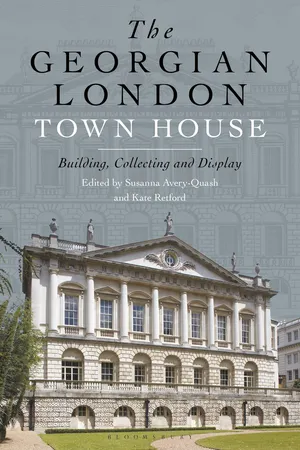
For every great country house of the Georgian period, there was usually also a town house. Chatsworth, for example, the home of the Devonshires, has officially been recognised as one of the country's favourite national treasures - but most of its visitors know little of Devonshire House, which the family once owned in the capital. In part, this is because town houses were often leased, rather than being passed down through generations as country estates were. But, most crucially, many London town houses, including Devonshire House, no longer exist, having been demolished in the early twentieth century.
This book seeks to place centre-stage the hugely important yet hitherto overlooked town houses of the eighteenth and early nineteenth centuries, exploring the prime position they once occupied in the lives of families and the nation as a whole. It explores the owners, how they furnished and used these properties, and how their houses were judged by the various types of visitor who gained access.
eBook - ePub
The Georgian London Town House
Building, Collecting and Display
- 364 pages
- English
- ePUB (mobile friendly)
- Available on iOS & Android
eBook - ePub
The Georgian London Town House
Building, Collecting and Display
About this book
Information
Part One
Architecture, Furnishing, Decorating
1
A House Divided
Building Biographies and the Town House in Georgian London
Matthew Jenkins and Charlotte Newman
This chapter will focus on the study of middling and genteel Georgian town houses in London. It will explore the potential of archaeological approaches to these houses and how these can illuminate the day-to-day experience of domestic living. It takes as a case study No 43, Parliament Street in Westminster and explores how the various inhabitants influenced the use of space in this ‘political house’. As outlined by the volume editors, the investigation of these houses and the social practices related to them has started to attract increasing research in recent years. However, this research has been primarily conducted by historians and social geographers, with little consideration of the houses themselves, particularly regarding the physical evidence and the material implications of spaces. Studies of urban space have revealed the complexity behind urban improvements and how such improvements were frequently not universal when examined on a street-by-street basis, with older architecture lingering long into the Georgian period.1 Equally, the field of Georgian interiors has investigated how these spaces were experienced by contemporaries and as venues for the performance of everyday life.2 Amanda Vickery has argued convincingly against a strict segregation between public and private, noting that the ‘genteel home was not in any simple sense “off-stage’’’.3 This study joins with those seeking to develop a more nuanced picture of eighteenth-century urban spaces, with a focus on building fabric.
If we are going to investigate the houses themselves, how does the material evidence fit into this picture? The neglect of the middling and genteel town house by archaeologists and architectural historians has also had the unfortunate side effect of undermining the value of the physical evidence of the buildings for some historians. Tim Meldrum, in his otherwise excellent study of domestic service, has warned against architectural determinism and argued that concepts such as privacy ‘cannot be read straight from the fabric of contemporary buildings’.4 This is a case that has then been repeated by other scholars.5 Most buildings archaeologists would agree that social relations cannot be simply ‘read’ from a house and there is a theoretically informed body of work, largely relating to the medieval and early modern periods, that offers a variety of approaches to spatial analysis and the examination of social space.6 Indeed, the theories of Giddens, Bourdieu and Goffman are starting to be taken up by historians, although unfortunately with little engagement with or awareness of how buildings archaeologists have been applying these ideas for decades.7 As noted in this book’s introduction, it is not by privileging one source over the other but by combining physical and documentary evidence that a more fruitful way forward can be developed.
It is by moving from large-scale narratives of urban improvement and privacy to look at qualitative data that historians such as Vickery and Meldrum have begun to analyse the complexity of domestic space.8 The use of diaries, letters, household accounts and court records has allowed the exploration of how interiors were experienced on an everyday level. A similar call has been made in historical archaeology. Charles Orser has advocated for archaeologists to ‘think globally, dig locally’9 and Dan Hicks has highlighted the importance of moving between small-scale studies and grand narratives.10 It is this combination of micro- and macro-level studies, exploring detailed case studies in the light of national data sets, that allows for a comprehensive exploration of the messiness and contradictions of lived experience and the complexity of how people engage with material culture. It is the telling of these ‘stories that “matter”’ that allows for a more nuanced understanding of improvement, privacy and Georgianization.11
In archaeology, this focus has gone hand-in-hand with the development of biographical approaches. Again, the use of this term has the potential for interdisciplinary confusion. Dana Arnold has highlighted the problems associated with biography in traditional architectural history interpretation, whereby a building is explained simply through the biography of a patron or architect.12 This is distinct from archaeological biographies that have been rapidly gaining popularity as a fruitful method of exploring a wide range of material culture.13 A crucial component of this approach is an uncovering of the reflexive relationship between people and their environment, analysing how the larger social context relates to the particular set of circumstances and material culture – the messiness that Hicks articulates.14 This also encompasses the life story of a building or landscape and how it has developed over time.15 This chapter utilizes both material and documentary evidence to explore how the house and the owner interacted with each other, the building both reflecting and helping to structure social relations.
Sources of Evidence
Several key institutions hold archives connected to the materiality of the London town house. Within London, the London Metropolitan Archive and local borough archives such as the City of Westminster Archive Centre hold plans, photographs and insurance document...
Table of contents
- Cover
- Half-Title Page
- Dedication
- Title Page
- Contents
- Preface
- Acknowledgements
- Map: Locations of the Principal Georgian London town houses Discussed in this book
- List of Illustrations
- Introduction
- Part One: Architecture, Furnishing, Decorating
- 1 A House Divided: Building Biographies and the Town House in Georgian London
- 2 ‘You never saw such a scene of magnificence and taste’: Norfolk House after its Grand Reopening in 1756
- 3 The Refurbishment of Northumberland House: Craftsmen and Interior Decoration in Mid-Eighteenth-Century London Town Houses
- 4 Town and Country: The Spencers of Althorp
- 5 The Regency Transformation of Burlington House, Piccadilly: The Architectural Drawings of Samuel Ware in the Royal Academy of Arts
- Part Two: Buying, Collecting, Display
- 6 The Display and Reception of Private Picture Collections in London Town Houses, 1780–1830
- 7 Superb Cabinets or Splendid Anachronisms? Anatomy, Natural History and Fine Arts in the London Town House
- 8 Artist in Residence: Joshua Reynolds at No 47, Leicester Fields
- 9 The Pictures at Carlton House
- 10 Glitter and fashion in the ‘Louvre of London’: Animating Cleveland House
- 11 John Julius Angerstein and the Development of his Art Collection at No 100, Pall Mall, London
- Afterword
- Select Bibliography
- Picture Credits
- Index
- Copyright
Trusted by 375,005 students
Access to over 1.5 million titles for a fair monthly price.
Study more efficiently using our study tools.
Frequently asked questions
Yes, you can cancel anytime from the Subscription tab in your account settings on the Perlego website. Your subscription will stay active until the end of your current billing period. Learn how to cancel your subscription
No, books cannot be downloaded as external files, such as PDFs, for use outside of Perlego. However, you can download books within the Perlego app for offline reading on mobile or tablet. Learn how to download books offline
We are an online textbook subscription service, where you can get access to an entire online library for less than the price of a single book per month. With over 1.5 million books across 990+ topics, we’ve got you covered! Learn about our mission
Look out for the read-aloud symbol on your next book to see if you can listen to it. The read-aloud tool reads text aloud for you, highlighting the text as it is being read. You can pause it, speed it up and slow it down. Learn more about Read Aloud
Yes! You can use the Perlego app on both iOS and Android devices to read anytime, anywhere — even offline. Perfect for commutes or when you’re on the go.
Please note we cannot support devices running on iOS 13 and Android 7 or earlier. Learn more about using the app
Please note we cannot support devices running on iOS 13 and Android 7 or earlier. Learn more about using the app
Yes, you can access The Georgian London Town House by Kate Retford, Susanna Avery-Quash, Kate Retford,Susanna Avery-Quash in PDF and/or ePUB format, as well as other popular books in Arte & Arquitectura residencial. We have over 1.5 million books available in our catalogue for you to explore.