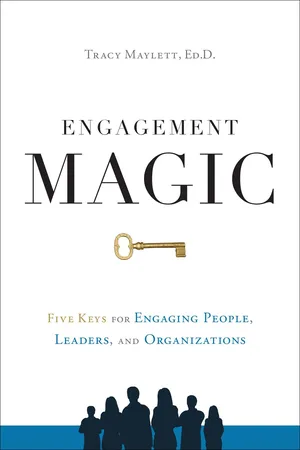
In this new edition, based on new research and double the survey data, ENGAGEMENT MAGIC provides you with an expert approach to increasing workplace engagement.
Discover how to engage employees (and yourself) more effectively.
Most leaders understand that engaged employees are passionate about their jobs and deliver better results, and most of us know what it’s like to either be engaged or disengaged in a workplace where we spend most of our waking hours. Yet, most don’t understand how engagement really works. Maylett introduces you to the five MAGIC keys of employee engagement—Meaning, Autonomy, Growth, Impact, and Connection—and discusses how leaders can help employees achieve higher levels of engagement, while engaging ourselves in the journey as well.
Learn tactics for increasing engagement at all levels of your organization.
Based on the most extensive employee engagement survey database of its kind, ENGAGEMENT MAGIC incorporates organizational research with updated case studies, stories, and examples to present you with practical solutions for creating an extraordinary employee experience. In addition, Maylett provides a self-assessment, thought-provoking questions, and specific applications for individuals, managers, and organizations.
Benefit from a psychological approach to fundamental business concepts.
?Based on data from over 32 million employee survey responses across 70 countries, ENGAGEMENT MAGIC combines principles of psychology and human motivation with solid business concepts, providing actionable advice for reducing attrition, encouraging initiative, and driving profitable growth at your organization.
- 262 pages
- English
- ePUB (mobile friendly)
- Available on iOS & Android
eBook - ePub
About this book
Information
Topic
Negocios y empresaSubtopic
GestiónPART ONE
ENGAGEMENT VERSUS SATISFACTION
CHAPTER ONE
MYTHS OF ENGAGEMENT
“A man’s delight in looking forward to and hoping for some particular satisfaction is a part of the pleasure flowing out of it, enjoyed in advance. But this is afterward deducted, for the more we look forward to anything the less we enjoy it when it comes.”
THIS IS A WORK of empirical fact, constructed on the bedrock of behavioral science and hard data. So, I’d like to start off by referencing perhaps the best movie ever made about the modern workplace, Office Space.
Yes, it’s a counterintuitive beginning, but bear with me.
You probably know this 1999 movie. I’ll refer to it throughout the book. It’s humorous, but it’s also a blistering commentary on what can happen when an employer actively thumbs its nose at engagement.
There may not be a less engaged company than Initech, the fictional software concern where most of the film plays out. Management treats the employees like drones. The employees either stare at their desks, war with printers, or kill time by shuffling papers from one place to another. The company’s efforts at creating culture—for example, Hawaiian-shirt day—are pathetic. Nothing illustrates Initech’s total lack of engagement better than a scene where the employees celebrate the boss’s birthday by standing boardstiff and singing “Happy Birthday” in a monotone, with the blank, slack faces of people being led on a death march.
Initech might be an extreme example of the dangers of disengagement (spoiler alert: At the end of the film, the most egregiously mistreated employee burns down the company headquarters), but unfortunately, it’s not entirely fictional. Plenty of well-meaning companies have tried to find ways to get their people engaged and failed:
- In 2011, Wells Fargo, worried that its recent announcement of a $3.8 billion profit wasn’t sexy enough for Wall Street, launched Project Compass. It was a “bottom-up initiative” that would ask employees to produce ideas that would trim costs and increase efficiency. Sounds great . . . until you consider that the main expense employees were asked to help cut was their own jobs. By June 2012, Wells Fargo had announced that it would be outsourcing more than a thousand jobs to places like India and the Philippines in order to help cut $1.7 billion in quarterly expenses.2 It’s hard to make employees feel empowered when you’re asking them to help decide which of their friends will be let go.
- Torbay Hospital in England had just been awarded the prestigious Acute Healthcare Organization of the Year Award. Twenty of its leaders enjoyed a lavish dinner and an awards ceremony in London. How did they reward the four thousand employees who’d made the honor possible? They gave them Kit Kats. Actually, they didn’t even bother to buy the chocolate bars—the staff got vouchers. The clueless gesture infuriated employees and made the hospital’s management a laughingstock.3
- DecisionWise Employee Experience survey data shows a clear increase in the amount of money spent on employee perks from 2013 to 2018. Yet, in many of these companies, the amount spent on perks is actually inversely proportional to levels of engagement.
- More companies seem to be spending money on incentive bonuses to try to keep their people from leaving. The Society for Human Resource Management reported that in 2017, 96 percent of private companies used some type of short-term incentive plan, up from 94 percent in 20164 These figures show a stark increase compared to the findings from the salary data website PayScale, which indicate that in 2012, 72 percent of employers awarded incentive bonuses, compared to only 53 percent in 2010.5 The improved job market is a big motivator, because people who have more choices are more apt to leave. Well, big investments equal huge payoffs, right? Not so fast. Despite the cash offers, engagement scores overall haven’t budged much across most organizations.
WHAT DOESN’T WORK
The reason that these and other efforts at employee engagement don’t work is simple: They have very little to do with engagement. They range from the well intentioned and clueless to the cynical and destructive, but they don’t come close to the core qualities that help employees be personally engaged in their work.
When senior executives talk about engagement, they’re usually thinking of “perks” like on-site gyms and health spas, nap pods, soda pop in the break room, Taco Tuesdays, dog-sitting and laundry services, and so on. These are typically costly investments. So, why do we continue spending money with little engagement to show for it?
First, most managers don’t understand the difference between engagement and satisfaction. Second, we’re taught in management school that every return requires an investment, and that investment always has a dollar (or euro, or yen, or . . .) figure attached to it. We’re taught to throw money at problems. Third, and perhaps most pervasive (and dangerous), it’s simpler to build an on-site gym than it is to help an employee find meaning in his or her work. Bringing in a few treadmills is more tangible and easier to get our arms around than building a sense of purpose in one’s work.
Simply put, while some managers may know how to bring in lunch for the team, or even how to have a productive conversation with employees about sales targets, few are comfortable with helping an employee find purpose and a sense of fulfillment in his or her work. This isn’t something we’re taught to do, at least not in business settings.
The environment and culture, not the bells and whistles, set the tone for how engaged, fulfilled, and challenged we feel at the office. Compensation and perks matter, but they’re far from the only factors. To put it another way, it’s the soil, not the flowers.
Think of this in terms of your own experience (we’ll dive into this in more depth a little later). Have you felt the energy that comes with doing something you feel is worthwhile, something that really floats your boat? How did it feel? What did it cause you to do?
When our consultants conduct workshops or facilitate team sessions, we often ask the question “What does a good day look like at work?” Responses vary. Participants may relate a good day to having accomplished something important. Or they may focus on solving a customer issue, making a significant discovery, healing a patient, or rewiring a machine on the assembly line that nobody else could fix. “Whenever my boss is gone, it’s a good day!” inevitably shows up somewhere in each session. But that’s a separate discussion.
Two important points emerge from these discussions. First, responses rarely relate to perks or compensation. Second, employees intuitively know how engagement feels—and when it’s not present. They get it.
WHAT IS ENGAGEMENT?
Here’s the definition we will refer to throughout this book:
Employee engagement is an emotional state where we feel passionate, energetic, and committed toward our work. In turn, we fully invest our best selves—our hearts, spirits, minds, and hands—in the work we do.
When you see engagement, you know it. For example, in 2001, Douglas Conant took over as CEO of Campbell’s Soup and called it a “bad” company. Its products were bleeding market share, and research showed that 62 percent of the company’s managers did not consider themselves actively engaged in their jobs. Yet by 2009, 68 percent of the company’s employees said they were actively engaged, while just 3 percent considered themselves actively disengaged. More important, Campbell’s increased its earnings by up to 4 percent per year over those eight years.6
How did Conant do it? He made a commitment to his people, embodied in the phrase “Campbell valuing people, people valuing Campbell.” He took down the prison-style barbed-wire fence surrounding the corporate HQ. He launched programs to get managers communicating with direct reports, and had direct reports evaluate managers. The top criterion that managers were expected to show: the ability to inspire trust. Those who didn’t measure up were replaced from within. Conant also instituted programs to celebrate individual success, from sending personal thank-you notes to having lunch with employees.
That’s a culture of engagement. It had nothing to do with air-hockey tables in break rooms or on-site clinics. People engage with people, and they give more when they feel heard, empowered, and appreciated.
What about Google? They’re the perennial champ of the best-places-to-work lists, and the role model for companies trying to create an environment that makes the best and brightest feel totally engaged. But to believe that the secret is the awesome organic cafeteria food or the famous personal-project policy is to ignore the brilliance of what Google does.
The company has a “people analytics team” that asks, “What makes our employees happy now versus in the future?” As economic conditions, business focus, and individual employees change, so does the research. Google uses the results to create evolving programs congruent with employees’ concerns, needs, and tastes.
MYTHS VERSUS FACTS
Engagement, done right, yields results. Then why is there so much fear and loathing surrounding the topic? In part, it’s a result of persistent myths propagated by polling companies and the news media. For example, if you’re in a leadership or human resources position at a company, you’ve almost certainly come across this alarming statistic (or something similar): “78 percent of your employees are disengaged and looking for new jobs!”
Those “scare quotes” are designed to do exactly that: scare you into hiring a consultant to help prevent all your employees from bolting. But that 78 percent figure is misleading. Polling companies arrive at it because they make engagement a binary equation: You’re either fully engaged or fully disengaged. They might gauge employee engagement on a 1–5 scale, with five being full engagement. If 22 percent of your workers score fives, the polling company will take the other 78 percent who score 1–4 and say they’re disengaged! Voilà—scary numbers.
Furthermore, many of the questions asked are not true engagement questions; they’re satisfaction questions (I’ll get into this in more depth later). But let’s apply some common sense here. Do you really think that over three-quarters of your workforce couldn’t care less about what happens at work? That goes against basic human nature.
Engagement isn’t binary. It’s a continuum, a spectrum. There are many levels, and they change over time. In our engagement surveys, we break down the results into four categories:
| Fully Engaged (32 percent of respondents to our surveys) | These are the most enthusiastic champions of the organization, whose excitement is palpable and contagious. They are constantly learning and taking calculated risks; feel that they are able to stretch beyond their comfort zone; take personal gratification in the quality of their work; feel that while work can be stressful, it can also be fun; and love their jobs. |
| Key Contributors (48 percent) | They meet performance expectations, do what they know well without taking many risks, respond well to leadership, don’t often feel challenged, and while they don’t necessarily love all aspects of their jobs, are actively contributing and involved in the day-to-day. We call these people the “strong-and-steady.” They make up the bulk of the workforce, and they generally perform. But much of their work is transactional, rather than transformational. They get things done, but they typically invest limited time in innovating, improving processes, or breaking from the status quo. It goes back to the old joke about the difference between the chicken and the pig in a bacon-and-egg breakfast: The chicken is involved; the pig is committed. These employees are involved, but they’re not putting their all into their work. |
| Opportunity Group (16 percent) | They generally feel underutilized, spend a lot of work time taking care of personal needs, do enough to get by and not get in trouble, seldom speak up, work mainly for the pay, and are basically marking time. In our interviews and focus groups with these individuals, we have found that many in the Opportunity Group are actually potential top performers who are burned out. It’s often difficult to identify these individuals, as they disengage and suffer in silence, checking out mentally and emotionally. They don’t make noise, but their contributions are limited. They are the “undecided vote.” As the name implies, there is a huge opportunity to sway this group to a higher level of engagement. However, if nothing is done, they leave the organization, either physically or psychologically. |
| Disengaged (4 percent) | They are bored and frustrated; say negative things about the work, the company, and its leadership; tend to blame others for their failures; and rather than quit, tend to stay on and, consciously or unconsciously, sabotage things. They are often the most vocal and negatively contagious group within the organization. They can be cancerous and toxic. Many leaders discount this group because of their small numbers. Yet having even one of these individuals on a team can have a significant negative impact. On the other hand, because these individuals tend to be quite vocal about their dissatisfaction and disengagement, management teams often spend a great deal of unproductive time addressing their demands. |
People tend to move in and out of these four categories of engagement depending on the environment, incentives, and where they are in their careers and lives. It’s a complex, fluid, true-to-life model that more closely resembles the makeup of a team or organization than the alarming (and inaccurate) statistics being thrown out as scare tactics. It also means that any claim that 78 or 80 percent of your employees are job hunting is a myth. Our research shows that, in fact, even during the employment challenges across the world...
Table of contents
- Cover
- Title Page
- Copyright
- Dedication
- Contents
- INTRODUCTION
- PART ONE: ENGAGEMENT VERSUS SATISFACTION
- PART TWO: KEYS TO UNLOCKING ENGAGEMENT
- PART THREE: ENGAGING PEOPLE™
- APPENDIX: Further Questions
- APPENDIX: Engagement Conversation
- NOTES
- INDEX
Trusted by 375,005 students
Access to over 1.5 million titles for a fair monthly price.
Study more efficiently using our study tools.
Frequently asked questions
Yes, you can cancel anytime from the Subscription tab in your account settings on the Perlego website. Your subscription will stay active until the end of your current billing period. Learn how to cancel your subscription
No, books cannot be downloaded as external files, such as PDFs, for use outside of Perlego. However, you can download books within the Perlego app for offline reading on mobile or tablet. Learn how to download books offline
Perlego offers two plans: Essential and Complete
- Essential is ideal for learners and professionals who enjoy exploring a wide range of subjects. Access the Essential Library with 800,000+ trusted titles and best-sellers across business, personal growth, and the humanities. Includes unlimited reading time and Standard Read Aloud voice.
- Complete: Perfect for advanced learners and researchers needing full, unrestricted access. Unlock 1.5M+ books across hundreds of subjects, including academic and specialized titles. The Complete Plan also includes advanced features like Premium Read Aloud and Research Assistant.
We are an online textbook subscription service, where you can get access to an entire online library for less than the price of a single book per month. With over 1.5 million books across 990+ topics, we’ve got you covered! Learn about our mission
Look out for the read-aloud symbol on your next book to see if you can listen to it. The read-aloud tool reads text aloud for you, highlighting the text as it is being read. You can pause it, speed it up and slow it down. Learn more about Read Aloud
Yes! You can use the Perlego app on both iOS and Android devices to read anytime, anywhere — even offline. Perfect for commutes or when you’re on the go.
Please note we cannot support devices running on iOS 13 and Android 7 or earlier. Learn more about using the app
Please note we cannot support devices running on iOS 13 and Android 7 or earlier. Learn more about using the app
Yes, you can access ENGAGEMENT MAGIC by Tracy Maylett in PDF and/or ePUB format, as well as other popular books in Negocios y empresa & Gestión. We have over 1.5 million books available in our catalogue for you to explore.