The European Union has a democracy problem. The polycrisis that has plagued the EU for years has led to a cacophony of voices calling for fundamental change to the integration project. Yet despite the shock of the Brexit referendum and the electoral upsets caused by nativist parties across the continent, few of the plans for EU reform include concrete proposals to address the perennial democratic deficit.
This volume looks at how the relationship between citizens, the state and EU institutions has changed in a multi-layered Union. As such, it focuses more on polity than on populism, and does not engage deeply with policy or output legitimacy. Building on the notion of increasing social, economic and political interdependence across borders, this book asks whether a sense of solidarity and European identity can be rescued from the bottom up by empowering citizens to 'take back control' of their Union.
Direct Democracy in the EU: The Myth of a Citizens' Union is part of the 'Towards a Citizens' Union' project and is the product of collaboration with 20 renowned think tanks from the European Policy Institutes Network (EPIN). It is the first of three publications that will also cover the state of representative democracy in the EU and the accountability of democratic institutions.
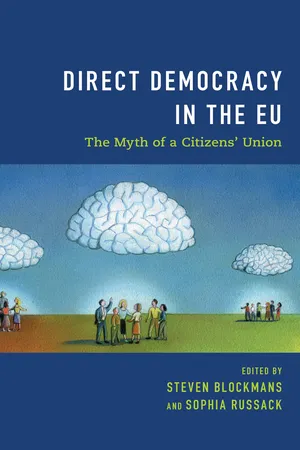
eBook - ePub
Direct Democracy in the EU
The Myth of a Citizens' Union
- 468 pages
- English
- ePUB (mobile friendly)
- Available on iOS & Android
eBook - ePub
Direct Democracy in the EU
The Myth of a Citizens' Union
About this book
Information
Publisher
Center for European Policy StudiesYear
2019Print ISBN
9781786609977
Edition
1eBook ISBN
9781786609991
1. INTRODUCTION
STEVEN BLOCKMANS & SOPHIA RUSSACK
1.1 Identity crisis
The state of democracy in the European Union is a subject of constant debate. While some have argued that concern about the ‘democratic deficit’ is misplaced,1 the prevailing sense is nevertheless that the EU has a democracy problem.2
This sense of a problem is compounded by recent figures about the decline of electoral democracy and the protection of civil liberties, including freedom of expression and backsliding on the rule of law in a growing number of member states.3 In Europe’s patchwork of political cultures, languages, national memories and diverse press channels, the algorithms behind social media are polarising people in a way not seen since the creation of the EU. The seismic shock of the Brexit referendum and the electoral upsets by nativist and Eurosceptic parties across the continent show that, in the EU too, “all politics is local”.4
Paradoxically, half a billion people living in a Union that has advanced the notion of ‘citizenship’ since 1991 have never before shared such an intertwined destiny. The single market, free movement and the Erasmus student exchange programme have all helped to break down cultural boundaries. But these achievements risk being reversed by political narratives that drive citizens into ever more divided national mind-sets. The popular anger that populists feed on seems to be deliberately channelled towards a growing list of targets: from the single currency and austerity policies attached to it, to EU trade agreements with third countries (mainly the US and Canada), refugees and economic migrants. Now, the radical right is encouraging Europeans to turn against each other.5
The achievements of single market, free movement and the Erasmus student exchange programme have all helped to break down cultural boundaries, but they risk being reversed by political narratives that drive citizens into ever more divided national mind-sets.
At the grassroots level, citizens’ perceptions have drifted a long way from the European ‘demos’ imagined by the architects of modern Europe. European integration is often perceived as an elitedriven project that is too remote from ordinary citizens. The ‘polycrisis’ that has plagued the EU for the past few years has led to a cacophony of voices calling for fundamental change to the European integration project.
Insofar as such proposals exist, they have been developed by elites, either “as damage limitation to placate a restless populace”6 or as an effort to reduce EU institutional interference at the national level. Examples of the former include the aim to create transnational lists for the European Parliament elections and to revive the lead candidate (‘Spitzenkandidat’) system pioneered in 2014. An example of the second category is the renewed call from Central and Eastern European governments to arm national parliaments with a red card to shoot down the European Commission’s unpalatable legislative initiatives. Emmanuel Macron’s proposal to organise civilian assemblies to debate the future of Europe may be more in tune with the mood of the masses, but a self-declared ‘Jupiterian’7 president seems hardly the right person to push for its implementation.
While the leaders of the EU institutions and member states increasingly invest their hopes in reviving ‘output legitimacy’ by delivering on policy objectives (e.g. shoring up security and defence cooperation, reform of the eurozone and the Schengen area, striking up progressive trade deals), the democratic legitimacy problem has in effect been left to fester. The (perception of) nontransparent decision-making continues to feed into popular frustration about how governments and EU institutions operate. The risk of an even greater negative feedback loop is therefore real.
While the leaders of the E U institutions and member states invest their hopes in reviving ‘output legitimacy’ ... the democratic legitimacy problem has been left to fester.
1.2 Towards a Citizens’ Union?
Against this backdrop, 20 renowned think tanks from the European Policy Institutes Network (EPIN) have joined forces in a three-year research project supported by the European Commission under its Erasmus+ programme. The ‘Towards the Citizens’ Union (2CU)’ project is concerned with the two-pronged question of i) how the relationship between citizen, state and EU has changed, and ii) whether and how direct democracy (this volume), representative democracy (volume 2, forthcoming in 2019) and the accountability of democratic institutions (volume 3, forthcoming in 2020) can be improved in a multi-layered EU. As such, 2CU uses the phenomenon of populism8 not so much to engage with policy, but as a research handle to assess process and polity.
This volume asks whether a sense of solidarity and European identity can be rescued from the bottom up by politically empowering citizens to ‘take back control’ of their EU.
Building on the notion of increasing social, economic and political interdependence across borders, this first volume asks whether and, if so, how a sense of solidarity and European identity can be rescued from the bottom up by politically empowering citizens to ‘take back control’ of their EU.
This first 2CU book on the state of direct democracy in the EU presupposes a common understanding of the semantics of direct political participation. Some clarifications may nevertheless be in order.
The EU is founded on the principle of representative democracy (Article 10(1) TEU). Citizens are thus directly represented at Union level in the European Parliament. The functioning of the EU is thus based on the assumption that the elected representatives reflect the goals and preferences of the citizens. Yet delegates might follow their own agenda more than the citizens’ will. Complementary procedures may therefore help maintain the legitimacy of governance.9 Mechanisms have been created to give more substance to the right of every citizen to participate in the democratic life of the EU (Article 10(3) TEU). The European Citizens’ Initiative (ECI) is the most emblematic of these (Article 11(4) TEU). It has been hailed as the world’s first transnational tool of direct democracy.10 Yet, as neither the ECI nor any of the other of the Union’s own instruments (cf. Article 11 TEU) is able to directly catalyse or constrain EU decision-making, the term ‘direct democracy’ is probably a misnomer at the supranational level. The power to govern the EU certainly does not lie directly in the hands of the people and cannot be expressed through, say, EU-wide referendums. The term ‘participatory democracy’ might thus be better suited for the EU as this concept challenges what is perceived as elitist forms of representation in liberal democracies and puts a prime on the active participation of civil society in public decision-making.11
In a narrower sense, however, ‘participatory democracy’ is a process of collective decision-making that combines elements from both direct and representative democracy: citizens have the power to decide on policy proposals through referendums, civilian assemblies, public consultations, initiatives, petitions, etc., for example12 and politicians assume the role of policy implementation with little personal discretion. In this sense, instruments of direct democracy are no silver bullets but may be valuable supplements to representative democracy. They provide “the opportunity to break the cycle of increasingly distant, technocratic political institutions and increasingly disconnected citizens supporting populist positions”.13
In its original form, ‘populism’ is an ideology that considers society to be ultimately separated into two homogenous and antagonistic groups: ‘the pure people’ and ‘the corrupt elite’, and argues that politics should be an expression of the volonté générale of the people. Practically, populist politicians almost always combine it with other ideologies, such as nativism on the right and socialism on the left. Populism is a particular view of how society is and should be structured, but it addresses only a limited part of the larger political agenda. For example, it says little about the ideal economic or political system that a (populist) state should have. Its essential features are: morality and monism. In his seminal book, ‘What is Populism?’14 Jan-Werner Müller argues that ‘populism’ is inimical to pluralism. Its target is pluralist, liberal democracy, with those vital constitutional and social checks and balances that prevent any “tyranny of the majority” from prevailing over individual human rights, safeguards for minorities, independent courts, a strong civil society, and independent, diverse media. Müller rejects the term ‘illiberal democracy’, arguing that it allows people like Viktor Orbán to claim that Hungary just has a different kind of democracy. Timothy Garton Ash stresses the need for
a term to describe what happens when a government [like that also of Jarosław Kaczyński in Poland] that emerges from a free and fair election is demolishing the foundations of a liberal democracy but has not yet erected an outright dictatorship – and may not even necessarily intend to.15
1.3 Structure of the book
The volume opens with a chapter that digs into the existing EU-level mechanisms intended to give European citizens a louder voice and have it heard. This analysis is complemented by a handful of thematic chapters on narrative, procedural and technical aspects of political participation (Part II). The main body of the book (part III) comprises an empirical analysis of local demand and upward mobilisation. In a representative cross-section of half of the EU’s membership (determined along geographical, economic, political, cultural and other lines), 14 country reports provide a bottom-up framework of political change and power contestation in the EU. Working with the grain of these socio-economic, cultural and political developments across the Union, the book concludes with a chapter that synthesises the research findings, debunks the myth of the unifying effects of direct democracy and offers recommendations to improve participatory democracy in the EU.
Footnotes
1 Adherents of the former view include, e.g. G Majone. (1998), “Europe’s ‘Democratic Deficit’: The Question of Standards”, European Law Journal, 4(1): 5–28; or A. Moravcsik (2002), “In Defence of the ‘Democratic Deficit’: Reassessing Legitimacy in the European Union”, Journal of Common Market Studies, 40(4): 603–24.
2. For the view of the mainstream see, e.g. F. Scharpf (1999), Governing in Europe. Effective and Democratic?, Oxford: Oxford University Press; S. Hix and Follesdal, A. (2006), “Why There is a Democratic Deficit in the EU: A Response to Majone and Moravcsik”, Journal of Common Market Studies, 44(3): 533-562; and Lindberg, 2018.
3 V-Dem Institute, “Democracy for All? The V-Dem Annual Democracy Report 2018” (https://www.v-dem.net/media/filer_public/3f/19/3f19efc9-e25f-4356-b159-b5c0ec894115/vdem_democracy_report_2018.pdf).
4 T. O’Neill & G. Hymel (1994), All Politics Is Local: And Other Rules of the Game, Holbrook, Ma: Bob Adams Inc.
5 H. Grabbe & S. Lehne (2018), “Could an Illiberal Europe Work?”, Carnegie Europe.
6 R. Youngs (2017), Europe Reset: New Directions for Europe, London: I.B. Tauris, at 11.
7 See J. Grayson, “The dual meaning behind Macron’s ‘Jupiterian Presidency’”, JohnGraysonBlog, 15 July 2017.
8 J.W. Müller (2016), What is Populism?, University of Pennsylvania Press; and C. Mudde & C. Rovira Kaltwasser (2017), Populism: A Very Short Introduction, Oxford: Oxford University Press.
9 H. Catt and M. Murphy (2003), “What voice for the people? Categorising methods of public consultation”, Australian Journal of Political Science, 38(3): 418.
10 J. Greenwood and K. Tuokko (2017), “The European Citizens’ Initiative: the territorial extension of a European political public sphere?”, European Politics and Society, 18(2): 5.
11 C. Pateman (1970), Participation and Democratic Theory, Oxford: Oxford University Press.
12 R. Lindner and U. Riehm (2011), “Broadening Participation Through E-Petitions? An Empirical Study of Petitions to the German Parliament”, Policy & Internet, 3(1): 63–85.
13 J. Organ (2017), “EU Citize...
Table of contents
- 1. Introduction
- Part I. EU-level Mechanisms
- Part II. Transversal Aspects & Thematic Issues
- Part III. Country Reports
- Part IV. Conclusions
- About the Contributors
Trusted by 375,005 students
Access to over 1.5 million titles for a fair monthly price.
Study more efficiently using our study tools.
Frequently asked questions
Yes, you can cancel anytime from the Subscription tab in your account settings on the Perlego website. Your subscription will stay active until the end of your current billing period. Learn how to cancel your subscription
No, books cannot be downloaded as external files, such as PDFs, for use outside of Perlego. However, you can download books within the Perlego app for offline reading on mobile or tablet. Learn how to download books offline
Perlego offers two plans: Essential and Complete
- Essential is ideal for learners and professionals who enjoy exploring a wide range of subjects. Access the Essential Library with 800,000+ trusted titles and best-sellers across business, personal growth, and the humanities. Includes unlimited reading time and Standard Read Aloud voice.
- Complete: Perfect for advanced learners and researchers needing full, unrestricted access. Unlock 1.5M+ books across hundreds of subjects, including academic and specialized titles. The Complete Plan also includes advanced features like Premium Read Aloud and Research Assistant.
We are an online textbook subscription service, where you can get access to an entire online library for less than the price of a single book per month. With over 1.5 million books across 990+ topics, we’ve got you covered! Learn about our mission
Look out for the read-aloud symbol on your next book to see if you can listen to it. The read-aloud tool reads text aloud for you, highlighting the text as it is being read. You can pause it, speed it up and slow it down. Learn more about Read Aloud
Yes! You can use the Perlego app on both iOS and Android devices to read anytime, anywhere — even offline. Perfect for commutes or when you’re on the go.
Please note we cannot support devices running on iOS 13 and Android 7 or earlier. Learn more about using the app
Please note we cannot support devices running on iOS 13 and Android 7 or earlier. Learn more about using the app
Yes, you can access Direct Democracy in the EU by Steven Blockmans,Sophia Russack, Steven Blockmans, Sophia Russack in PDF and/or ePUB format, as well as other popular books in Politics & International Relations & Conservatism & Liberalism. We have over 1.5 million books available in our catalogue for you to explore.