![]()
CHAPTER 1
The Story of the Introduction of Non-extractable Polyphenols into Polyphenol Research: Origin, Development and Perspectives
F. SAURA-CALIXTO
a Nutriantioxidants and Science FDI S.L., Avda Muñoz Degrain 17, 33007 Oviedo, Asturias, Spain;
bFormer Research Professor, Spanish National Research Council (CSIC), Madrid, Spain
*E-mail:
[email protected] 1.1 Introduction
Research into polyphenols (PP) has undergone massive and increasing development in recent decades, as indicated by the large number of articles—over 51 000—published in the period 1997–2017 versus around 12 000 in the period 1977–1996. Most of those papers report chemical, biological, nutritional, epidemiological and intervention studies that focus exclusively on phenolic compounds extracted from plant material using aqueous–organic solvents, ignoring an important fraction of PP in food and diets, the so-called non-extractable PP (NEPP).
This chapter presents an overview of what we know about NEPP, including the main milestones in the research and perspectives in this field, based mainly on the studies developed by my research team. It addresses the gap in the field of PP research, from the origin of the concept of NEPP to the current understanding of their physiological behaviour, metabolism and health-related properties. Other aspects such as differences between the chemical and physiological approaches to NEPP, the importance of their interactions with dietary fibre (DF) and their potential relevance in nutrition and health are discussed.
The aim of the chapter is to provide scientists currently working on PP, and especially scientists from other fields, with an overall idea of the topic. It may be seen as an introduction to the following chapters of the book, written by pioneering scientists working in this field, which describe in detail the main aspects of our current knowledge of NEPP.
1.2 Why is There a Gap in Dietary Polyphenols?
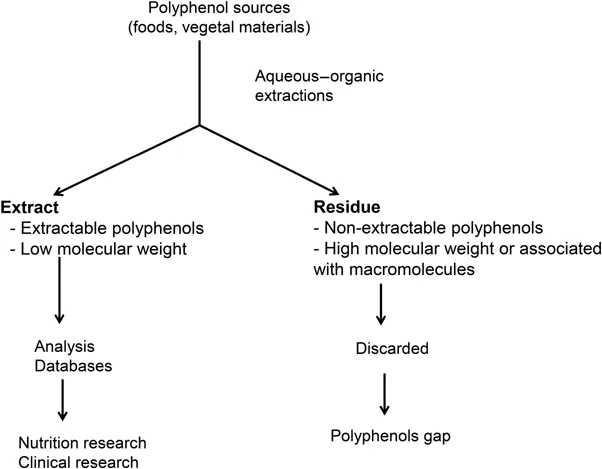
A quick look at the methods typically used to analyse PP in food (Figure 1.1) can provide an answer to the question of why there is a significant gap in the current predominant approach in the field of dietary PP. The contents and composition of PP are determined by analysing aqueous–organic extracts from plant foods, and such analysis is the only source of current databases of PP in foods. The general assumption that the total PP content of a food is in these extracts, neglecting the possible presence of PP in the extraction residues, is what leads to the current gap. However, simple analysis of the residues shows this assumption to be incorrect.
Figure 1.1 Common procedure for polyphenol analysis and the derived gap in polyphenols research.
Indeed, for the analysis of other food constituents, the assumption that the entire constituent is present in an aqueous–organic extract is not held, in contrast to the PP field. Thus, the most common methods used for the analysis of plant macromolecules such as polysaccharides and protein require, in addition to initial extraction of sugars or free amino acids, treatment of the samples with a strong acid or enzymes to obtain hydrolysates containing the monomers (monosaccharides and amino acids) that form the polymeric structures. In these cases, if the same partial approach had been followed as in the field of PP, we would now have almost complete knowledge of soluble sugars and free amino acids, but we would not know of the existence of insoluble proteins and polysaccharides in plant foods.
In this context, after 1988, the analysis of hydrolysates obtained via the acid treatment of the extraction residues of numerous materials and plant foods showed the presence of appreciable amounts of polymeric proanthocyanidins and simple PP linked to cell walls, as described below. These PP were named NEPP. Unfortunately, this complete approach to PP analysis has not been generally adopted in the field of PP, a methodological error that has led to the current situation: virtually complete knowledge of extractable PP (EPP) but a lack of knowledge of NEPP.
1.3 Polyphenols Associated with Dietary Fibre: Origin and Development of Research into Non-extractable Polyphenols
After the first physiological definition of DF by Trowell,1 intense research carried out in the 1980s and 1990s demonstrated the key role of DF in gastrointestinal health and in reducing chronic disease risks. As a consequence, increased DF intake is currently recommended by the World Health Organization (WHO) and numerous national and international health agencies, especially in Western countries where DF intake is below dietary recommendations. At the same time, massive development of foods enriched with DF has occurred.
The first studies on DF described it as consisting of two fractions, depending on their solubility in intestinal fluids: insoluble DF (IDF), constituted by the polysaccharides cellulose and hemicellulose; and soluble DF (SDF), consisting of polysaccharides such as beta-glucans, arabinoxylans, galactomannans and pectins. Nevertheless, later research showed that DF is a complex matrix containing numerous indigestible substances, in addition to the polysaccharides indicated in the original definition of Trowell. Presently, DF is considered the edible part of plant food that is resistant to digestion and absorption in the human small intestine, which undergoes complete or partial fermentation in the large intestine. It contains polysaccharides as major constituents, along with other substances such as lignin, resistant starch, oligosaccharides, Maillard compounds, cutin, PP and carotenoids.
Interestingly, a certain similarity was observed in the physiological behaviour of DF and PP.2,3 Thus, EPP and SDF can be solubilized in intestinal fluids during digestion, while IDF and NEPP remain insoluble. Once in the colon, SDF and the EPP that are not absorbed in the small intestine are mostly fermented by the action of the microbiome, while IDF and NEPP are only partially fermented. This suggested that dietary PP may have a significant contribution to some health effects attributed exclusively to DF.
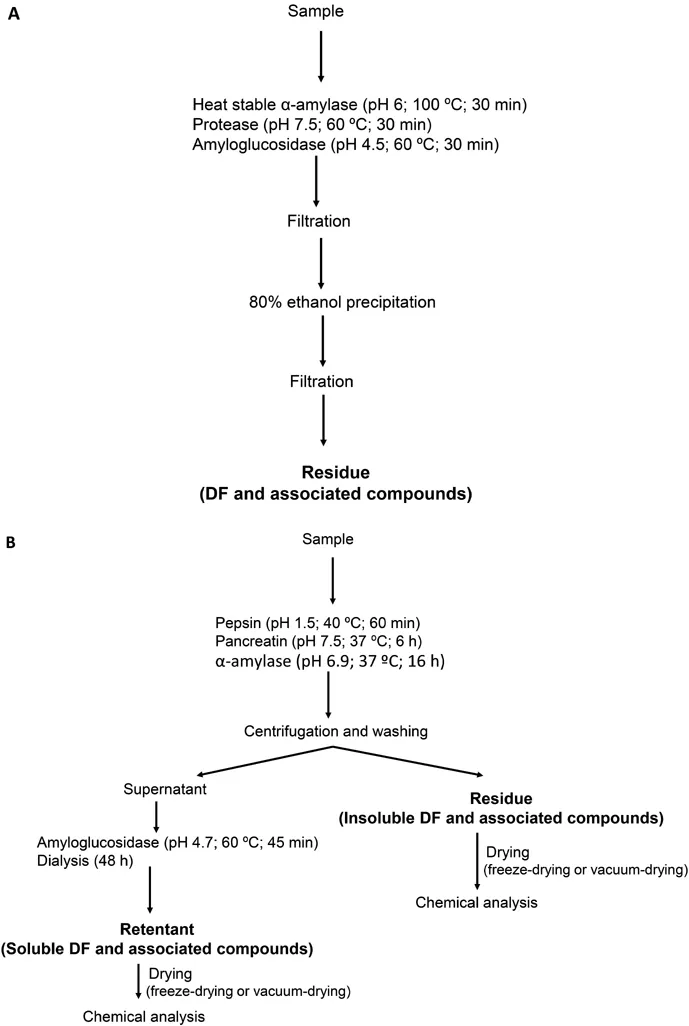
The close relationship between DF and NEPP is also seen in the fact that the concept of NEPP arose from the analysis of DF in some plant materials. Following the Association of Official Analytical Chemists (AOAC) enzymatic–gravimetric method (Figure 1.2a), which was the most common procedure available in the 1980s, a paradoxical result was found in the analysis of DF from carob pods (Ceratonia siliqua), a Mediterranean legume.4 Their DF content was high (36.9% of dry matter) and we initially assumed that most of this corresponded to indigestible polysaccharides, as in other legumes and in most vegetable foods. However, analysis of the DF showed that the actual amount of polysaccharides and lignin was only 18.9% of dry matter and therefore there was a gap of 18.0%! This missing matter was identified, after treatment of the DF with HCl/butanol, as non-extractable proanthocyanidins (NEPA), with a basic flavan-3-ol structure and a molecular weight of over 30 000 Da. In a later analysis, we also found NEPA in other plant materials (Table 1.1), and this can be considered the origin of NEPP.
Figure 1.2 Me...