Formaldehyde is virtually ubiquitous in the modern environment due to its cost-effective nature, its use in resin formation, and its preservative properties. Though formaldehyde is necessary for many products and processes important to the world's economy, this economic dependence on formaldehyde comes at a cost to public health.
Growth and consequent industrialization rely heavily on formaldehyde use. New buildings—residences, public places, and offices—are not only built with timber preserved by formaldehyde, but they are also furnished with wood, wool, and textile products that contain formaldehyde. The general population faces environmental exposure from indoor and outdoor air pollution, food, and even medicine. Scientific inquiry into formaldehyde exposure has grown in response.
This book consolidates the new and established body of formaldehyde research in the scholarly community, focusing on exposure, genotoxicity, and adverse health outcomes. Through this resource, we hope to increase awareness of the broad range of health effects posed by formaldehyde exposure, and to encourage interdisciplinary interest, as well as research, into this pervasive compound—especially in the United States and China, where formaldehyde production and usage is high. This book will be useful to researchers of environmental and occupational exposure, students, and government regulators and anyone exposed to formaldehyde in the workplace and/or at home.
- 389 pages
- English
- ePUB (mobile friendly)
- Available on iOS & Android
eBook - ePub
About this book
Information
Publisher
Royal Society of ChemistryYear
2018Print ISBN
9781782629733
9781782629733
Edition
1eBook ISBN
9781788014519
CHAPTER 1
Introduction to Formaldehyde
1.1 Formaldehyde—The Origins of Life on Earth
The importance of formaldehyde’s contribution to life must be acknowledged, although this book focuses on toxicities and adverse health impacts of formaldehyde exposure. In recent years, research has indicated that formaldehyde is the likely source of organic carbon solids in the solar system, possibly helping to create organic compounds and molecules that led to life on Earth.1,2 It is well established that RNA preceded DNA and protein enzymes in playing roles in both inheritance and catalysis in the evolution of life.3 This compelling fact begs the question of where RNA originated. What pathways led from prebiotic inorganic chemistry and geochemistry to the biochemistry of life? Figure 1.1 delineates the biochemical conditions and feasible pathways that enabled molecules to cross the frontier from organic chemistry to life. Through open system chemistry, where reactants from different stages of a pathway are allowed to interact, scientists have uncovered early chemical processes that may have led to the emergence of information coding nucleic acids on early Earth.3 These processes were enabled by catalysts that accelerated reaction rates, pruned networks, and developed positive feedback loops. Hence, life was “selected” from a possible universe of small organic molecules, one of which was formaldehyde.
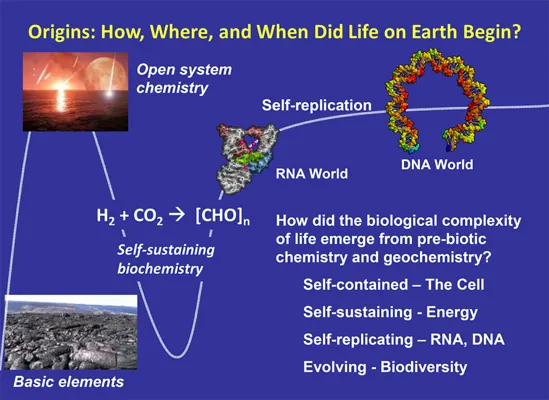
Figure 1.1 Hypothesis for the origins of life on Earth. Reprinted with permission from NSF.4
Formaldehyde is a common molecule throughout the universe.4 Due to its reactivity and abundance, researchers have theorized that interstellar formaldehyde might have had a role in the creation of organic molecules found inside asteroids and comets,5,6 which in turn are suspected to have been responsible for providing early Earth with essential materials such as carbon.7 Most recently, research has shown that organic solids in comets and chondrites were likely derived from a formaldehyde polymer.8 The study concludes: “The origin of a significant fraction of organic solids in primitive solar system objects can logically be attributed to formaldehyde polymerization. Formaldehyde is relatively abundant in the galaxy and also in comets.”8
1.2 Endogenous and Exogenous Formaldehyde
A naturally occurring chemical, formaldehyde can be produced in myriad ways. Endogenous formation arises primarily due to the aldehyde’s role as an important metabolic intermediate that is present in all cells.9 Industrial applications demand the exogenous synthesis of the staple chemical, due to its widespread uses (see Section 1.3 below). In this section, the different ways in which formaldehyde is formed will be discussed.
1.2.1 Endogenous Production of Formaldehyde
In most organisms, including humans, naturally produced formaldehyde is physiologically present as a metabolic byproduct in all bodily fluids, cells, and tissues.10 The endogenous formaldehyde can be produced via numerous sources, including amino acid metabolism, methanol metabolism, lipid peroxidation, and demethylation of DNA, RNA and histone.9,11 Formaldehyde concentrations in human plasma range from 13 to 97 µM.12 The endogenous concentration in the blood of humans, monkeys and rats is approximately 2–3 mg L−1 (100 µM).13,14 Endogenous formaldehyde and its oxidation product, formic acid, are intermediates in the ″one-carbon pool″15 used for the biosynthesis of purines, thymidine, and some amino acids. As a naturally occurring metabolite in many living organisms, formaldehyde is also found at high background levels in many types of food, such as shiitake mushrooms and a variety of seafood. There have also been instances of formaldehyde found in beer, fruit, and vermicelli noodles,16 where it occurs either naturally from an endogenous source or as a result of contamination from exogenous exposure.17 For example, formaldehyde added to chicken feed to prevent birds from contracting salmonella poisoning18 may contaminate the chicken meat and egg. Similarly, endogenous formaldehyde levels in farmed fish may elevate due to the addition of formaldehyde as a preservative.19
Formaldehyde has survived multiple evolutions from natural selection and its ubiquitous presence in all cells inspires the question: what is the key physiological role of formaldehyde? In many instances, it may act as a building block molecule in the production of various biological compounds.20,21 In other cases, formaldehyde may act as a methyl donor through the “one-carbon pool”.22,23 Currently, a novel hypothesis has been proposed that it may act as a second or third messenger in signal transduction pathways,23 which needs to be further explored and confirmed. The full extent of the major physiological role of formaldehyde remains a mystery.
1.2.2 Exogenous Synthesis of Formaldehyde
Formaldehyde has the chemical formula CH2O and is the simplest, yet most reactive, aldehyde.10,24 It has a strong, pungent odor and exists as a colorless gas at room temperature. While Aleksandr Butlerov, a Russian chemist, first synthesized the chemical in 1859, it was August Wilhelm von Hofmann, a German scientist, who identified it in 1867, as the product formed from passing methanol and air over a heated platinum spiral.25
Although there are many possible ways to synthesize formaldehyde, this method is still the basis for the industrial production of formaldehyde today, where methanol is oxidized using a metal catalyst (Figure 1.2). In the dehydrogenation process, the highly endothermic reaction takes place in the presence of iron and chromium oxides. The vapors are absorbed in water, producing formalin in solution. In contrast to the dehydration process, the oxidation process is highly exothermic. Air is heated and sent to a methanol evaporator, where the gases react. The gases are then heated and reacted in the presence of silver and molybdenum oxides. The product gases are sent to a light end stripper and then an alcohol stripper, where formalin is produced. Some unreacted methanol is also recovered and recycled.26
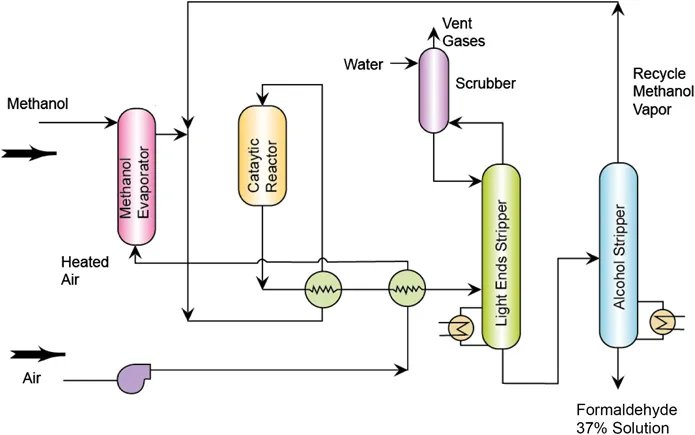
Figure 1.2 Formaldehyde production from methanol and heated air follows two routes: the dehydrogenation and the oxidation process. Reprinted with permission from NPTEL.26
Soon after the technical synthesis of formaldehyde by the dehydrogenation of methanol was achieved, its suitability for numerous industrial applications was discovered. By the early 20th century, an explosion of knowledge in chemistry and physics, coupled with the demand for more innovative synthetic products, set the scene for the birth of a new material—plastic—which dramatically increased formaldehyde usage. Driven by high volume synthetic polymer production, the role of formaldehyde in plastic formation led to it becoming a major industry chemical.
1.3 Industrial Uses of Formaldehyde
Four major types of industrial formaldehyde were developed during the 20th century. Casein formaldehyde, used to make small plastic items such as buttons, buckles, and knitting needles, became popular. It was also critical in the production of phenolic resins, the first completely synthetic plastics, which were made by condensing phenol and formaldehyde in the presence of a catalyst. From the 1920s to the 1940s, phenolic resins—popularly known as “Bakelite,” developed in 1907 by the Belgian-born American inventor, Leo H. Baekeland—were used to make electrical insulators...
Table of contents
- Cover
- Title Page
- Copyright Page
- Preface
- Acknowledgements
- Dedication
- Contents
- Chapter 1 Introduction to Formaldehyde
- Chapter 2 Formaldehyde Exposure, Regulation, and Metabolism
- Chapter 3 Formaldehyde Exposure in China
- Chapter 4 General Toxicity of Formaldehyde
- Chapter 5 Formaldehyde Carcinogenesis
- Chapter 6 Formaldehyde Exposure and Leukemia Risk
- Chapter 7 Potential Mechanisms of Formaldehyde-induced Leukemia
- Chapter 8 Formaldehyde Induced Leukemia-specific Chromosomal Aneuploidy
- Chapter 9 Formaldehyde-associated Brain Tumors
- Chapter 10 Formaldehyde-associated Neurodegenerative Diseases
- Chapter 11 Formaldehyde Toxicity in Children
- Chapter 12 Reproductive and Developmental Toxicity of Formaldehyde Exposure in Humans
- Chapter 13 Reproductive and Developmental Toxicity of Formaldehyde Exposure in Animals
- Chapter 14 Mechanisms of Action for Formaldehyde-induced Reproductive and Developmental Toxicity
- Chapter 15 Conclusions and Future Directions
- Appendix 1 Abbreviations
- Appendix 2 Glossary
- Appendix 3 Meta-analysis Methods
- Appendix 4 Statistical Methods Applied and Supplementary Data (Chapter 8)
- Appendix 5 Figure Index
- Appendix 6 Table Index
- Subject Index
Trusted by 375,005 students
Access to over 1.5 million titles for a fair monthly price.
Study more efficiently using our study tools.
Frequently asked questions
Yes, you can cancel anytime from the Subscription tab in your account settings on the Perlego website. Your subscription will stay active until the end of your current billing period. Learn how to cancel your subscription
No, books cannot be downloaded as external files, such as PDFs, for use outside of Perlego. However, you can download books within the Perlego app for offline reading on mobile or tablet. Learn how to download books offline
Perlego offers two plans: Essential and Complete
- Essential is ideal for learners and professionals who enjoy exploring a wide range of subjects. Access the Essential Library with 800,000+ trusted titles and best-sellers across business, personal growth, and the humanities. Includes unlimited reading time and Standard Read Aloud voice.
- Complete: Perfect for advanced learners and researchers needing full, unrestricted access. Unlock 1.5M+ books across hundreds of subjects, including academic and specialized titles. The Complete Plan also includes advanced features like Premium Read Aloud and Research Assistant.
We are an online textbook subscription service, where you can get access to an entire online library for less than the price of a single book per month. With over 1.5 million books across 990+ topics, we’ve got you covered! Learn about our mission
Look out for the read-aloud symbol on your next book to see if you can listen to it. The read-aloud tool reads text aloud for you, highlighting the text as it is being read. You can pause it, speed it up and slow it down. Learn more about Read Aloud
Yes! You can use the Perlego app on both iOS and Android devices to read anytime, anywhere — even offline. Perfect for commutes or when you’re on the go.
Please note we cannot support devices running on iOS 13 and Android 7 or earlier. Learn more about using the app
Please note we cannot support devices running on iOS 13 and Android 7 or earlier. Learn more about using the app
Yes, you can access Formaldehyde by Luoping Zhang in PDF and/or ePUB format, as well as other popular books in Physical Sciences & Chemistry. We have over 1.5 million books available in our catalogue for you to explore.