![]()
CHAPTER 1
Introduction to Chemically Derived Graphene
QIUJIAN LE†a, TIAN WANG†a, YUXIN ZHANGa AND LILI ZHANG,*b
a College of Materials Science and Engineering, Chongqing University, Chongqing 400044, China;
1.1 General Background of Graphite and Its Derivatives
Graphite consists of a stack of graphene sheets, making it a three-dimensional carbon allotrope with two-dimensional lattice bonds. In each graphene layer, three of the four outer shell electrons in an individual carbon atom are bound to its three neighboring carbon atoms by strong sp2 bonds (or sigma bonds), leaving one electron moving freely to define its conductivity. Relatively weak van der Waals interactions hold the graphene sheets together in the third direction, allowing the easy separation of layers of graphene sheets. Unlike the free electrons in metals, the free electrons, so-called π-electrons, in each graphene layer are able to move freely only on the atomic plane and thus graphene does not conduct in the direction perpendicular to the plane. After oxidization by Hummers,1 Staudenmaier,2 or Brodie’s3 methods, graphite layers are intercalated with water molecules, ions, and oxygen-containing functional groups, i.e., hydroxyl, carboxyl, and carbonyl groups. As a result, the distance between layers is expanded and the van der Waals forces are weakened, facilitating further exfoliation processes. The oxidized product is known as graphite oxide. Monolayer graphite oxide, also known as graphene oxide, can be obtained by ultrasonication or vigorous stirring in the form of water-dispersible suspensions.4 Chemically derived graphene (CDG) is finally obtained via reduction with various reducing agents, such as hydrazine,5–8 sodium borohydride,9,10 active metal,11–13 reductive organics,14–18 and some other methods.19–23
Graphite and its derivatives, such as graphite oxide, graphene oxide, and graphene, consist all of carbon atoms. However, they differ in terms of their atomic arrangement and chemical composition. Graphite is composed of a number of graphene layers, rendering it an excellent lubricant. Graphite oxide has a similar layered structure to that of graphite, but with a larger interlayer spacing (about two times that of the original graphite) owing to the intercalation of water molecules, functional groups, and ions. Due to the destruction of the conjugated structure in graphite by oxidation processes, graphite oxide exhibits poor electrical conductivity. However, the introduction of foreign molecules and oxygen-containing functional groups increases the hydrophilicity of graphite, facilitating subsequent processes in water-like environments. Graphene oxide refers to monolayer graphite oxide produced through the exfoliation of graphite oxide. It displays unique properties arising from the presence of rich functional groups, such as tunable solubility in a variety of solvents, controllable electrical and optical properties, and compatibility with organic and inorganic compounds to form composites. Graphene possesses much better electrical conductivity than graphene oxide. However, the obtained graphene still differs from the ideal material due to the defects and functional groups introduced during oxidation–reduction–exfoliation processes. Nevertheless, functionalized CDG holds great promise in electrocatalysis, photocatalysis, electrochemical energy storage and conversion, flexible devices, anti-corrosion, water purification, sensors, and many other areas. Perfect graphene refers to a defect-free two-dimensional single atomic layer of graphite. Numerous and excellent properties arise from its sp2 hybridization and thin atomic thickness of 0.35 nm, such as a large theoretical specific surface area (2630 m2 g−1),24 ultrahigh intrinsic charge carrier mobility of 200000 cm2 V−1 s−1,25 good optical transparency (∼97.7%),26 high Young’s modulus (∼1 TPa),27 and excellent thermal conductivity (3000–5000 W m−1 K−1).28 The properties of graphite and its derivatives are summarized and compared in Table 1.1.
Table 1.1 Properties of graphite and its derivatives
| Product | Graphite | Graphene | Graphite oxide | Graphene oxide | Chemically derived graphene |
| Form | Layered structure (>10 layers) | Monolayer carbon atom | Layered structure with expanded interlayer spacing | Monolayer structure with many defects | Monolayer structure with some defects |
| Powder form | Film | Paste/powder | Suspension/powder | Suspension/powder |
| Elemental composition | C | C | C, O, H | C, O, H | C, O, H |
| Density (g cm−3) | 2–2.3 | ∼0.77 mg m−2 | Depends on defects | Depends on defects | Depends on defects |
| Electrical conductivity (S m−1) | 2–3 × 10⁵ (in-plane) | 106 (in plane) | Nearly insulator | Nearly insulator | 4600–5880 |
| 3 × 10² (cross-plane) |
| Thermal conductivity (W m−1 K−1) | 2000 (in-plane) 20 (cross-plane) | 5300 (in-plane) | N/A | 1.68–2.21 (in-plane) | 61 (in-plane), 0.09 (cross-plane) |
| Young’s modulus | N/A | 1.06 TPa | N/A | 290–470 GPa | 6.3 GPa |
| Basic synthesis method | Exists in nature | Micromechanical exfoliation, chemical vapor deposition, epitaxial growth, chemically derived methods | Hummers method, Staudenmaier method, Brodie method | Thermal, chemical, electrochemical, exfoliation of graphite oxide | Chemical oxidation–exfoliation–reduction of graphite, liquid exfoliation, solid exfoliation by ball milling, intercalation–exfoliation |
| Main applications | Pencils, batteries, refractories, steel making, brake linings | Fundamental research, semiconductor, energy storage, screen, optoelectronic applications | Intermediate product of CDG, biomedicine, catalysis | Intermediate product of CDG, biomedicine, energy storage, catalysis, environmental protection, sensor, optoelectronic applications | Semiconductor, energy storage, catalysis, optoelectronic applications, biomedicine |
This book will focus on the most recent and state-of-the-art progress on CDG materials and their applications. General fabrication methods and properties of CDG will be covered in the following sections. Challenges with respect to the technology, economics, and environmental concerns will be presented in the last section of this introductory chapter.
1.2 Preparation Methods and State-of-the-art Research Progress
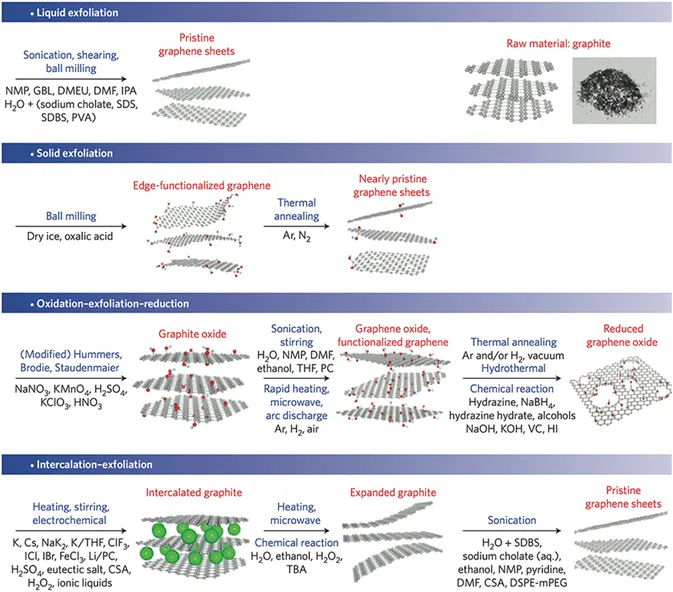
The main methods to produce CDG include the chemical oxidation–exfoliation–reduction of graphite, liquid exfoliation of graphite, solid exfoliation of graphite, intercalation–exfoliation of graphite, and bottom-up chemical assembly.29Figure 1.1 shows these typical methods for the mass production of CDG.29 These methods differ in terms of the yield, efficiency, cost, properties of the product, and environmental impact. The achievement of uniform product quality with a green and sustainable process at low cost is a universal challenge.
Figure 1.1 Four typical methods for the production of CDG. Reprinted by permission of Macmillan Publishers Ltd: Nature Nanotechnology (ref. 29), Copyright 2014.
1.2.1 Chemical Oxidation–Exfoliation–Reduction of Graphite
This method for the production of CDG involves the oxidation of bulk graphite, exfoliation of graphite oxide, and reduction of graphene oxide. There are three well-known oxidation methods: modified Hummers,1 Staudenmaier,2 and Brodie procedures.3 All three methods involve the use of strong inorganic protonic acids (such as concentrated sulfuric acid, fuming nitric acid, or their mixtures) to intercalate small molecules within the graphite layers, followed by an oxidation reaction using KMnO4, KClO4, or other strong oxidants. Exfoliation of graphite oxide through ultrasonication or vigorous stirring results in graphene oxide and few-layer graphite oxide. CDG is finally obtained through a reduction process. Sometimes, exfoliation and reduction can be carried out in a single step.
Chemical, thermal, electrochemical, and hydrothermal reduction processes are the most commonly used reduction methods. In particular, chemical reduction is the most widely applied reduction method due to its simplicity, the possibility of large scale production, and good disparity in various solutions. A variety of organic and inorganic reducing agents have been used to reduce graphene oxide. Stankovich et al.4,30 reported the successful reduction of graphene oxide with hydrazine monohydrate, providing...